


AI Summary
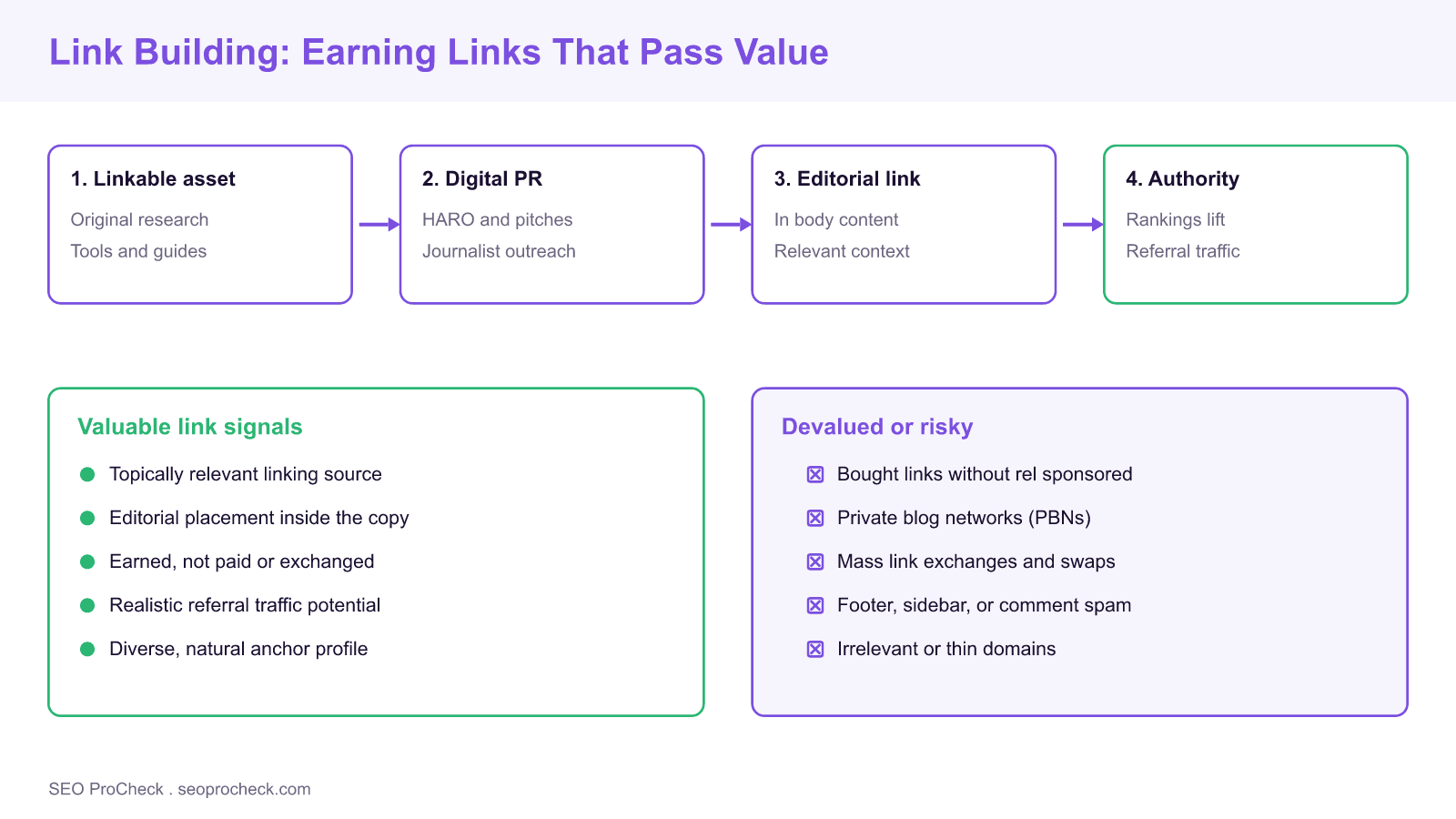
Modern link building earns editorial links through valuable content, digital PR, and genuine relationships rather than buying or exchanging them. A small number of relevant, authoritative, in content links outperforms a large volume of low quality links, and manipulative tactics now carry real penalty risk.
- Evaluate every prospect on relevance, authority, placement, context, and how the link was acquired.
- Create linkable assets (original data, tools, guides) that give journalists and site owners a reason to cite you.
- Use digital PR and HARO style sourcing to turn newsworthy angles into earned coverage.
- Avoid paid links without disclosure, PBNs, mass exchanges, and directory or comment spam.
Link Building Fundamentals
Link building remains a core SEO discipline despite evolving dramatically from its manipulative past. Modern link building focuses on earning links through quality content, genuine relationships, and strategic promotion rather than artificial acquisition. Links serve as votes of confidence that signal authority and relevance to search engines. While Google's algorithms have become sophisticated at detecting and devaluing manipulative links, authentic editorial links from relevant sources continue to drive ranking improvements.
Link Quality Evaluation
Not all links carry equal value. Evaluate potential links across multiple dimensions: relevance (topical alignment between linking and linked sites), authority (linking site's credibility and ranking power), placement (editorial links within content versus footer/sidebar), context (surrounding content relevance), traffic (potential referral visitors), and diversity (avoiding over-reliance on single sources or link types). A few high-quality links from authoritative, relevant sources outperform many low-quality links from irrelevant or spammy sites.
| Factor | High Quality Signal | Low Quality Signal |
|---|---|---|
| Relevance | Same or related industry | Completely unrelated topic |
| Authority | Established, trusted domain | New, thin, or spammy domain |
| Placement | Editorial within content | Footer, sidebar, comments |
| Context | Surrounded by relevant content | Random or forced mention |
| Acquisition | Earned editorially | Purchased or exchanged |
Content-Driven Link Earning
The most sustainable link building creates content worthy of natural links. Original research and data journalism attracts links from journalists and industry analysts. Comprehensive guides become reference resources that others cite. Interactive tools, calculators, and templates earn links through utility. Visual assets like infographics, diagrams, and videos get embedded with attribution links. Expert roundups and interview content encourages participants to share and link. Focus on creating genuine value that fills information gaps in your industry.
Digital PR and Outreach
Digital PR generates links by creating newsworthy content and pitching to journalists, bloggers, and publishers. Identify news angles, data stories, expert commentary opportunities, and trend analyses relevant to your industry. Build media relationships before you need them. Use tools like HARO (Help a Reporter Out) to connect with journalists seeking sources. Pitch relevant stories to industry publications and news sites. Create press-ready assets including data visualizations, expert quotes, and supporting research. Track coverage and follow up on unlinked brand mentions.
Link Building Tactics to Avoid
Google's algorithms and manual review teams actively penalize manipulative link schemes. Avoid: purchasing links (including sponsored posts without proper disclosure), private blog networks (PBNs), excessive link exchanges, automated link building tools, low-quality directory submissions, comment and forum spam, and links from irrelevant sites regardless of authority. Focus on links that would exist naturally regardless of SEO benefit. If a tactic feels manipulative or you'd be uncomfortable explaining it to Google, avoid it. Penalties can devastate organic traffic and take months to recover from.
Running a Repeatable Link Campaign
A durable program runs in cycles rather than one off pushes. Each cycle has four moves: define a target topic and audience, build or select a linkable asset, prospect for relevant sites and journalists, then pitch and follow up. Treat the asset as the centre of gravity, because outreach without something genuinely citable converts poorly. Our linkable asset creation framework walks through choosing formats that attract editorial coverage, and the digital PR campaign planning guide covers angle development and media list building.
| Tactic | Effort | Link Quality | Best For |
|---|---|---|---|
| Original research and data study | High | Very high, editorial | Earning press and reference links |
| Free tool or calculator | High | High, evergreen | Passive links from utility |
| Digital PR pitch (data or expert) | Medium | High, news domains | Authority and brand mentions |
| Resource page outreach | Low to medium | Medium, relevant | Niche topical relevance |
| Expert commentary (HARO style) | Low | Medium to high | Steady link velocity |
| Unlinked mention reclamation | Low | High, already earned | Quick wins from existing coverage |
Expert sourcing services and journalist request feeds are efficient ways to earn steady links; our HARO strategy for link building explains how to write pitches that get quoted.
Measuring Links and Reclaiming Mentions
Track a small set of outcomes rather than raw link counts: referring domains gained, topical relevance of those domains, anchor and landing page distribution, and any movement in rankings for the pages you pointed links at. Vanity metrics like total backlinks hide the fact that ten relevant editorial links usually beat a thousand scraped ones. For attributing links to business value, see our note on measuring link building ROI. One of the highest return tactics is reclaiming brand mentions that never linked: search for your brand name, filter to pages without a link, and ask politely for attribution, a workflow detailed in converting unlinked brand mentions.
Frequently Asked Questions
Do backlinks still matter for SEO in 2026?
Yes. Links remain one of the strongest signals of authority and relevance, and they also influence which sources are cited by AI answer engines. What has changed is that quality and relevance dominate: manipulative or irrelevant links are devalued or penalised rather than helpful.
How many backlinks do I need to rank?
There is no fixed number. Relevance, authority, and placement of each link matter far more than volume. A handful of editorial links from trusted, topically related sites often outranks pages with many low quality links, so focus on earning fewer, better links.
Are paid links against Google guidelines?
Buying links that pass ranking signals violates Google's guidelines unless they use rel sponsored or rel nofollow. Paid placements without proper disclosure, along with PBNs and mass exchanges, can trigger algorithmic devaluation or a manual action, so disclose sponsorships and treat paid links as advertising.
What is the difference between white hat and black hat link building?
White hat link building earns links through content, digital PR, and relationships that would exist regardless of SEO. Black hat tactics manufacture links through networks, purchases, or automation. The practical test is whether you would be comfortable explaining the link to a Google reviewer.
What are linkable assets?
Linkable assets are pages built specifically to attract links, such as original research, data studies, free tools, calculators, templates, and definitive guides. They give journalists and site owners a concrete reason to cite you, which makes outreach far more effective than pitching ordinary pages.
How long does link building take to show results?
Earned links can take weeks to months to influence rankings as search engines recrawl, reassess, and pass signals. Digital PR can produce faster coverage spikes, while asset driven links compound gradually. Plan campaigns in quarters rather than expecting immediate movement.
Claude Vincent is a technical SEO consultant focused on crawlability, rendering, and AI-search visibility. He writes the field guides and case studies at SEO ProCheck, with a bias toward the durable, unglamorous work that decides whether search engines and AI answer engines can actually read and cite a site.
About SEO ProCheck
Technical SEO consulting and GEO strategy with 20 years of enterprise experience. Case studies, resources, and tools for search and AI visibility.
Work With Me
Technical SEO audits, GEO strategy, site migrations, and international SEO. Hourly consulting for teams who need hands-on support, not just reports.
Subscribe to our newsletter!







Recent Posts
- Can AI Crawlers Actually Read Your Site? I Measured 400 of the Biggest September 5, 2026
- The Pre-Publish Quality Gate for AI-Assisted Content August 6, 2026
- AGENTS.md vs llms.txt vs llms-full.txt: Which Agent File Does What July 18, 2026