

Why We Removed 3,000 Pieces of Outdated Content From the HubSpot Blog
- September 19, 2019
- Content
AI Summary
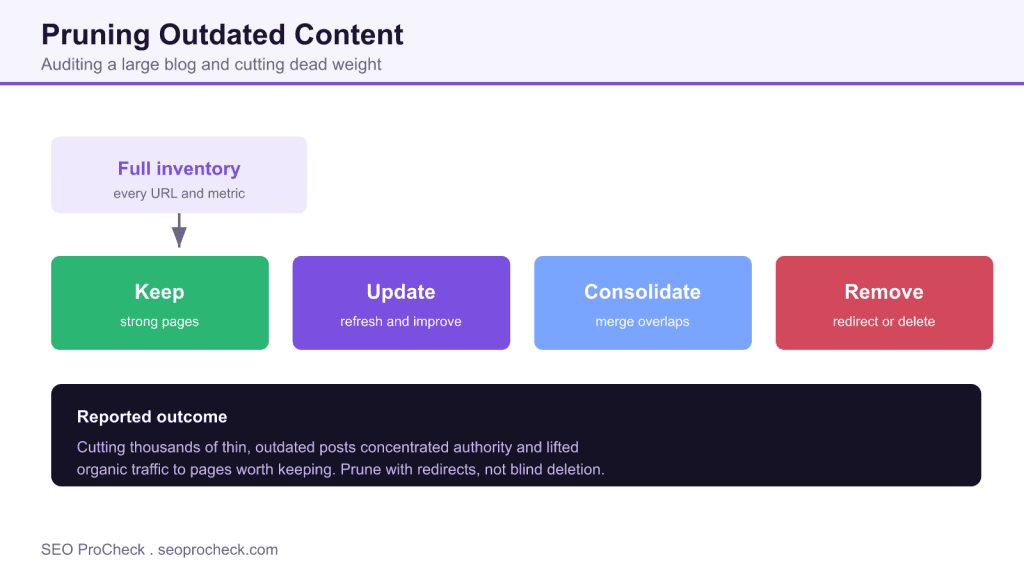
Removing thousands of outdated posts, as HubSpot documented, can concentrate authority and lift organic traffic to the pages worth keeping, but only when it is done through a structured audit that decides whether each URL should be kept, updated, consolidated or removed with a redirect. Prune deliberately with data, never by blanket deletion.
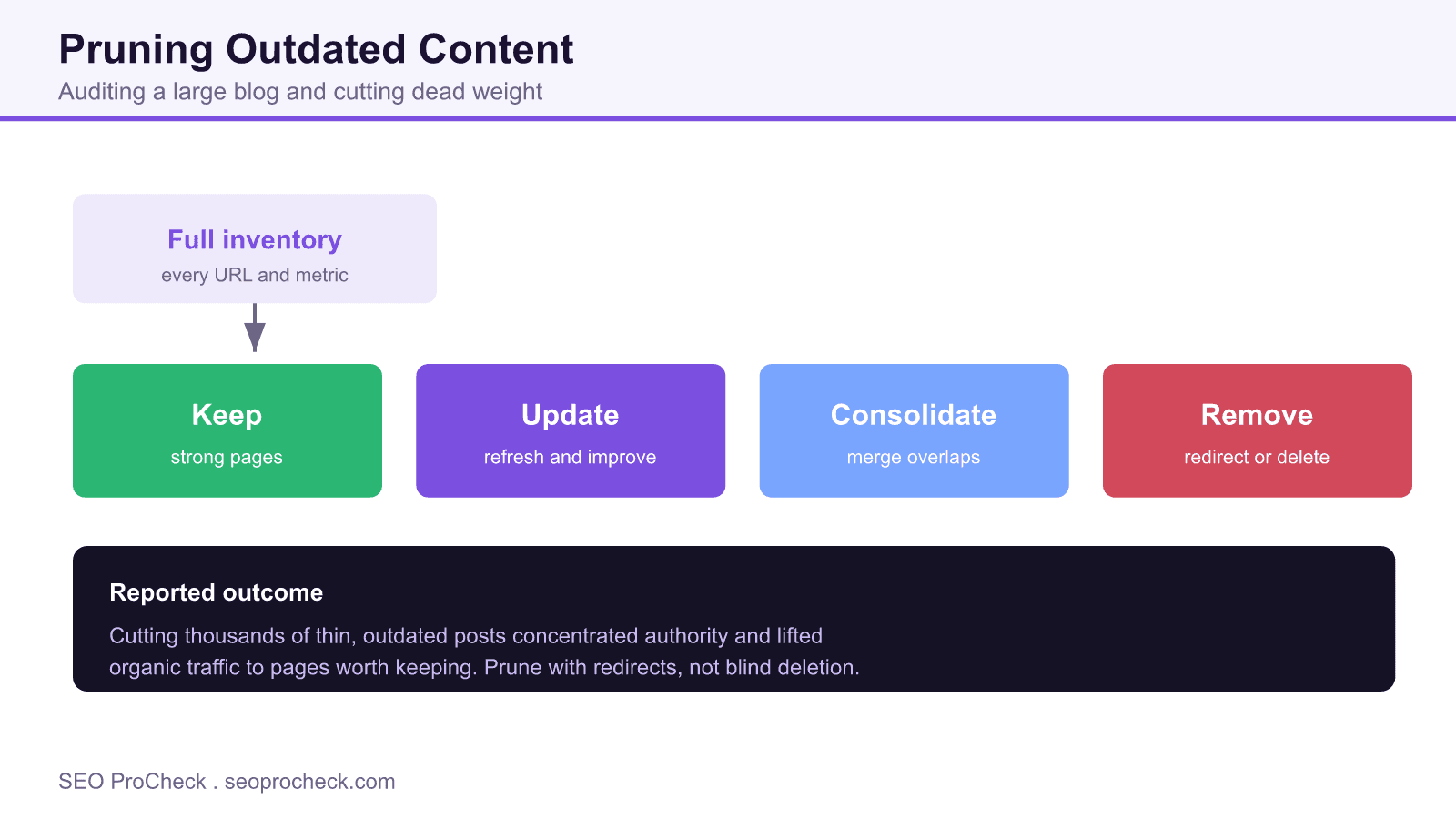
- A content audit sorts every URL into keep, update, consolidate or remove.
- Pruning thin, outdated pages can improve crawl efficiency and focus authority.
- Removed URLs should be redirected to the closest relevant page, not left to 404.
- Consolidation merges overlapping posts into one stronger canonical page.
Why a large brand prunes content
The HubSpot case referenced in the source below describes cutting thousands of outdated blog posts. On the surface removing content to grow traffic sounds backwards, but at scale a bloated blog carries dead weight: pages that no longer rank, duplicate or overlap each other, or misrepresent the brand with stale advice. Pruning is the practice of removing or reworking that dead weight so crawl budget and internal authority concentrate on the pages that still earn their place. Our full walkthrough of the content audit process covers how to run this end to end.
The four decisions in a content audit
Every URL in the inventory resolves to one of four outcomes. Keep covers strong pages that rank and convert, which you leave alone or lightly refresh. Update covers pages with potential that have gone stale, where refreshing data, examples and internal links revives them. Consolidate covers clusters of thin, overlapping posts that compete with each other, which you merge into one stronger canonical page and redirect the rest. Remove covers pages with no traffic, no links and no strategic value, which you delete and redirect. The scoring behind these calls is the hard part, and our content audit scoring methodology lays out one repeatable way to make them.
How to remove content safely
Deletion without redirects is where pruning goes wrong. When you remove a URL, redirect it with a 301 to the most relevant surviving page so any accumulated link equity and any lingering traffic are preserved rather than dumped into a 404. If no close match exists, redirect to the parent category. Update internal links that pointed at the removed page so you are not sending users and crawlers into redirects unnecessarily. Keep a log of what you removed and where it now points, because you will want that record when you review results months later. For the underlying principles, the content auditing guide is a solid reference.
What to expect after pruning
Results tend to show up as improved crawl efficiency, since search engines spend less time on low value URLs, and as stronger performance for the pages you kept, which now face less internal competition. Traffic may dip briefly as removed pages leave the index, then recover and often exceed the starting point as authority consolidates. Treat pruning as ongoing hygiene rather than a one-time purge: schedule a review at least annually so the library never bloats back to where it started.
Content pruning decision matrix
| Signal | Decision | Action |
|---|---|---|
| Ranks and converts | Keep | Leave or lightly refresh |
| Stale but has potential | Update | Refresh data, examples and links |
| Overlaps other posts | Consolidate | Merge into one canonical, redirect the rest |
| No traffic, links or value | Remove | Delete and 301 redirect |
What has changed since
Since HubSpot documented this pruning, Google's helpful content signals, now part of the core system, have made removing or improving unhelpful, outdated pages even more worthwhile. Pruning has shifted from a niche tactic to routine site hygiene for large content libraries.
Case summary and source
The original third-party summary and attribution for this page are preserved below.
Content-driven SEO success requires strategic approaches to creation, optimization, and management. This case study demonstrates how content strategy directly drives organic growth when aligned with user needs and search behavior.
Content Strategy Framework
Effective content strategy begins with understanding target audiences, their questions, and the competitive content landscape. This case study outlines the strategic framework that guided content decisions, from topic selection to format choices.
Content Development Process
Moving from strategy to published content requires efficient processes for research, creation, and optimization. This case study documents workflows, quality standards, and production approaches that enabled consistent, high-quality output.
Optimization and Distribution
Published content requires ongoing optimization based on performance data. This case study covers how content was refined post-publication, how internal linking supported content performance, and how distribution amplified content reach.
Results and Attribution
Measuring content ROI requires connecting content efforts to business outcomes. This case study demonstrates the traffic, engagement, and business results achieved through strategic content investment. Attribution methodology helps validate content strategy effectiveness.
Content SEO case studies help practitioners build cases for content investment with documented results.
Source: https://blog.hubspot.com/marketing/remove-outdated-content
Frequently asked questions
Why would removing content increase traffic?
Cutting thin, outdated pages reduces internal competition and lets crawl budget and link authority concentrate on the pages worth keeping. At scale this can lift organic traffic to the surviving content, as HubSpot documented.
Should I delete or redirect pruned pages?
Redirect. When you remove a URL, 301 it to the closest relevant surviving page so any link equity and residual traffic are preserved. Blanket deletion into 404s throws that value away.
What is the difference between updating and consolidating content?
Updating refreshes a single page that has gone stale but still has standalone value. Consolidating merges several overlapping pages into one stronger canonical page and redirects the others.
How do I decide which pages to prune?
Score each URL on traffic, rankings, backlinks, conversions and strategic value, then sort into keep, update, consolidate or remove. A repeatable scoring methodology keeps the decisions consistent across a large library.
Will traffic drop after pruning?
There is often a short dip as removed pages leave the index, followed by recovery and frequently a net gain as authority consolidates. Proper redirects minimize the dip.
How often should I audit and prune content?
Treat it as ongoing hygiene with at least an annual review. Regular audits stop the library from bloating back to where it started and keep the site focused on content that performs.
Take this with you
The assistant links open with a question about this page already written. Nothing is sent until you press enter.
Claude Vincent is a technical SEO consultant focused on crawlability, rendering, and AI-search visibility. He writes the field guides and case studies at SEO ProCheck, with a bias toward the durable, unglamorous work that decides whether search engines and AI answer engines can actually read and cite a site.
About SEO ProCheck
Technical SEO consulting and GEO strategy with 20 years of enterprise experience. Case studies, resources, and tools for search and AI visibility.
Work With Me
Technical SEO audits, GEO strategy, site migrations, and international SEO. Hourly consulting for teams who need hands-on support, not just reports.
Subscribe to our newsletter!








Recent Posts
- Most Top Sites Never Say Who They Are in Structured Data October 14, 2026
- Homepage Titles Are Mostly Too Short, Not Too Long October 8, 2026
- Who Actually Serves an llms.txt? 184 Top Sites Measured September 29, 2026