AI Summary
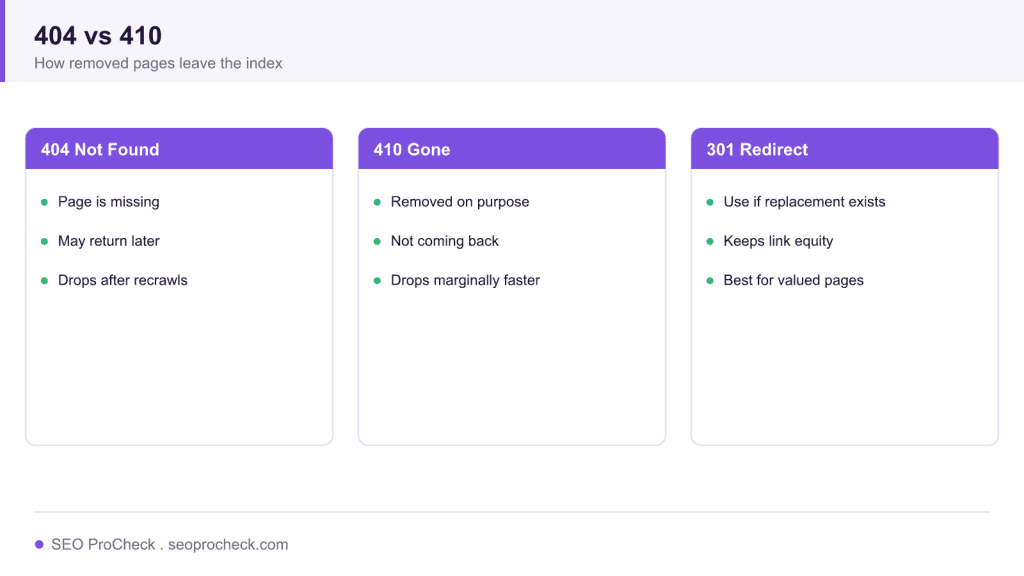
Google treats 404 and 410 almost identically, with 410 sometimes dropping a URL from the index marginally faster because it removes the possibility that the page returns. Neither code recovers traffic or link equity, so a 301 redirect to a live equivalent is the better choice whenever a page had value.
- 404 means Not Found, a soft signal the URL may or may not return.
- 410 means Gone, an explicit signal the page was removed on purpose.
- The deindexing speed difference is small, measured in crawl cycles, not ranking power.
- Use 301 for valued pages and a robots noindex when the URL should stay live but out of the index.
This SEO case study documents a successful optimization initiative, providing actionable insights for practitioners. The documented approach demonstrates how strategic SEO implementation drives measurable results.
Initial Situation
Understanding the starting point is essential context for evaluating any case study. This documentation covers the initial challenges, competitive position, and business objectives that shaped the SEO strategy.
Strategy and Approach
The strategic approach combined multiple SEO disciplines to address identified opportunities. Key decisions around prioritization and resource allocation provide a template for similar initiatives.
Implementation
Moving from strategy to execution required specific technical implementations, content development, and process changes. This case study documents the practical steps that translated strategy into action.
Results and Learnings
The outcomes demonstrate effectiveness through measurable improvements in rankings, traffic, and business metrics. Analysis of successes and challenges provides learning value for practitioners.
Case studies like this contribute to the SEO knowledge base, helping practitioners learn from documented real-world experiences.
What the status codes actually tell Google
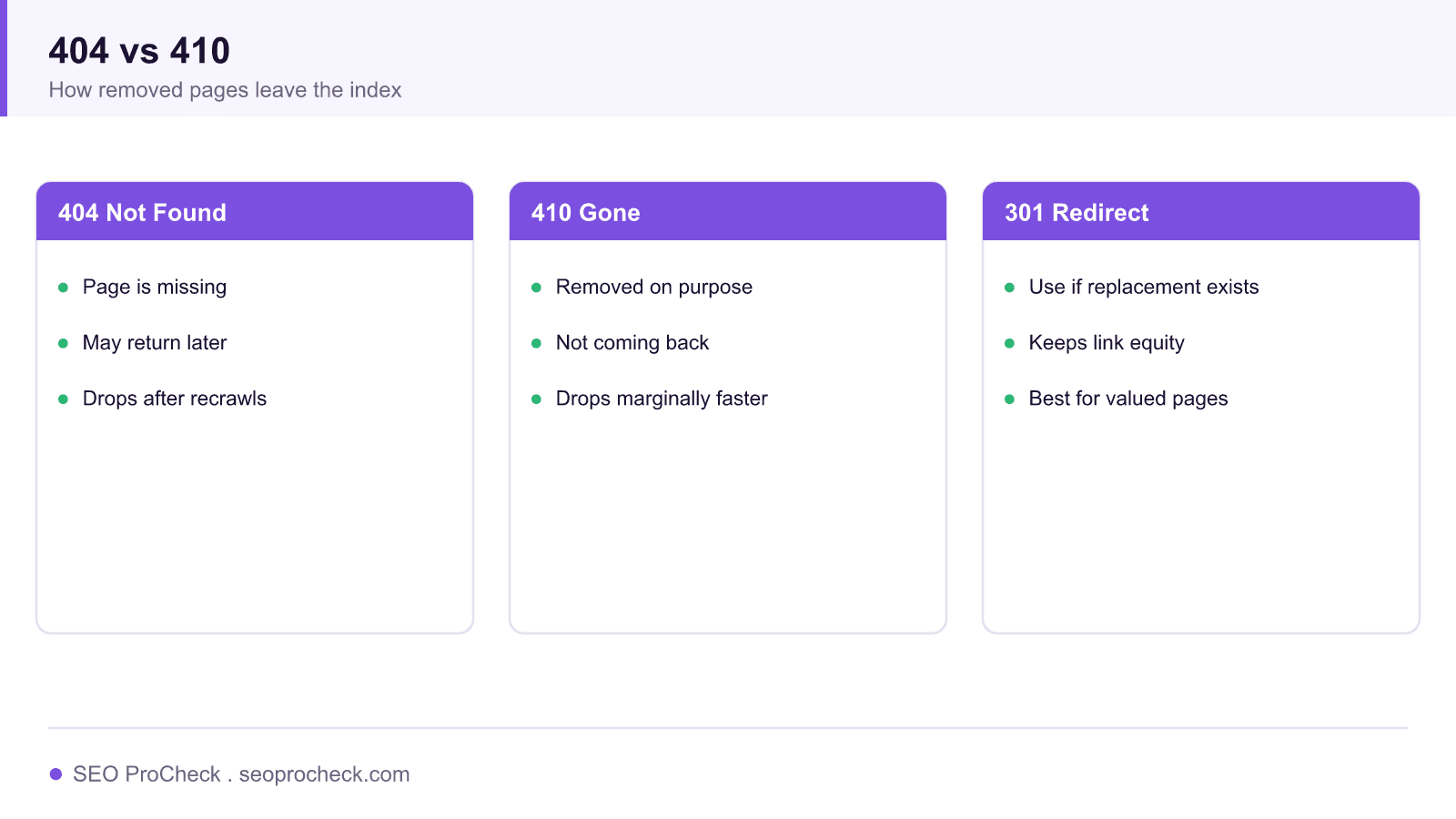
A 404 means Not Found, a soft signal that a URL is missing but might return. A 410 means Gone, an explicit statement that the resource was removed on purpose and is not coming back. Both are valid ways to retire a page, and both eventually drop the URL from the index. The practical question the linked experiment probes is whether 410 gets pages deindexed faster than 404.
Reading the experiment as a practitioner
Google's public guidance, repeated by John Mueller over the years, is that 404 and 410 are treated almost identically, with 410 sometimes processed a little faster because it removes the ambiguity of a possible comeback. In practice the difference is a small number of crawl cycles, not a difference in ranking power. Nothing you do with a 410 recovers link equity or traffic that a removed page once had. If the page had value, a 301 redirect to the closest live equivalent is almost always the better move, and our guidance on choosing between 404 and 410 lays out the decision tree.
How to return each code correctly
On Apache, send a hard gone response with a rule such as "Redirect gone /old-page" in .htaccess, or a RewriteRule with the G flag. On Nginx, use a location block that returns 410, for example "location = /old-page { return 410; }". In WordPress, a small snippet on the template can call status_header(410) for retired URLs. Confirm the header with a request, because a themed error page that still returns 200 is the most common mistake, an issue we cover in 404 page best practices. The response line should read 410 Gone or 404 Not Found, never 200 OK.
Keep a useful page for humans even when the status is 404 or 410. A helpful error page with search and top links recovers visitors who would otherwise leave, which our guide to implementing proper 404 pages walks through.
When to pick which
Use 410 when you have deliberately killed a page, an expired product, spam cleanup, or a merged section, and you want it gone quickly. Use 404 when a URL is simply missing and you are unsure of its future. Use a 301 when a relevant replacement exists. For pages you want kept out of the index while the URL still resolves, a robots noindex tag is the right tool, as explained in our meta robots and x-robots-tag reference.
Choosing a response for a removed page
| Response | Meaning to Google | Index effect | Use when |
|---|---|---|---|
| 404 Not Found | Missing, may return | Drops after several recrawls | A URL is gone and the future is unclear |
| 410 Gone | Removed on purpose | Drops marginally faster | You deliberately retired the page |
| 301 Redirect | Moved permanently | Consolidates to the target | A relevant replacement exists |
| 200 with noindex | Live but not for the index | Stays crawlable, leaves index | The URL must resolve but not rank |
Frequently asked questions
Is 410 better than 404 for SEO?
Only slightly, and only for the speed of removal. Google treats the two almost the same and 410 can drop a URL a bit faster, but neither preserves rankings or traffic. Choose based on intent, not on a hope of an SEO gain.
Will a 410 remove a page from Google faster?
Usually a little faster, because 410 tells Google the page is gone for good and removes the reason to keep rechecking. The gap is measured in crawl cycles, so do not expect instant removal.
Do 404 and 410 pass link equity?
No. Any equity pointing at the removed URL is lost. If the page earned links or traffic, redirect it with a 301 to the most relevant live page instead of returning an error.
How do I set a 410 in WordPress?
Use a redirect or SEO plugin that supports a 410 status, or add a small snippet that calls status_header(410) and exit for the retired URLs. Then confirm the header returns 410 with a request.
What is a soft 404 and why does it matter?
A soft 404 is a missing page that returns a 200 OK with thin or empty content. Google flags these because the status contradicts the content. Return a real 404 or 410 so search engines can act on the signal.
Should I noindex a page instead of returning 410?
Use noindex when the URL should stay live and reachable but out of the index, such as a thin filter page. Use 410 when the page itself should no longer exist.
Source: https://www.rebootonline.com/blog/404-vs-410-the-technical-seo-experiment/
Claude Vincent is a technical SEO consultant focused on crawlability, rendering, and AI-search visibility. He writes the field guides and case studies at SEO ProCheck, with a bias toward the durable, unglamorous work that decides whether search engines and AI answer engines can actually read and cite a site.
About SEO ProCheck
Technical SEO consulting and GEO strategy with 20 years of enterprise experience. Case studies, resources, and tools for search and AI visibility.
Work With Me
Technical SEO audits, GEO strategy, site migrations, and international SEO. Hourly consulting for teams who need hands-on support, not just reports.
Subscribe to our newsletter!