

AI Summary
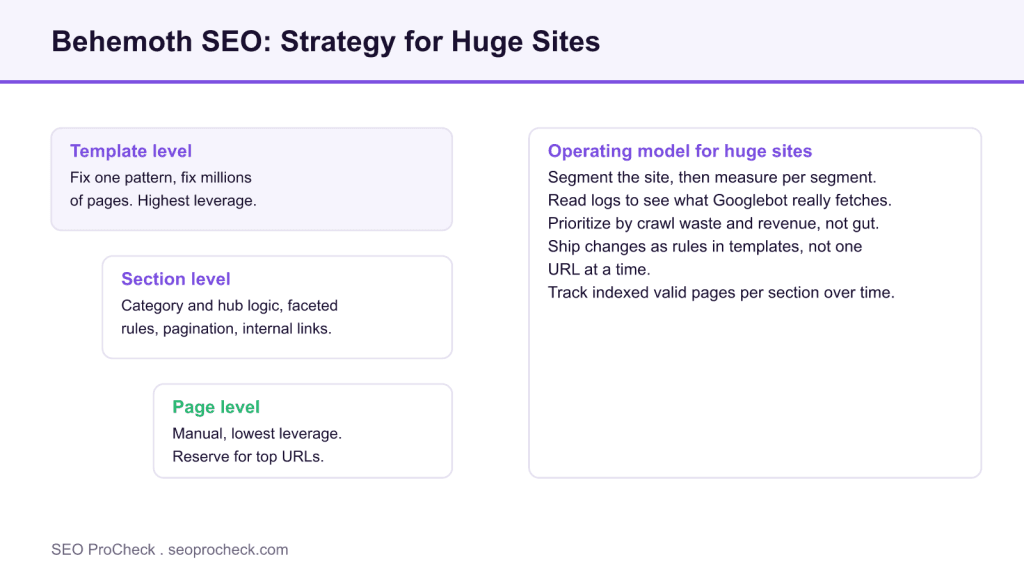
Behemoth SEO is the practice of managing sites with hundreds of thousands or millions of URLs, where you cannot fix pages one at a time. The winning approach is to think in templates and sections, read server logs to see what Googlebot actually fetches, and prioritize changes by crawl waste and revenue rather than by gut feel.
- At huge scale you fix patterns in templates, not individual pages.
- Log file analysis is the ground truth for how Googlebot spends its time.
- Segment the site and measure indexation per section, not just sitewide.
- Prioritize by the intersection of crawl waste and business value.
This SEO case study documents a successful optimization initiative, providing actionable insights for practitioners. The documented approach demonstrates how strategic SEO implementation drives measurable results.
Initial Situation
Understanding the starting point is essential context for evaluating any case study. This documentation covers the initial challenges, competitive position, and business objectives that shaped the SEO strategy.
Strategy and Approach
The strategic approach combined multiple SEO disciplines to address identified opportunities. Key decisions around prioritization and resource allocation provide a template for similar initiatives.
Implementation
Moving from strategy to execution required specific technical implementations, content development, and process changes. This case study documents the practical steps that translated strategy into action.
Results and Learnings
The outcomes demonstrate effectiveness through measurable improvements in rankings, traffic, and business metrics. Analysis of successes and challenges provides learning value for practitioners.
Case studies like this contribute to the SEO knowledge base, helping practitioners learn from documented real-world experiences.
Think in templates, not pages
When a site has millions of URLs, no team can audit or fix pages individually. The leverage lives in templates. A single change to a category template, a pagination rule, or an internal linking module ripples across millions of pages at once. This is why large site work feels more like software engineering than page editing: you are changing systems and rules, then watching the aggregate effect. The same mindset underpins crawl budget optimization.
Log file analysis is not optional
Google Search Console samples and aggregates, which is useful but limited. Raw server access logs are the ground truth for how Googlebot behaves. The workflow is straightforward in principle: collect the access logs, keep only requests from verified Googlebot, group the hits by directory and template, and look at how fetches are distributed. Verification matters because many bots spoof the Googlebot user agent, so confirm each IP with a reverse DNS lookup that resolves back to a googlebot.com or google.com host, then a forward lookup back to the same IP.
Segment, then measure
Sitewide numbers hide the story. Break the site into logical segments such as category pages, product pages, editorial content, and user generated areas, then track indexed valid pages and crawl share for each one over time. In Search Console you can approximate this with URL prefix properties or with the folder filters in the Page Indexing and Crawl Stats reports. When one segment shows heavy crawling but poor indexation, you have found a template level problem worth fixing.
Prioritize by waste and value
The prioritization rule for huge sites is simple to state and hard to resist overcomplicating: rank opportunities by the intersection of crawl waste and business value. A template that consumes a large share of crawling but produces no revenue is the first thing to fix. A high value section that is crawled too rarely is the next. This keeps engineering effort pointed at the changes that move both discovery and revenue, and it pairs naturally with quality indexation for large sites.
Leverage levels for large sites
| Level | Example change | Reach | Tooling |
|---|---|---|---|
| Template | Fix canonical logic or internal link module | Millions of pages | Log analysis, crawler, code review |
| Section | Rework a category or faceted area | Thousands to millions | Page Indexing report by folder |
| Page | Manual edit to a top URL | One page | URL Inspection tool |
What has changed since this case study
Search Console has grown more useful for scale work. The Page Indexing report now groups excluded pages by reason, and the Crawl Stats report breaks fetches down by response code, purpose, and Googlebot type, which shortens the gap between logs and dashboards. The URL Parameters tool was removed, so parameter governance is fully your responsibility now. IndexNow gives large publishers a way to signal fresh and changed URLs to some engines. None of this replaces log analysis, but together these changes make it easier to measure per segment behaviour that once required custom pipelines.
Related on SEO ProCheck
- what is crawl budget
- how we optimized our crawl budget
- revisiting the importance of quality indexation for large sc
Frequently asked questions
What is behemoth SEO?
It is technical SEO for very large sites, typically hundreds of thousands or millions of URLs, where the work shifts from editing pages to changing templates, rules, and systems that affect pages in bulk.
Why is log file analysis important for big sites?
Server logs are the only complete record of what Googlebot actually fetched. Unlike sampled reports, they let you group real crawl activity by template and section so you can find where budget is wasted.
How do I verify a request is really from Googlebot?
Do a reverse DNS lookup on the IP address. A genuine Googlebot request resolves to a googlebot.com or google.com host, and a forward lookup of that host returns the same IP. This filters out bots that spoof the user agent.
How should I prioritize fixes on a huge site?
Rank by the intersection of crawl waste and business value. Fix templates that eat crawling but earn nothing first, then improve high value sections that are under crawled.
Can I use Search Console instead of logs?
Search Console is a helpful complement, especially the Crawl Stats and Page Indexing reports, but it samples and aggregates. For precise per template analysis on large sites, raw logs remain the ground truth.
Does IndexNow help large sites?
It can help you signal new and updated URLs to participating engines, which speeds discovery of changes. It does not replace good site structure, clean sitemaps, or log driven prioritization.
Take this with you
The assistant links open with a question about this page already written. Nothing is sent until you press enter.
Claude Vincent is a technical SEO consultant focused on crawlability, rendering, and AI-search visibility. He writes the field guides and case studies at SEO ProCheck, with a bias toward the durable, unglamorous work that decides whether search engines and AI answer engines can actually read and cite a site.
About SEO ProCheck
Technical SEO consulting and GEO strategy with 20 years of enterprise experience. Case studies, resources, and tools for search and AI visibility.
Work With Me
Technical SEO audits, GEO strategy, site migrations, and international SEO. Hourly consulting for teams who need hands-on support, not just reports.
Subscribe to our newsletter!








Recent Posts
- Most Top Sites Never Say Who They Are in Structured Data October 14, 2026
- Homepage Titles Are Mostly Too Short, Not Too Long October 8, 2026
- Who Actually Serves an llms.txt? 184 Top Sites Measured September 29, 2026