

AI Summary
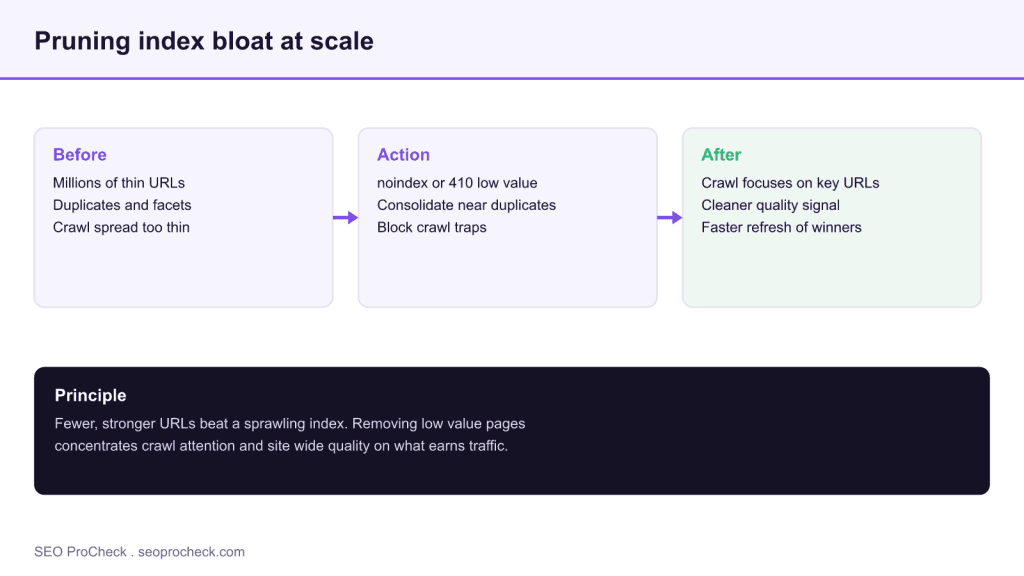
Deleting or deindexing tens of millions of low value pages is a deliberate quality strategy, not a mistake, because a bloated index dilutes crawl efficiency and site wide quality signals. When a large site removes thin, duplicate, and dead weight URLs, crawling concentrates on the pages that actually earn traffic and the overall quality assessment improves.
- Index bloat spreads crawl budget across pages that never earn value.
- Use noindex, 410, or consolidation depending on the page type.
- Site wide quality can lift the pages you keep, not just the ones you cut.
- Measure with crawl stats, Page Indexing, and impressions on retained URLs.
A headline like deleting 130 million pages sounds reckless until you understand index bloat. At very large scale, most of a site can be thin templated pages, near duplicate variants, expired listings, and parameter combinations that no user ever searches for. Carrying them in the index does not help. It quietly hurts. This case is about the logic of pruning aggressively and doing it in a controlled way.
The problem with a bloated index is twofold. First, crawl budget is finite. Every request Googlebot spends on a worthless URL is a request it does not spend refreshing a page that earns revenue. On a site with millions of URLs, that misallocation delays discovery and updates of the pages that matter. Second, quality is assessed in part at the site level. A large mass of thin or duplicate content can weigh on how the whole domain is judged, so the dead weight can suppress the pages you care about even when those pages are individually strong.
Choosing the right removal method
Not every page should be handled the same way. For low value pages you want gone from the index but kept for users, a noindex meta tag or header is appropriate. For pages that are truly retired with no replacement, returning a 410 Gone status tells Google to drop them faster than a soft handling would. For near duplicates that should consolidate into a stronger page, a 301 redirect or a canonical is the tool. For crawl traps like infinite faceted combinations, blocking the pattern or removing the internal links that generate it prevents the bloat from regrowing. The mix of methods is what makes a large cleanup safe.
Sequencing a large cleanup
Aggressive pruning works when it is measured. Segment the URL inventory by template and by performance so you can see which clusters produce impressions and clicks and which produce nothing. Remove in waves rather than all at once, so you can watch crawl stats, the Page Indexing report, and traffic on the retained pages for any unintended drop. Keep internal linking clean so the pages you keep are well connected and the pages you cut are not still being linked into existence. Watch server logs to confirm that crawl activity is shifting toward the URLs you want refreshed.
What has changed since
The strategic thinking here has only grown more relevant. As automated and templated content has exploded, search has leaned harder on site wide quality, which raises the cost of carrying low value pages. Google has been explicit that a smaller set of strong pages generally serves a site better than a sprawling index of weak ones. The practical takeaway for large sites is to treat the index as a curated asset: decide deliberately what deserves to be indexed, remove what does not with the right method for each type, and measure the effect on the pages you keep rather than on the raw count of URLs.
This pairs directly with revisiting quality indexation for large scale sites, and the underlying consolidation mechanics connect to how Google selects a canonical. The wider crawling and indexing library collects the related patterns.
Removal methods by page type
| Page type | Recommended method | Why |
|---|---|---|
| Thin page kept for users | noindex | Drops from index, stays for visitors |
| Retired page, no replacement | 410 Gone | Faster removal than a soft signal |
| Near duplicate of a stronger page | 301 or canonical | Consolidates signals to one URL |
| Faceted or parameter trap | Block or remove links | Stops the bloat from regrowing |
| Expired but seasonal | noindex or keep | Depends on future value |
Frequently asked questions
Why would a site delete millions of pages on purpose?
To remove index bloat. Thin, duplicate, and dead pages dilute crawl budget and can weigh on site wide quality, so removing them concentrates crawling and quality on the pages that earn traffic.
Does deleting pages hurt rankings?
Removing low value pages generally helps the pages you keep, because crawl attention and quality signals concentrate. Removing valuable pages by mistake hurts, which is why segmentation and phased removal matter.
Should I use noindex or a 410 status?
Use noindex for pages you want out of the index but kept for users. Use 410 Gone for pages that are truly retired with no replacement, since it prompts faster removal.
How does index bloat affect crawl budget?
Crawl budget is finite, so every crawl of a worthless URL is one not spent refreshing a valuable page. On large sites this delays discovery and updates of the pages that matter.
How do I measure the impact of pruning?
Watch crawl stats and server logs for shifting crawl activity, track the Page Indexing report, and monitor impressions and clicks on the retained URLs rather than the raw page count.
This SEO case study documents a successful optimization initiative, providing actionable insights for practitioners. The documented approach demonstrates how strategic SEO implementation drives measurable results.
Initial Situation
Understanding the starting point is essential context for evaluating any case study. This documentation covers the initial challenges, competitive position, and business objectives that shaped the SEO strategy.
Strategy and Approach
The strategic approach combined multiple SEO disciplines to address identified opportunities. Key decisions around prioritization and resource allocation provide a template for similar initiatives.
Implementation
Moving from strategy to execution required specific technical implementations, content development, and process changes. This case study documents the practical steps that translated strategy into action.
Results and Learnings
The outcomes demonstrate effectiveness through measurable improvements in rankings, traffic, and business metrics. Analysis of successes and challenges provides learning value for practitioners.
Case studies like this contribute to the SEO knowledge base, helping practitioners learn from documented real-world experiences.
Claude Vincent is a technical SEO consultant focused on crawlability, rendering, and AI-search visibility. He writes the field guides and case studies at SEO ProCheck, with a bias toward the durable, unglamorous work that decides whether search engines and AI answer engines can actually read and cite a site.
About SEO ProCheck
Technical SEO consulting and GEO strategy with 20 years of enterprise experience. Case studies, resources, and tools for search and AI visibility.
Work With Me
Technical SEO audits, GEO strategy, site migrations, and international SEO. Hourly consulting for teams who need hands-on support, not just reports.
Subscribe to our newsletter!





Recent Posts
- Can AI Crawlers Actually Read Your Site? I Measured 400 of the Biggest September 5, 2026
- The Pre-Publish Quality Gate for AI-Assisted Content August 6, 2026
- AGENTS.md vs llms.txt vs llms-full.txt: Which Agent File Does What July 18, 2026