

9 Month Case Study: Visibility Increases From Links To Inner Pages | Reboot
- January 31, 2022
- Growth
AI Summary
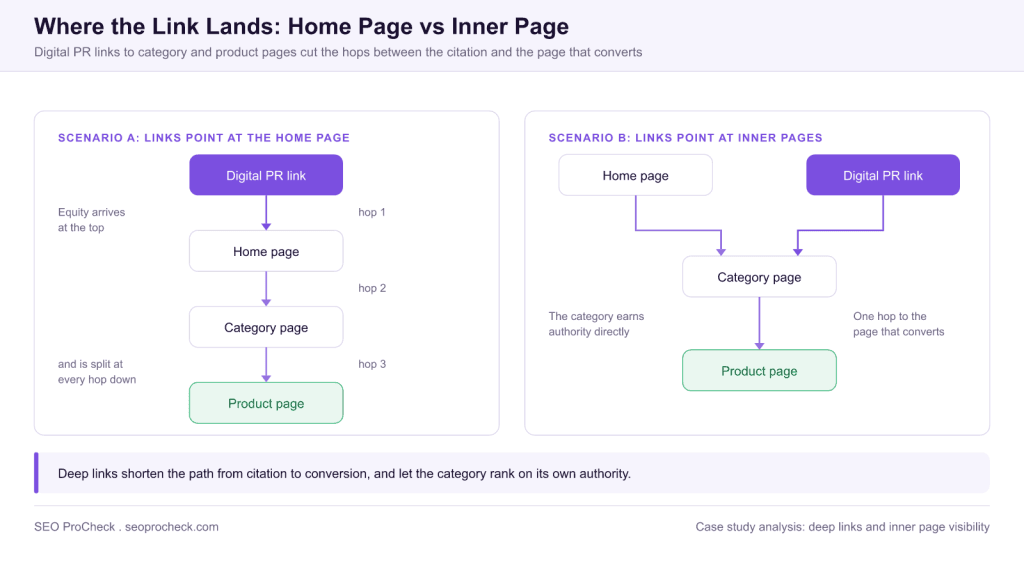
This nine month case study looks at what happens to organic visibility when digital PR links are aimed at inner pages, category and product URLs, rather than at the home page. The mechanism is simple: the page that receives the link benefits most, so pointing citations at commercial pages removes internal hops between the earned authority and the page that actually converts.
- A link to a category page gives that category its own authority, instead of making it depend on internal links.
- Inner pages are harder to earn links to, so the page itself needs something linkable on it.
- Anchor text should stay natural: campaigns dominated by commercial anchors look manufactured.
- Judge a digital PR campaign over a quarter or more, not over weeks.

Most link building defaults to the home page because it is the easiest URL to pitch. That default quietly costs money on ecommerce sites, because the pages that generate revenue then rely entirely on internal links to inherit authority. Aiming digital PR at category and product URLs shortens that path. To make it work you have to give the inner page a reason to be linked to, keep the anchor text natural, verify each earned link is in the main content and followed, and measure visibility at the level of the linked URL over at least a quarter. Track landing page impressions in Search Console alongside new referring domains per URL, because the two together tell you whether the link moved anything.
The case study below is summarised from the original source, credited in full at the end of the summary. Underneath it sits the operating detail: how to choose which inner pages to aim at, how to make a category page linkable in the first place, the checks that confirm an earned link is actually countable, and the reports that show whether the campaign shifted visibility.
This case study documents a successful organic growth strategy, demonstrating how strategic SEO implementation drives measurable business results. The approach provides actionable insights for practitioners facing similar challenges.
Challenge and Context
Every successful SEO initiative begins with understanding the starting position and objectives. This case study reveals the initial challenges, competitive landscape, and business goals that shaped the strategy. Understanding context helps practitioners assess applicability to their own situations.
Strategic Approach
The methodology employed combined technical optimization, content strategy, and authority building in a coordinated approach. Key decisions around prioritization, resource allocation, and tactical execution provide a template for similar initiatives. The strategy balanced quick wins with sustainable long-term growth.
Implementation Details
Moving from strategy to execution required specific technical implementations, content creation processes, and measurement frameworks. This case study documents the practical steps taken, tools used, and workflows developed. These implementation details help practitioners translate strategy into action.
Results and Analysis
The outcomes demonstrate the effectiveness of the approach through measurable metrics: traffic growth, ranking improvements, and business impact. Analysis of what worked best and what could have been done differently provides learning value beyond the raw results.
This case study contributes to the evidence base for effective SEO strategy, helping practitioners learn from documented successes.
Source: https://www.rebootonline.com/blog/9-month-case-study-visibility-increases-links-inner-pages/
Practitioner notes: choosing the target URL before the campaign
Link target selection is a commercial decision made before any outreach happens, and it is usually made by accident. The home page is the easiest URL to pitch because it needs no explanation, so most campaigns default to it. On an ecommerce site that default means the pages carrying revenue inherit authority only through internal links, and every internal hop between the home page and a product is a point where that authority gets divided among everything else linked at that level.
Build the target list from the intersection of two things: pages with commercial value, and pages that are currently underpowered relative to the competition. In practice that means exporting your category URLs with revenue or assisted revenue from GA4, then pulling referring domains per URL from Ahrefs Site Explorer under Pages then Best by links. Categories with high commercial value and low referring domain counts are the campaign targets. The general evidence base for which link tactics still move rankings is summarised in the link building tactics study.
Making an inner page linkable
The reason inner page campaigns fail is rarely the outreach, it is that nobody wants to link to a product grid. The fix is to put something on the category URL worth citing, on the category URL itself rather than on a separate blog post that then has to pass the value along. The table below covers the options and what each one realistically earns.
| Asset placed on the inner page | Effort | Why a publisher would link to it | Typical link source |
|---|---|---|---|
| Original survey or dataset about the category | High | Journalists need a citable number with a named source | News, trade press, industry blogs |
| Interactive calculator or sizing tool | High | Genuinely useful, and hard for a writer to reproduce | Resource roundups, forums, how to articles |
| Buying guide built into the category page | Medium | Answers the question the article is already about | Comparison and advice content |
| Expert commentary with named contributors | Medium | Gives the writer a quotable source | Journalist requests, expert roundups |
| Free template or downloadable checklist | Low | Easy to recommend, easy to link | Blogs, newsletters, social shares |
| Product grid with no added content | None | Nothing to cite | Almost none, which is the point |
Verifying that an earned link actually counts
A reported link and a countable link are different things. Before a placement goes in the results column, check four things, in this order:
- Is it in the main content? A link in the body of an article carries more than the same link in a sitewide footer or an author box.
- Is it followed? View source and check for
rel="nofollow",rel="sponsored"orrel="ugc". A nofollowed placement still has brand and referral value, it just is not the outcome you costed the campaign against. - Is the linking page indexed? Search the exact URL in Google. A link on an unindexed page does very little, and syndicated copies of a story often are not indexed even when the original is.
- Does it point where you asked? Redirect chains, tracking parameters and edited URLs are common. Run the target through a redirect checker and confirm it resolves in one hop to the canonical version of the page.
Internal linking still decides where the value ends up
Earning a link to a category page is the start. Where the authority flows next is decided by your own internal linking, and on most ecommerce sites that structure is an accident of the template. After a campaign lands, run a crawl and check two numbers for the linked URL: how many internal links point at it, and how many hops it sits from the home page. In Screaming Frog those live in the Internal tab as Inlinks and Crawl Depth. A newly powered category three or four clicks deep, with links only from pagination, will not do much with what it just earned.
Then look at where that category links out to. If it links to every product equally, it distributes evenly, which is rarely what you want. Feature the products you actually want to rank, and use descriptive anchors. The wider mechanics are covered in how to structure and communicate a technical SEO audit.
Measuring a nine month campaign
- Search Console, Performance then Pages, filtered to the target URL. Compare quarter over quarter, and read impressions before clicks. Impressions move first because they reflect ranking for more queries.
- Search Console, Performance then Queries, filtered to the same page. Count how many distinct queries the page appears for. Query breadth expanding is the clearest early signal that a page has gained authority.
- Ahrefs, Site Explorer then Pages then Best by links, filtered to new in the campaign window. Referring domains per target URL, not sitewide, because a sitewide number hides whether the campaign hit its targets.
- GA4, Reports then Acquisition then Traffic acquisition, with a landing page dimension. Separates referral traffic from the placements against organic growth on the same URL.
- Screaming Frog crawl, before and after. Confirms the internal link structure around the target actually changed the way you intended.
Common mistakes in inner page link campaigns
- Pitching the category page with nothing on it. Give the page something citable first, or the campaign is an outreach problem that outreach cannot solve.
- Over optimised anchors. A run of commercial anchor text on newly earned links is a pattern, and patterns are detectable. Ask for the URL, not the anchor.
- Landing links on a URL that redirects. Fix the canonical URL before outreach, not after, because publishers rarely edit a live article.
- Ignoring internal depth. A powered category that sits four clicks from the home page cannot pass on much.
- Reading results too early. Nine months is a realistic window for this kind of work, which is exactly why the original case study used one.
- Seasonal category timing. Aiming a campaign at a seasonal category after the season has started means the visibility gains arrive when demand has gone.
More worked examples are collected in the growth case study library.
FAQ
A deep link is an external link that points at a page other than your home page, typically a category, product, or resource page. It matters because the page that receives the link is the page that gains the most from it, so pointing every earned citation at the home page leaves your commercial pages dependent on internal links alone.
Journalists and bloggers link to things that are interesting to their readers, and a product listing rarely qualifies. The workaround is to give the inner page something linkable: original data, a tool, a guide, or a genuinely useful resource module that sits on the category URL itself rather than on a separate blog post.
Both, in different amounts. The linked page gains the most, then the pages it links to internally, and the domain gains some general benefit. That is exactly why link target selection is a strategic decision: the same link produces a different commercial outcome depending on where it lands.
Plan on a quarter before the pattern is readable and longer for competitive commercial terms. Links have to be discovered and processed, then rankings move, then clicks follow. A campaign judged at week three will always look like a failure, which is how good campaigns get cancelled.
No. Earned editorial links naturally carry brand names, URLs, and descriptive phrases, and a campaign where most anchors are commercial keywords looks manufactured because it is. Ask for the link to land on the right URL and let the publication write the anchor.
Confirm three things: the link is in the main content rather than a sitewide footer, it is not marked nofollow or sponsored, and the linking page itself is indexed. Check the last one by searching the exact URL in Google or inspecting it in Search Console if you have access, because a link on a page nobody indexes does very little.
Want this analysed against your own site?
Case studies are only useful once you know which constraint is actually holding your site back. An audit tells you that.
Take this with you
The assistant links open with a question about this page already written. Nothing is sent until you press enter.
Claude Vincent is a technical SEO consultant focused on crawlability, rendering, and AI-search visibility. He writes the field guides and case studies at SEO ProCheck, with a bias toward the durable, unglamorous work that decides whether search engines and AI answer engines can actually read and cite a site.
About SEO ProCheck
Technical SEO consulting and GEO strategy with 20 years of enterprise experience. Case studies, resources, and tools for search and AI visibility.
Work With Me
Technical SEO audits, GEO strategy, site migrations, and international SEO. Hourly consulting for teams who need hands-on support, not just reports.
Subscribe to our newsletter!







Recent Posts
- Finding a Competitor's Sitemap, and Turning It Into a Change Log September 15, 2026
- AI Crawler User Agents: The Current Names, and Which Ones Sites Actually Block September 9, 2026
- Can AI Crawlers Actually Read Your Site? I Measured 400 of the Biggest September 5, 2026