

AI Summary
Read enough hreflang case studies and the same three problems keep appearing: the wrong region ranks in a market, same language versions cannibalize each other, and global visitors get a random locale. Each maps to one fix, a complete reciprocal cluster, self canonical versions, and a declared x-default.
- Region mismatch is solved by a complete reciprocal hreflang cluster with valid region codes.
- Cross market duplication is solved by keeping each version self canonical so none is suppressed.
- Unmatched visitors are solved by a deliberate x-default that points to a selector or the primary market.
- Across all three, the win comes from routing existing demand to the right URL, not from a ranking boost.
International SEO presents unique challenges for reaching users across languages and regions. This case study documents successful international expansion strategies that established search visibility in target markets. Comparing several case studies side by side is more useful than reading any single one, because the specifics differ but the underlying failure patterns repeat. Learn the three patterns and you can diagnose most international sites on sight.
International Context
International SEO requirements vary based on target markets, content localization needs, and technical infrastructure. This case study establishes the international scope and specific challenges addressed. What links the case studies is that none of them earned traffic by making hreflang a ranking lever. hreflang has no ranking power. Every gain came from stopping a mismatch: the correct version was already capable of ranking, it just was not the one Google served. That reframing matters, because it tells you where to look. The problem is almost never content quality, it is which URL the annotations route a searcher to.
Technical Implementation
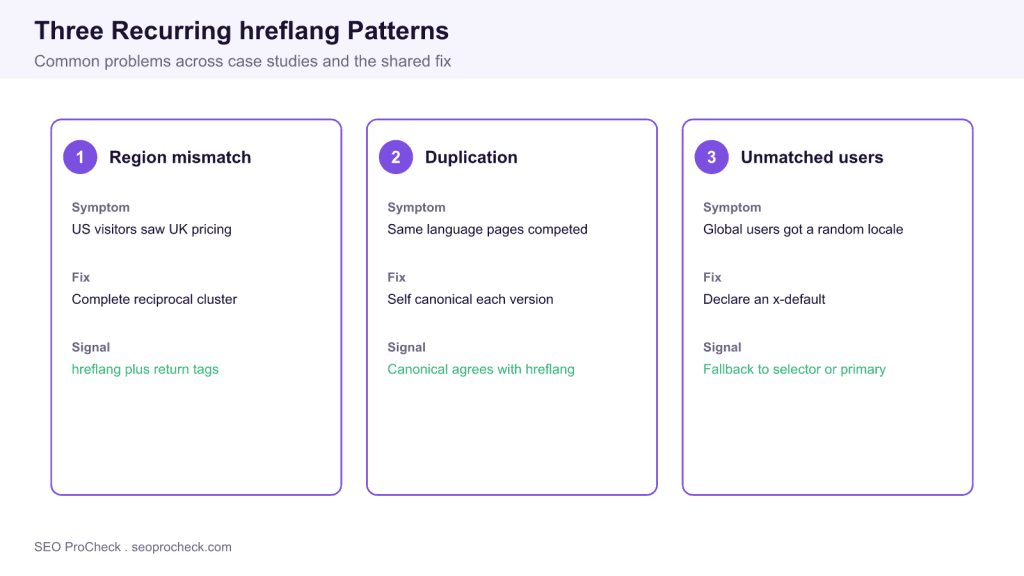
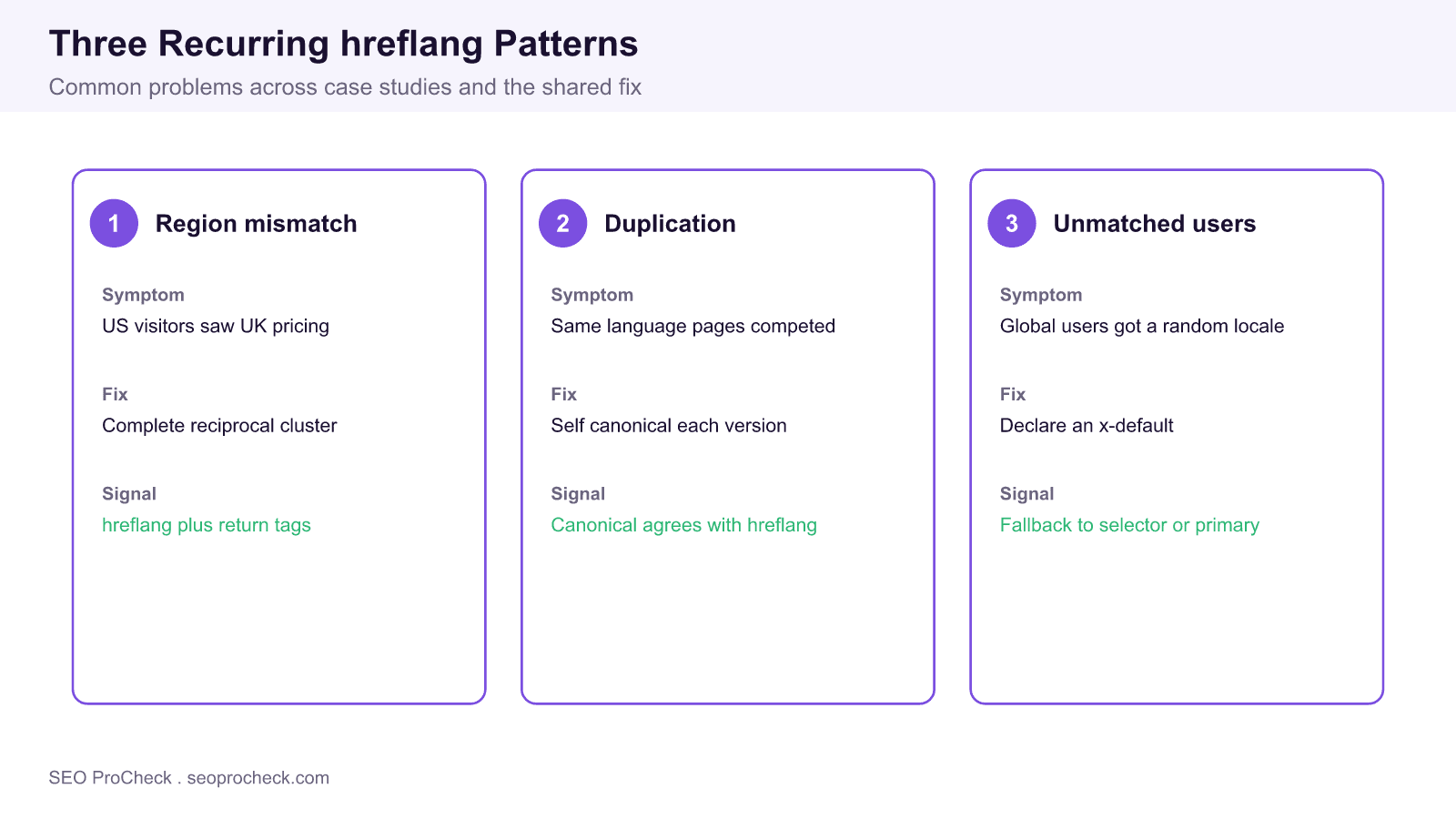
International targeting requires proper technical setup: URL structure decisions, hreflang implementation, and Search Console configuration. This case study documents the technical approach that enabled successful international targeting. The diagram above distills the three recurring patterns. Pattern one is region mismatch: a searcher in one country is served a version built for another, most visibly when they see foreign pricing or spelling. The fix is a complete reciprocal cluster where every version lists itself and all siblings with valid language and region codes, so Google can confirm which URL belongs to which market.
Pattern two is cross market duplication. When two versions share a language, such as en-us and en-gb, they can look like duplicates and compete, so one gets filtered from results. The fix is to keep each version self canonical and let hreflang, not the canonical tag, express the relationship. A canonical that points both versions at a single URL collapses the pair and is a frequent hidden cause. Pattern three is unmatched visitors: users and crawlers that match none of your declared locales get whatever Google guesses. The fix is a deliberate x-default that sends them to a language selector or your primary market.
The Three Patterns at a Glance
The table lines up each pattern with how to detect it and how to confirm the fix, so you can run the same diagnosis across any international site.
| Pattern | Symptom you observe | The fix | How to detect it |
|---|---|---|---|
| Region mismatch | Visitors in one country see another country pricing | Complete the reciprocal cluster with return tags | Country filtered Search Console performance report |
| Cross market duplication | Same language versions filter each other out | Make each version self canonical | Duplicate title and canonical audit in a crawl |
| Unmatched visitors | Global users land on a random locale | Declare an x-default fallback | Missing x-default flagged on a crawl |
Localization Strategy
Beyond technical implementation, international success requires appropriate content localization. This case study covers translation quality, local relevance adaptation, and market-specific content development. The case studies that sustained their gains did not stop at annotations. Once hreflang routed the right visitor to the right URL, that URL had to reward the visit with localized pricing, currency, availability, and terminology. When two versions share a language, the differentiation is spelling, price, and local proof, not a rewritten article. Annotations decide eligibility, localization decides conversion.
Market Performance
International SEO success is measured by visibility and traffic in target markets. This case study quantifies performance across markets, demonstrating the effectiveness of the international approach. Across the patterns, the reliable early indicator of success is the same: the wrong version stops appearing in a market. Filter the Search Console performance report by country to watch for that, then track click through and finally aggregate sessions. Judge each locale on its own line rather than a blended total, because the whole point of the fixes is per market precision.
International SEO case studies help practitioners navigate the complexity of multi-market optimization.
What Has Changed Since These Case Studies Were Published
The patterns are durable, but the validation tooling has moved. Google retired the dedicated hreflang report and the international targeting setting in Search Console, so detection now relies on crawlers such as Screaming Frog and Sitebulb, log analysis, and inspection of the rendered head or sitemap. Google still describes hreflang as a hint used to choose the version shown, not a ranking factor. That is why the three fixes remain the same across old and new case studies: build a complete reciprocal cluster, keep versions self canonical, and declare a purposeful x-default, then verify with a crawl.
Related SEO ProCheck resources
- Missing hreflang check: detect pages shipped without alternates.
- Missing x-default check: confirm the fallback for unmatched visitors.
- International SEO glossary and case studies: browse more worked examples.
Frequently Asked Questions
What do most hreflang case studies have in common?
They report gains from correcting which version Google serves, not from hreflang boosting rankings. The same three problems recur: the wrong region ranks in a market, same language versions cannibalize each other, and global visitors get a random locale. Each maps to one clear fix.
How do I fix the wrong regional version ranking?
Build a complete reciprocal hreflang cluster in which every version lists itself and all siblings, using valid ISO 639-1 language and ISO 3166-1 Alpha 2 region codes. When Google can confirm every pairing, it can serve the correct market version instead of guessing.
Why do my same language pages compete with each other?
Because en-us and en-gb look like near duplicates, so one can be filtered from results. Keep each version self canonical and let hreflang express the relationship. A canonical that points both versions at one URL collapses the pair and causes exactly this cannibalization.
What should x-default point to?
Point x-default at a language selector page or at your primary market version. It is the fallback for users and crawlers that match none of your declared locales. The choice is valid either way as long as it is deliberate and applied consistently across the cluster.
Does hreflang improve rankings?
No. hreflang is not a ranking factor. It improves results by making sure each searcher is shown the version built for them, which raises relevance and click through. The measurable gains in case studies come from routing existing demand to the correct URL.
How do I confirm an international fix worked?
Crawl the site to confirm every alternate is reciprocal and returns a 200 status, then filter the Search Console performance report by country. The earliest sign of success is the wrong locale version dropping out of a market, followed by improved click through and then aggregate growth.
Claude Vincent is a technical SEO consultant focused on crawlability, rendering, and AI-search visibility. He writes the field guides and case studies at SEO ProCheck, with a bias toward the durable, unglamorous work that decides whether search engines and AI answer engines can actually read and cite a site.
About SEO ProCheck
Technical SEO consulting and GEO strategy with 20 years of enterprise experience. Case studies, resources, and tools for search and AI visibility.
Work With Me
Technical SEO audits, GEO strategy, site migrations, and international SEO. Hourly consulting for teams who need hands-on support, not just reports.
Subscribe to our newsletter!







Recent Posts
- Can AI Crawlers Actually Read Your Site? I Measured 400 of the Biggest September 5, 2026
- The Pre-Publish Quality Gate for AI-Assisted Content August 6, 2026
- AGENTS.md vs llms.txt vs llms-full.txt: Which Agent File Does What July 18, 2026