

Can adding pricing information client-side increase SEO performance?
- September 22, 2022
- JavaScript SEO
AI Summary
Adding pricing text that is rendered client side can be indexed because Googlebot executes JavaScript, but the organic gain depends on whether the price was previously missing from the rendered page and whether it strengthens relevance or click through. In controlled split testing the durable win comes from making price content crawlable and eligible for rich results, not from the rendering method by itself.
- Googlebot renders JavaScript in a deferred second wave, so client side price text can index on a delay.
- Server rendering or hydration removes both the delay and the render budget cost.
- Product and Offer structured data is the durable way to expose price to search engines.
- Measure the change with a controlled SEO split test and judge it on organic entrances.
This SEO case study documents a successful optimization initiative, providing actionable insights for practitioners. The documented approach demonstrates how strategic SEO implementation drives measurable results.
Initial Situation
Understanding the starting point is essential context for evaluating any case study. This documentation covers the initial challenges, competitive position, and business objectives that shaped the SEO strategy.
Strategy and Approach
The strategic approach combined multiple SEO disciplines to address identified opportunities. Key decisions around prioritization and resource allocation provide a template for similar initiatives.
Implementation
Moving from strategy to execution required specific technical implementations, content development, and process changes. This case study documents the practical steps that translated strategy into action.
Results and Learnings
The outcomes demonstrate effectiveness through measurable improvements in rankings, traffic, and business metrics. Analysis of successes and challenges provides learning value for practitioners.
Case studies like this contribute to the SEO knowledge base, helping practitioners learn from documented real-world experiences.
What this experiment actually tested
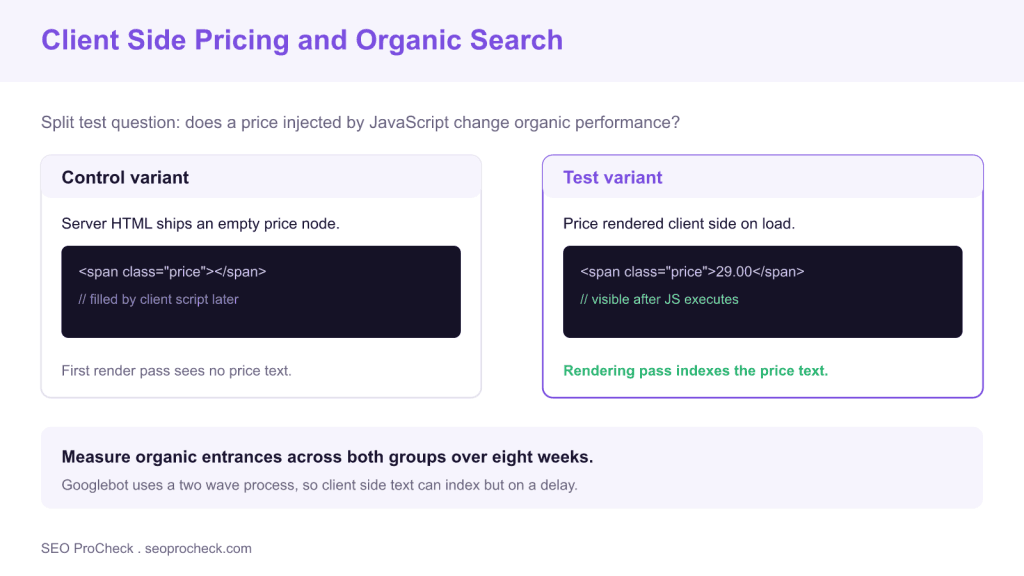
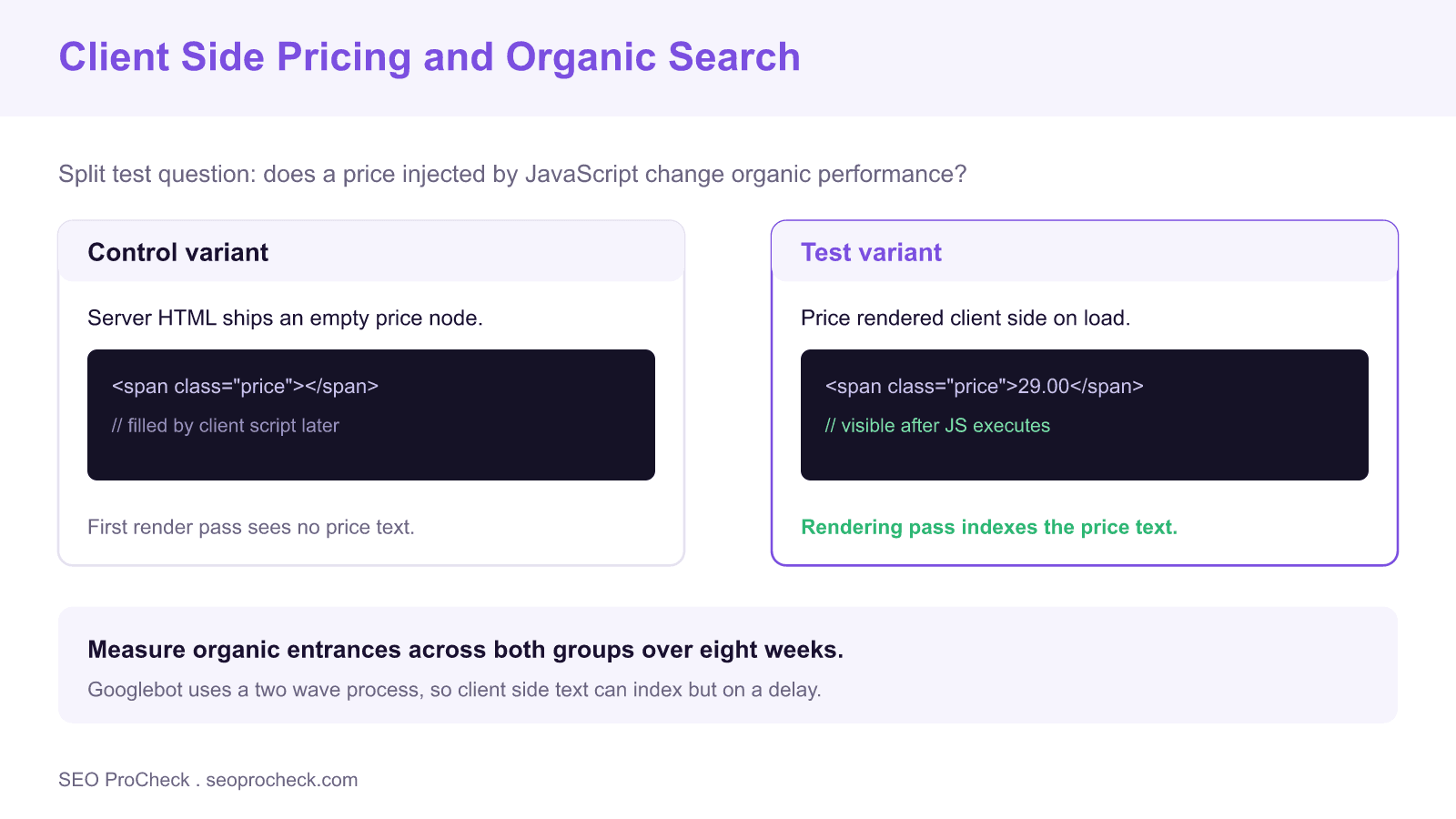
The underlying question is narrow and useful: if an ecommerce product page ships without a visible price in its server response, and that price is then written into the DOM by client side JavaScript, does the search engine treat the page differently? SearchPilot answered it with a controlled SEO split test rather than a single before and after look, which is the right way to isolate one change from seasonality and from ordinary ranking noise.
In the control group the price node arrives empty in the HTML that the server returns. A script populates it after load, so a human sees the price but the raw response does not contain it. In the test group the same price value is present once JavaScript executes and the rendering pass completes. Everything else on the two page sets is held constant, so any measured difference in organic entrances can be attributed to the price text becoming visible to the rendered page.
Why the rendering path matters
Google processes a page in two broad steps. The crawler first fetches the raw HTML, then the page is queued for rendering where the JavaScript runs and the final DOM is captured. Client side content only becomes eligible for indexing after that second step. For a high value template this delay is often short, but on large catalogs with heavy scripts the render queue can stretch, so a price that depends entirely on client execution can be missing from the index for a while.
You can confirm what Google actually sees rather than guessing. Use the URL Inspection tool in Google Search Console, run a live test, and open the rendered HTML and screenshot tabs. If the price appears there, the rendered DOM contains it. A second quick check is to fetch the page with JavaScript disabled in DevTools and compare it against the fully rendered view. If the price is only in the second view, it is client side dependent.
A more durable pattern than injection
Rather than relying on the rendering pass to expose a price, most teams get a cleaner result by putting the value in the server response and by describing it with structured data. A Product entity with an Offer makes the price machine readable and can qualify the listing for price rich results. The markup is small and it does not depend on a script running.
<script type="application/ld+json">
{
  "@context": "https://schema.org",
  "@type": "Product",
  "name": "Trail Runner 200",
  "offers": {
    "@type": "Offer",
    "priceCurrency": "USD",
    "price": "29.00",
    "availability": "https://schema.org/InStock"
  }
}
</script>
If the price genuinely cannot be server rendered, prerendering or hydration keeps the visible value in the first response while your framework takes over on the client. That removes the render dependency without a full rebuild of the front end.
How to expose price to search
| Method | Visible on first crawl | Render cost | Rich result eligible |
|---|---|---|---|
| Server rendered HTML | Yes | None | Yes, with Offer markup |
| Client side JavaScript injection | No, appears after render | Higher, uses render budget | Only after successful render |
| Prerender or hydration | Yes | Low | Yes |
| Offer structured data | Yes | None | Yes, primary path |
What has changed since this test
Google has stated for years that it renders JavaScript, and its evergreen crawler keeps pace with modern browser features, so client side content is more reliably picked up than it once was. Even so, the rendering step still runs on a queue and still consumes resources, which is why the practical advice has shifted toward server rendering and hydration for anything that matters for ranking or click through. Price rich results and merchant listings have also matured, so the structured data path now carries more of the value than a raw text injection ever did. If you are revisiting a page that hides its price behind a script, the modern move is to surface the value in the response and to back it with an Offer, then confirm the outcome with a controlled test.
For related reading on how rendered and indexable states interact, see our meta robots and X Robots Tag reference, the companion CSS and JavaScript hidden text experiment, and more studies in our JavaScript SEO case study library.
Frequently asked questions
Does Google index text that is added with JavaScript?
Yes. Googlebot runs a rendering step that executes JavaScript, so text injected client side can be indexed. The catch is that rendering happens in a deferred wave after the initial crawl, so the price text may take longer to appear in the index than server rendered markup.
Is client side rendered pricing bad for SEO?
It is not automatically bad, but it adds risk and delay. If the price is important for relevance or click through, server rendering or hydration is safer because the value is present on the first pass and does not depend on a successful render.
How long does Google take to see client side content?
There is no fixed number. Rendering can happen within hours for high priority pages or take days to weeks for lower priority ones. Pages that change often and render quickly are processed sooner than heavy pages that block the main thread.
Does showing a price affect click through rate from search?
It can. When a price appears through structured data or in the visible snippet, it sets expectations before the click and tends to attract more qualified visitors. That is a click through effect, which is separate from any ranking change.
Should I put the price in the title tag or meta description?
Prices change often, so hard coding an exact figure in the title is fragile and can go stale. A safer pattern is to expose price through Product and Offer structured data and to keep the title focused on the product and category intent.
How do I run a controlled SEO test for a pricing change?
Split a large set of similar pages into a control group and a variant group, apply the change only to the variant, and compare organic entrances over several weeks using a model that accounts for seasonality. Judge the outcome on traffic, not on a single keyword ranking.
Take this with you
The assistant links open with a question about this page already written. Nothing is sent until you press enter.
Claude Vincent is a technical SEO consultant focused on crawlability, rendering, and AI-search visibility. He writes the field guides and case studies at SEO ProCheck, with a bias toward the durable, unglamorous work that decides whether search engines and AI answer engines can actually read and cite a site.
About SEO ProCheck
Technical SEO consulting and GEO strategy with 20 years of enterprise experience. Case studies, resources, and tools for search and AI visibility.
Work With Me
Technical SEO audits, GEO strategy, site migrations, and international SEO. Hourly consulting for teams who need hands-on support, not just reports.
Subscribe to our newsletter!








Recent Posts
- Most Top Sites Never Say Who They Are in Structured Data October 14, 2026
- Homepage Titles Are Mostly Too Short, Not Too Long October 8, 2026
- Who Actually Serves an llms.txt? 184 Top Sites Measured September 29, 2026