

AI Summary
SEO reporting turns search data into a decision-ready narrative for a specific audience: the right metrics, at the right cadence, framed so the reader knows what to do next. Match cadence and depth to who reads it, lead with the answer, and tie every metric to a goal, because a report nobody acts on is just a data dump with a logo on it.
- Name the audience first, because that choice sets your metrics, depth, and length.
- Lead with the headline (up, down, or steady, and why) before any chart.
- Segment brand versus non-brand so branded spikes do not flatter the work.
- Automate the data pull and hand-write the interpretation.

SEO reporting is the practice of turning search data into a decision-ready narrative for a specific audience, the right metrics, at the right cadence, framed so the reader knows what to do next. A report nobody acts on is just a data dump with a logo on it.
The stakes: SEO lives or dies on how well its wins get communicated. Do the best technical and content work of your career, report it as a wall of screenshots, and the person holding the budget will conclude nothing is happening. Good reporting is how a slow channel keeps its funding through the quarters where revenue hasn't caught up yet.
A real example: same data, three audiences
A retailer's organic traffic drops 12% month over month. The analyst needs the diagnosis: a category-page template change dropped 400 URLs out of the index, here are the affected URLs and the fix ticket. The marketing director needs the impact and the plan: "12% dip, isolated to one template, fix ships Thursday, recovery expected in 3 to 4 weeks." The CFO needs one line: "Temporary, contained, no revenue at risk beyond this month, already being fixed." Same event, three completely different reports. Sending the CFO the URL list is how you lose the room.
Report cadence, audience, and what to actually show
| Cadence | Primary audience | What to lead with |
|---|---|---|
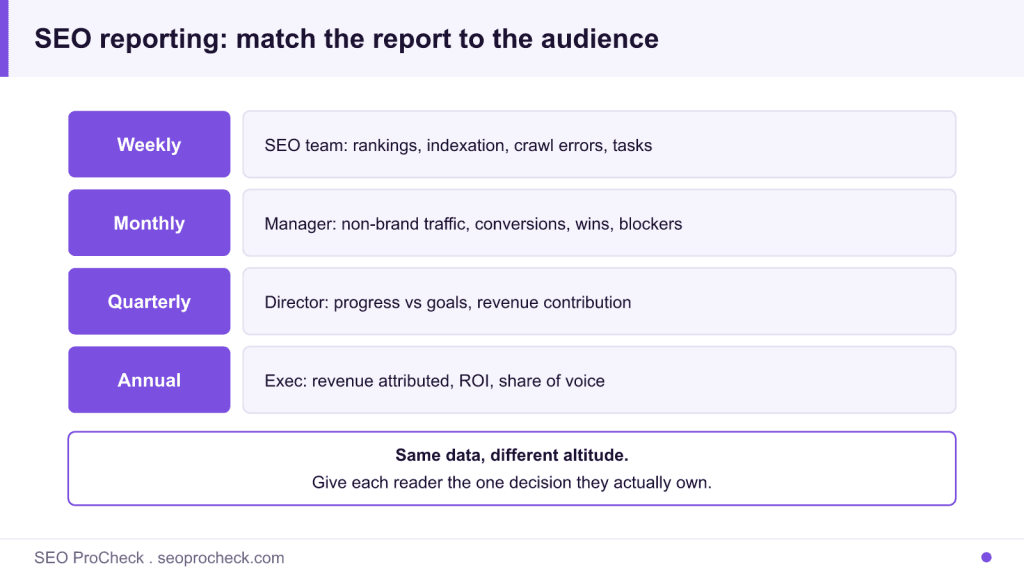
| Weekly | SEO team / practitioners | Rankings movement, indexation, crawl errors, in-flight tasks |
| Monthly | Marketing manager / channel owner | Non-brand traffic, conversions, top movers, wins and blockers |
| Quarterly | Director / VP | Progress vs. goals, pipeline/revenue contribution, next-quarter plan |
| Annual / QBR | Executive / finance | Revenue attributed, ROI, share of voice, strategic bets |
| Ad hoc | Whoever's panicking | What happened, is revenue at risk, what's the fix and ETA |
How to build a report people actually read
- Name the audience first. Write down who reads it and what decision they make. That single choice sets your metrics, depth, and length.
- Lead with the answer. Open with the headline, up, down, or steady, and why, before any chart. Executives read the first line and skim the rest.
- Tie every metric to a goal. If a number doesn't map to a KPI you agreed on, it doesn't belong in the report. Kill it.
- Segment brand vs. non-brand. Otherwise branded spikes make your work look better than it is, and one bad month looks like a catastrophe.
- Add the "so what." Every section gets one line of interpretation: what it means and what you're doing about it. Data without a verdict is homework you're assigning the reader.
- End with next steps and asks. What's shipping, what you need unblocked, what decision you're requesting. Reports that end in a chart end the conversation.
- Automate the pull, hand-write the story. Let a dashboard gather the numbers so you spend your time on the narrative, which is the part that changes minds.
Reporting mistakes and how to fix them
- Same report for every audience. The engineer's detail bores the exec; the exec's summary is useless to the engineer. Fix: build tiered versions from one data source.
- Leading with rankings. Stakeholders don't buy positions, they buy outcomes. Fix: open with traffic and conversions; keep rankings as supporting evidence.
- No context on the numbers. "Traffic: 42,000" means nothing without a comparison. Fix: always show period-over-period and progress-to-target.
- Reporting activity instead of impact. "Published 12 posts, fixed 30 errors" is a to-do list, not a result. Fix: report what those actions moved.
- Hiding the bad news. Burying a decline destroys trust when it surfaces anyway. Fix: lead with problems, paired with a diagnosis and a fix.
A reusable reporting stack that scales
The reason most SEO reports rot is that they are rebuilt by hand every cycle, so the analyst spends the hours copying numbers instead of explaining them. Fix that by separating collection from narrative. Pull the raw numbers once into a single source of truth: Search Console for impressions, clicks, and position; GA4 for sessions and conversions; a rank tracker for the keyword set that maps to revenue. A connector such as Looker Studio can refresh those on a schedule so the figures stay current without manual export.
On top of that one dataset, build tiered views rather than one report for everyone. The weekly team view carries indexation, crawl errors, and in-flight tasks. The monthly manager view leads with non-brand traffic and conversions. The quarterly leadership view reports progress against goals and revenue contribution. Each tier reads from the same numbers, so they never disagree, and each is filtered to the one decision its reader owns. Keep the live dashboard for self-serve monitoring and write a short narrative on top for decisions, because a dashboard gathers data well but never explains why traffic moved or what you are doing about it. That explanation is the part that keeps a slow channel funded.
Frequently asked questions
How often should I send SEO reports?
Match cadence to audience: weekly for the working team, monthly for channel owners, quarterly for leadership. Sending executives a weekly report trains them to ignore it.
What metrics belong in an executive SEO report?
Non-brand organic traffic, conversions or pipeline, revenue contribution, and progress against the quarter's goal. Four numbers with context beat forty without it.
Should I automate my SEO reporting?
Automate the data collection, never the interpretation. Dashboards are great at gathering; they're terrible at explaining why traffic moved and what to do about it. That's your job and it's the whole value.
How do I report an SEO drop without losing the room?
Lead with it, not around it: what dropped, why, whether revenue is at risk, and the fix with an ETA. A calm diagnosis reads as competence; a buried decline reads as a cover-up.
How long should an SEO report be?
As short as the decision allows. A monthly for a manager might be one page plus an appendix; a QBR might be a five-slide story. If the reader has to hunt for the point, it's too long.
Dashboard or written report, which should I use?
Use both, for different jobs. A live dashboard is great for self-serve monitoring, anyone can check current numbers anytime. A written or slide report is where you do the thing a dashboard can't: explain what changed, why, and what happens next. When people say "the dashboard isn't landing with leadership," it's almost always because there's no narrative layer on top. Ship the dashboard for access and the written summary for decisions.
Reporting is only as good as the metrics feeding it, start from a defensible set of SEO KPIs before you design a single slide. For getting buy-in on what you report, see stakeholder management, and to frame the money story, SEO ROI.
Take this with you
The assistant links open with a question about this page already written. Nothing is sent until you press enter.
Claude Vincent is a technical SEO consultant focused on crawlability, rendering, and AI-search visibility. He writes the field guides and case studies at SEO ProCheck, with a bias toward the durable, unglamorous work that decides whether search engines and AI answer engines can actually read and cite a site.
About SEO ProCheck
Technical SEO consulting and GEO strategy with 20 years of enterprise experience. Case studies, resources, and tools for search and AI visibility.
Work With Me
Technical SEO audits, GEO strategy, site migrations, and international SEO. Hourly consulting for teams who need hands-on support, not just reports.
Subscribe to our newsletter!








Recent Posts
- Most Top Sites Never Say Who They Are in Structured Data October 14, 2026
- Homepage Titles Are Mostly Too Short, Not Too Long October 8, 2026
- Who Actually Serves an llms.txt? 184 Top Sites Measured September 29, 2026