

AI Summary
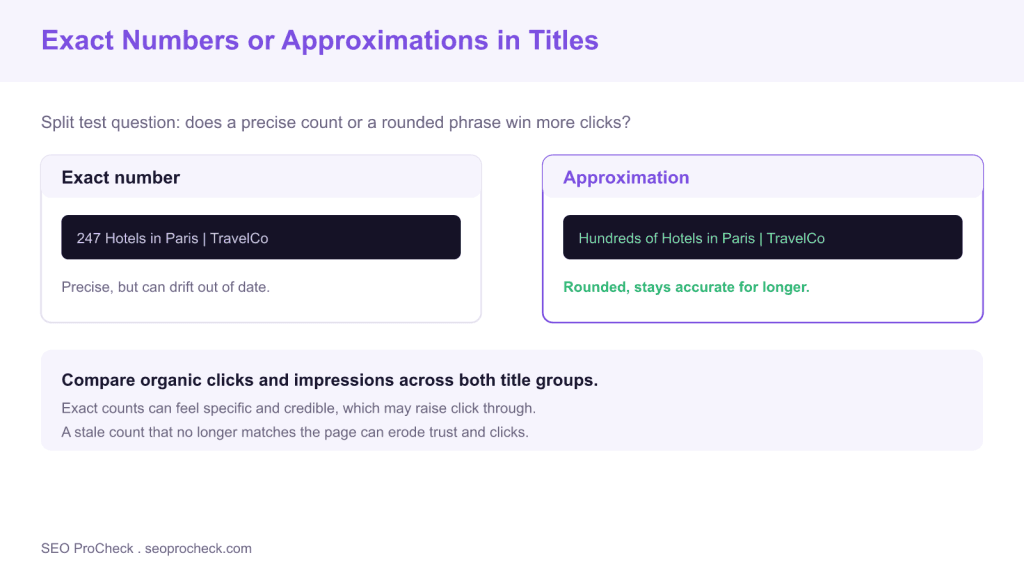
Whether an exact number or a rounded approximation works better in a title tag depends on the query and on how quickly the count changes. A precise figure can feel specific and credible and lift click through, but a number that goes stale and no longer matches the page can erode trust, so the choice is best settled with a controlled split test that measures organic clicks.
- Exact counts can signal precision and freshness and raise click through.
- Approximations stay accurate as inventory changes, avoiding stale numbers.
- Google may rewrite either version, so judge by clicks, not the source tag.
- If you use an exact count, generate it from live data so it never drifts.
This SEO case study documents a successful optimization initiative, providing actionable insights for practitioners. The documented approach demonstrates how strategic SEO implementation drives measurable results.
Initial Situation
Understanding the starting point is essential context for evaluating any case study. This documentation covers the initial challenges, competitive position, and business objectives that shaped the SEO strategy.
Strategy and Approach
The strategic approach combined multiple SEO disciplines to address identified opportunities. Key decisions around prioritization and resource allocation provide a template for similar initiatives.
Implementation
Moving from strategy to execution required specific technical implementations, content development, and process changes. This case study documents the practical steps that translated strategy into action.
Results and Learnings
The outcomes demonstrate effectiveness through measurable improvements in rankings, traffic, and business metrics. Analysis of successes and challenges provides learning value for practitioners.
Case studies like this contribute to the SEO knowledge base, helping practitioners learn from documented real-world experiences.
Source: https://www.searchpilot.com/resources/case-studies/title-tag-exact-numbers-vs-approximations-seo/
What this experiment tested
The question is a classic copywriting trade off applied to search: on pages that quote a quantity, does a precise number or a rounded approximation earn better organic performance? SearchPilot answered it with a controlled SEO split test, applying an exact count to one group of pages and a rounded phrase to a matched group, then comparing organic clicks over time. The split test design matters because title changes mostly move click through, and click through is noisy enough that a simple before and after view would mislead.
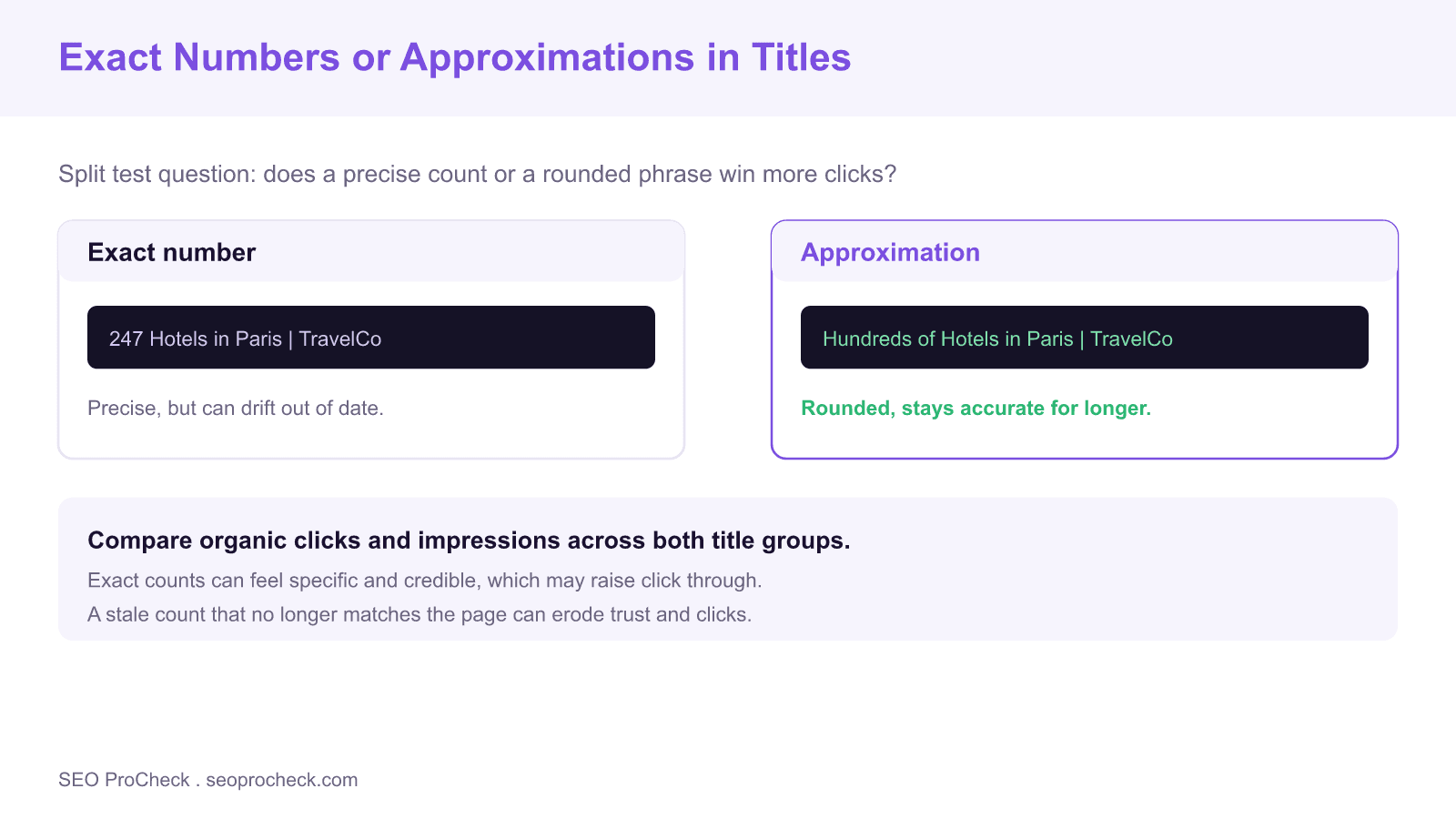
In the control group the title carries a specific figure, for example 247 Hotels in Paris. In the variant the same idea is rounded, for example Hundreds of Hotels in Paris. Everything else on the page is held constant, so a difference in clicks can be traced to the numeric style rather than to anything else on the template.
Why the choice is a real trade off
An exact number carries two advantages. It looks specific, which reads as credible, and it implies the page is current and maintained. Those signals can lift click through on queries where scale matters, such as travel, jobs, or property listings. The cost is fragility. A hard coded figure drifts the moment inventory changes, and a title that promises 247 hotels on a page now showing 190 undercuts the very trust the number was meant to build. It can also invite Google to rewrite the title once it no longer matches the page.
A rounded approximation trades a little specificity for durability. Hundreds of hotels stays true across a wide range of real counts, needs no maintenance, and never contradicts the page. On fast changing inventory that resilience is often worth more than the small edge a precise figure might give.
How to implement an exact count safely
If the test points to exact numbers, do not type them by hand. Bind the figure to the same live count that the page itself displays, so the title and the body always agree. In a templated CMS this means injecting a variable into the title template rather than editing each page.
Title template:
{{result_count}} Hotels in {{city}} | TravelCo

Rendered from live data:
247 Hotels in Paris | TravelCo

Fallback when the count is low or unstable:
Hotels in {{city}} | TravelCo
Keep the meaningful words within roughly 60 characters so the number and the topic survive truncation, and add a fallback for pages where the count is too small or volatile to quote.
Approaches compared
| Approach | Example | Strength | Weakness |
|---|---|---|---|
| Exact static number | 247 Hotels in Paris | Specific and credible | Goes stale, needs upkeep |
| Exact dynamic number | Count injected from live data | Precise and always current | Needs a data binding and fallback |
| Rounded approximation | Hundreds of Hotels in Paris | Durable, never contradicts page | Less specific pull |
| No number | Hotels in Paris | Simple and stable | Misses the pull of scale |
What has changed since this test
Google now rewrites displayed titles far more often than it used to, and one of its triggers is a title that looks inaccurate or out of step with the page, which raises the stakes on any hard coded number. That makes the dynamic exact count, bound to live data, the strongest version of the exact number strategy and the static typed figure the weakest. Approximations have quietly become the safer default for volatile inventory precisely because they never fall out of sync. The enduring lesson is to match the numeric style to how fast the underlying count moves, to automate exact figures, and to let organic clicks decide the winner.
For related metadata studies see our test on adding category names to product titles, the study on an estimated read time in the result, and the full metadata case study library.
Frequently asked questions
Do numbers in title tags help SEO?
Numbers can help mostly through click through rather than ranking. A count, a year, or a quantity can make a result stand out and feel specific in a crowded list of blue links, which nudges more people to click. The ranking effect of the number itself is usually small compared with the relevance of the surrounding words.
Should I use an exact number or round it in my titles?
It depends on how fast the number changes and how you generate it. An exact figure feels precise and current, which can lift clicks, but only if it stays accurate. If the count shifts often and you cannot keep it fresh, a rounded phrase such as hundreds of options avoids the risk of a stale, misleading title.
How do I keep an exact count in a title accurate?
Generate it from live data rather than typing it by hand. Pull the current count from the same source that renders the page, for example the number of matching results, and inject it into the title template so it updates whenever the underlying data changes. A hard coded number will drift and become a liability.
Does Google rewrite title tags that contain numbers?
It can. Google rewrites any title it judges to be a weak match, boilerplate, or misleading, and a number that no longer matches the page content is exactly the kind of signal that invites a rewrite. That is one more reason to keep counts accurate and to measure the displayed result by clicks.
Do numbers actually improve click through rate?
Often, but not always. Specificity and a sense of scale can make a snippet more compelling, yet a number that looks arbitrary or too good to be true can have the opposite effect. Because the outcome varies by query and audience, it is worth testing rather than assuming.
How do I test which title format works best?
Run a controlled split test. Split a large set of similar pages into a control group with one format and a variant group with the other, change only the title, and compare organic clicks over several weeks using a model that accounts for seasonality. Judge the winner on clicks, not on a single ranking position.
Take this with you
The assistant links open with a question about this page already written. Nothing is sent until you press enter.
Claude Vincent is a technical SEO consultant focused on crawlability, rendering, and AI-search visibility. He writes the field guides and case studies at SEO ProCheck, with a bias toward the durable, unglamorous work that decides whether search engines and AI answer engines can actually read and cite a site.
About SEO ProCheck
Technical SEO consulting and GEO strategy with 20 years of enterprise experience. Case studies, resources, and tools for search and AI visibility.
Work With Me
Technical SEO audits, GEO strategy, site migrations, and international SEO. Hourly consulting for teams who need hands-on support, not just reports.
Subscribe to our newsletter!








Recent Posts
- Most Top Sites Never Say Who They Are in Structured Data October 14, 2026
- Homepage Titles Are Mostly Too Short, Not Too Long October 8, 2026
- Who Actually Serves an llms.txt? 184 Top Sites Measured September 29, 2026