

Commercial vs. Functional vs. Emotional: A Case Study on Page Title SEO Testing
- August 3, 2022
- Metadata
AI Summary
Commercial, functional, and emotional are three ways to frame the same page title: leading with an offer, with plain specs, or with a benefit. Which one earns more organic clicks is an empirical question that depends on the audience and query intent, so the answer comes from a controlled title test, not an opinion.
- Commercial leads with deals and price; functional with specs and exact-match keywords; emotional with aspiration and benefit.
- There is no universal winner: match the framing to the query intent, then test it.
- Keep the core keyword when using emotional framing, or you risk losing relevance.
- Test at the page level across similar templated pages, measuring click-through rate and organic traffic.
Two pages can target the same keyword with wildly different title tags. One shouts the discount, one states the specifications, and one sells the feeling. These are the three classic title framings: commercial, functional, and emotional. Marketers have strong opinions about which is best, but opinions do not rank pages. The Moz case study this page summarizes put the question to a real test, and the framework below shows how to think about the three angles and how to test them on your own pages, rather than guessing.
This SEO case study documents a successful optimization initiative, providing actionable insights for practitioners. The documented approach demonstrates how strategic SEO implementation drives measurable results.
The three ways to frame a title
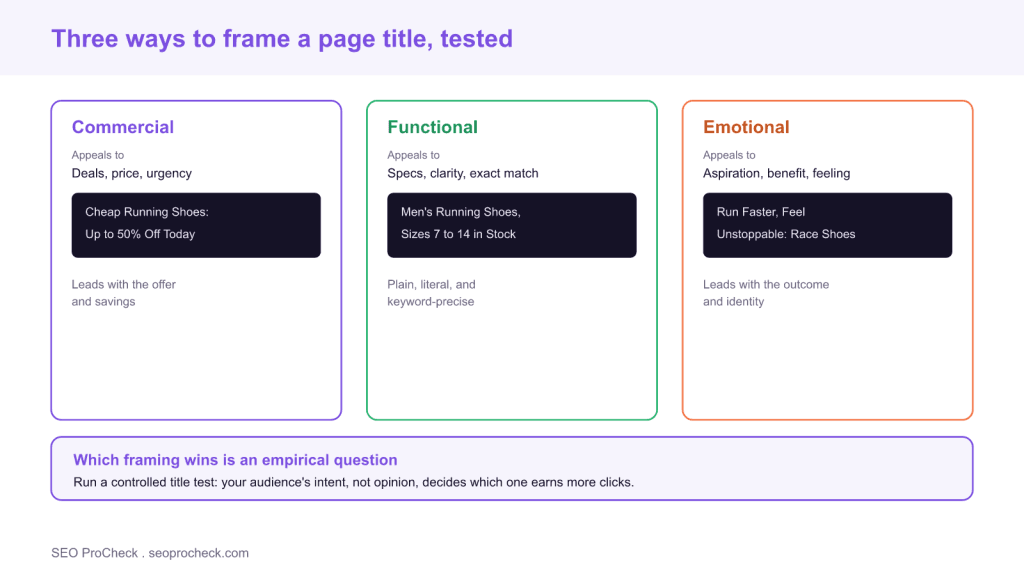
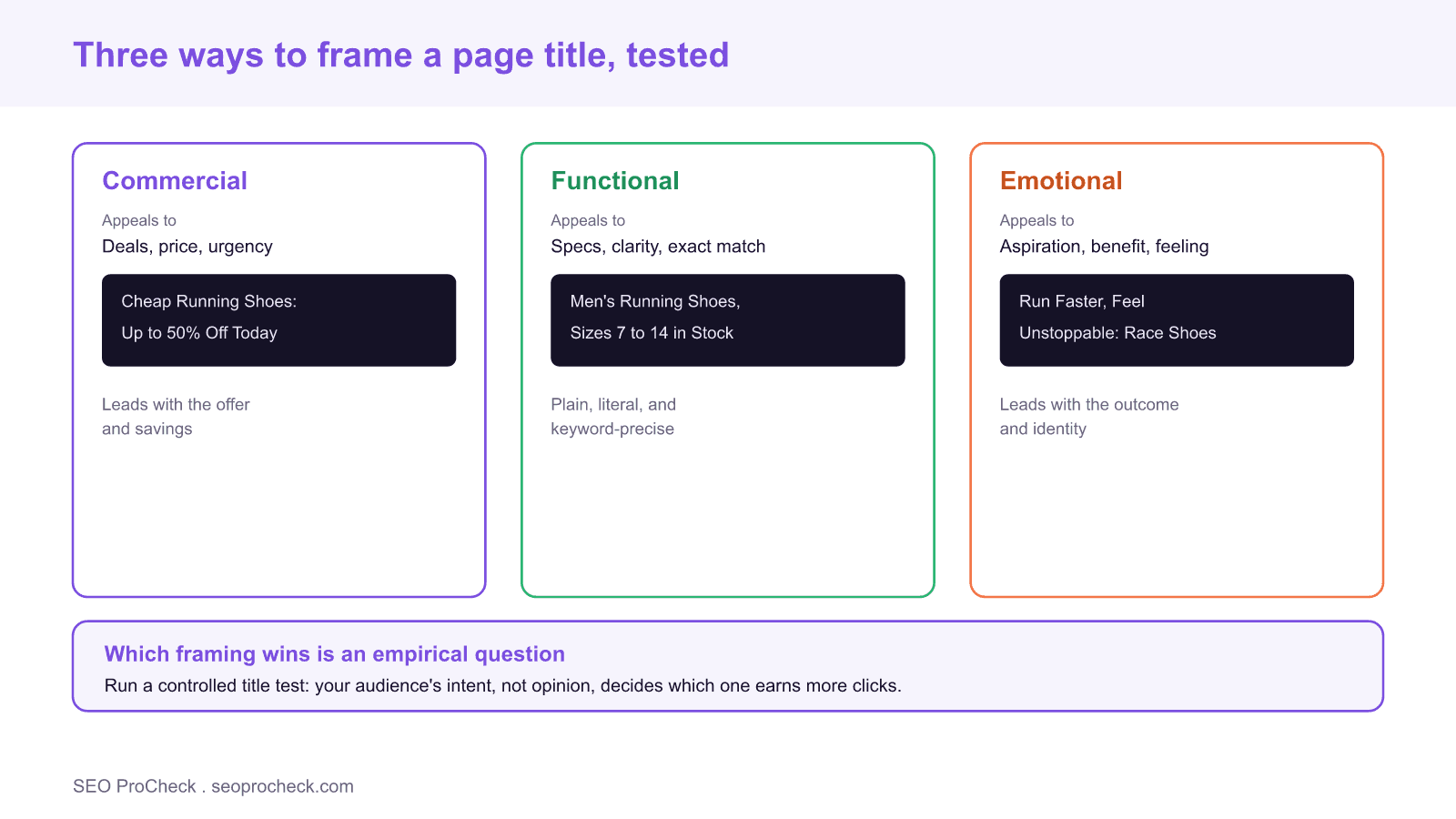
Every title tag makes a choice about what to lead with, even when the writer does not think of it as a choice. Commercial framing foregrounds the offer: the price, the discount, the deadline. Functional framing foregrounds the facts: the model, the size, the exact-match keyword. Emotional framing foregrounds the payoff: how the reader will feel or what they will become. Each has a natural fit and a natural failure mode, summarized below.
| Framing | Appeals to | Example title | Watch out for |
|---|---|---|---|
| Commercial | Deals, price, urgency | Cheap Running Shoes: Up to 50% Off Today | Can feel spammy; may miss non-buyers |
| Functional | Specs, clarity, exact match | Men's Running Shoes, Sizes 7 to 14 in Stock | Safe but forgettable; low emotional pull |
| Emotional | Aspiration, benefit, feeling | Run Faster, Feel Unstoppable: Race Shoes | Can bury the keyword and lose relevance |
The examples share one product and one keyword. What differs is the angle, and that angle is what a title test measures.
Initial Situation
Understanding the starting point is essential context for evaluating any case study. This documentation covers the initial challenges, competitive position, and business objectives that shaped the SEO strategy.
Begin by classifying the titles you already have. Pull your key templates and ask which framing each one uses today, then compare that against the intent behind the queries those pages rank for. A common mismatch is a functional, spec-only title sitting on a page that ranks for aspirational queries, or a heavily commercial title on a page that mostly attracts researchers. Search Console shows the queries and the current click-through rate for each page, which is your baseline and your first clue about where a reframing could help.
Strategy and Approach
The strategic approach combined multiple SEO disciplines to address identified opportunities. Key decisions around prioritization and resource allocation provide a template for similar initiatives.
The strategy is to treat framing as a hypothesis matched to intent, then prove it with a page-level test. Use the query intent to pick which framing to try first, as in the table below, but hold these as bets to validate rather than conclusions. Because you cannot show Googlebot two versions of one URL, the test splits pages instead of users: a control group keeps the current framing and a matched variant group adopts the new one, exactly the split-testing method used to measure whether changing one word from price to cost moved traffic.
| Query intent | Framing to test first | Reasoning |
|---|---|---|
| Transactional (buy, cheap, deals) | Commercial | The searcher is ready to purchase and scans for offers |
| Spec or informational (size, specs, how to) | Functional | Exact-match clarity answers the query directly |
| Aspirational or brand (best, for me) | Emotional or blended | The decision is driven by outcome and identity |
Implementation
Moving from strategy to execution required specific technical implementations, content development, and process changes. This case study documents the practical steps that translated strategy into action.
Implement the test on a set of similar templated pages so the groups are comparable. Rewrite only the title framing on the variant pages, keep the core keyword present even in emotional versions, and leave the rest of each page unchanged. Run it for several weeks, then measure both organic traffic and click-through rate against a forecast or matched control, so seasonality does not masquerade as a result. This is the same measured, one-change-at-a-time discipline behind lean SEO, and it only produces trustworthy numbers on a technically sound site.
Results and Learnings
The outcomes demonstrate effectiveness through measurable improvements in rankings, traffic, and business metrics. Analysis of successes and challenges provides learning value for practitioners.
Interpret the result as a statement about these pages and this audience, not a universal law of copywriting. Sometimes the plain functional title beats the clever emotional one because it matches the query more precisely; sometimes the emotional version wins by lifting click-through rate across the whole group. Whatever the Moz case study at the source below measured reflects its pages and market, so read the figures there as one documented outcome rather than a rule to copy. Titles are also just one on-page lever: they perform best on top of the technical fundamentals that make sure the page is crawlable, indexable, and fast in the first place.
Case studies like this contribute to the SEO knowledge base, helping practitioners learn from documented real-world experiences.
FAQ
They are three ways to frame the same page title. Commercial framing leads with an offer, price, or urgency; functional framing leads with specs, clarity, and exact-match keywords; emotional framing leads with aspiration, benefit, or feeling. The underlying page is the same, only the angle of the title changes.
There is no universal winner. The best framing depends on the query intent and audience for those specific pages. A functional, keyword-precise title often wins for spec-driven searches, while emotional framing can win where the decision is aspirational. The reliable way to know is to test, not to argue.
Run a page-level SEO A/B test. Split a set of similar templated pages into a control group and a variant group, apply the new framing to the variant titles only, and measure organic traffic and click-through rate against a forecast or matched control over several weeks so the effect is attributable.
It can, if it pushes the exact-match keyword out of the title or buries it too deep. The safest emotional titles keep the core keyword and add the benefit alongside it, rather than replacing the keyword with a slogan that a search engine cannot match to the query.
Yes. The title tag remains a core relevance signal and it is the headline searchers read in the results, so it influences both how a page is understood and how often it is clicked. That is true even though Google sometimes rewrites titles it judges unhelpful.
Google may replace your title in the search result when it decides yours is too long, keyword-stuffed, or generic. Writing a clear, appropriately sized, relevant title reduces the chance of a rewrite and keeps your chosen framing visible to searchers.
Source: https://moz.com/blog/page-title-seo-testing-case-study
Arguing about title copy instead of testing it?
Commercial, functional, or emotional: the right framing depends on your audience, and only a controlled test settles it. An audit shows where reframing your titles is worth testing.
Take this with you
The assistant links open with a question about this page already written. Nothing is sent until you press enter.
Claude Vincent is a technical SEO consultant focused on crawlability, rendering, and AI-search visibility. He writes the field guides and case studies at SEO ProCheck, with a bias toward the durable, unglamorous work that decides whether search engines and AI answer engines can actually read and cite a site.
About SEO ProCheck
Technical SEO consulting and GEO strategy with 20 years of enterprise experience. Case studies, resources, and tools for search and AI visibility.
Work With Me
Technical SEO audits, GEO strategy, site migrations, and international SEO. Hourly consulting for teams who need hands-on support, not just reports.
Subscribe to our newsletter!








Recent Posts
- Most Top Sites Never Say Who They Are in Structured Data October 14, 2026
- Homepage Titles Are Mostly Too Short, Not Too Long October 8, 2026
- Who Actually Serves an llms.txt? 184 Top Sites Measured September 29, 2026