

What's the impact on SEO from having an ‘Estimated read time' in the SERP?
- July 26, 2022
- Metadata
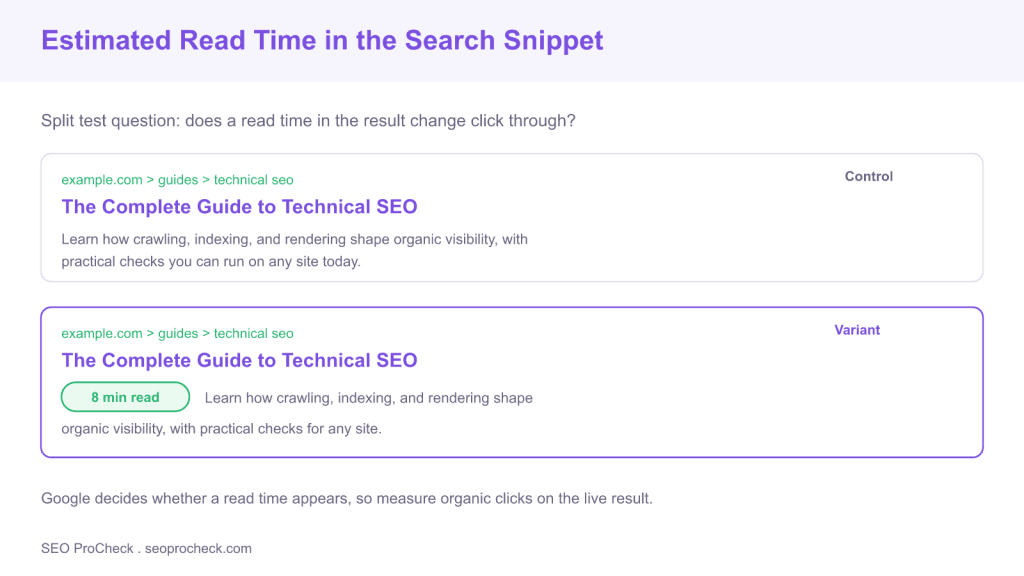
AI Summary
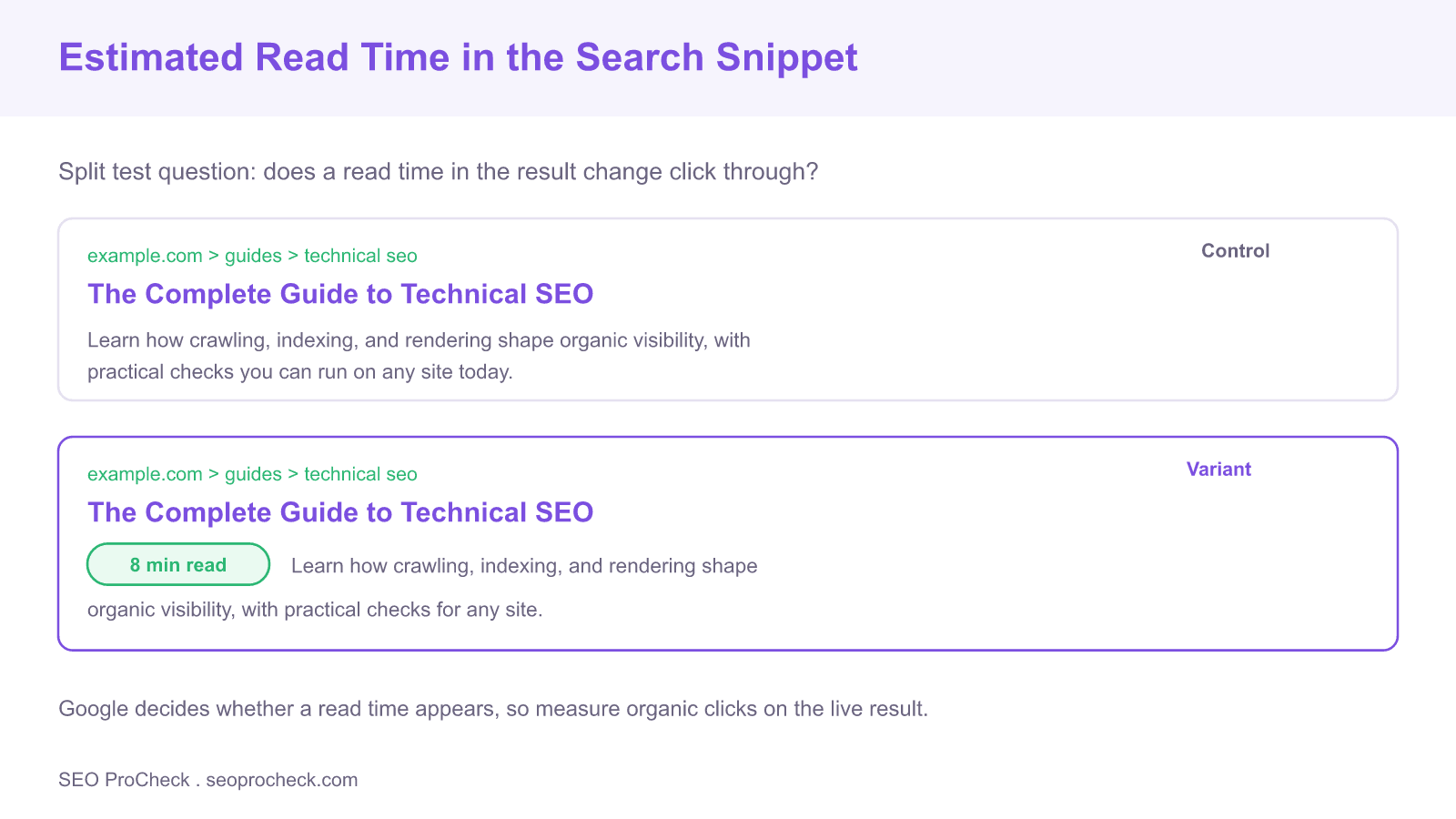
Adding an estimated read time to a page, whether in the visible content or the meta description, can set expectations and make a result feel more inviting, but Google decides whether that text ever appears in the snippet. Because the snippet is only partly in your control, the honest way to judge the effect is a controlled split test that compares organic clicks.
- A read time can signal effort and set expectations before the click.
- Google generates snippets dynamically, so a read time may or may not show.
- Schema has a timeRequired property, but it does not create a snippet feature on its own.
- Prove any change with a split test that measures organic clicks.
This SEO case study documents a successful optimization initiative, providing actionable insights for practitioners. The documented approach demonstrates how strategic SEO implementation drives measurable results.
Initial Situation
Understanding the starting point is essential context for evaluating any case study. This documentation covers the initial challenges, competitive position, and business objectives that shaped the SEO strategy.
Strategy and Approach
The strategic approach combined multiple SEO disciplines to address identified opportunities. Key decisions around prioritization and resource allocation provide a template for similar initiatives.
Implementation
Moving from strategy to execution required specific technical implementations, content development, and process changes. This case study documents the practical steps that translated strategy into action.
Results and Learnings
The outcomes demonstrate effectiveness through measurable improvements in rankings, traffic, and business metrics. Analysis of successes and challenges provides learning value for practitioners.
Case studies like this contribute to the SEO knowledge base, helping practitioners learn from documented real-world experiences.
Source: https://www.searchpilot.com/resources/case-studies/estimated-read-time/
What this experiment tested
The question sits at the boundary of on page content and the search result itself: if a page advertises an estimated read time, does that change organic performance? SearchPilot approached it with a controlled SEO split test, adding a read time to one group of pages and leaving a matched group untouched, then comparing organic clicks over time. The design is important because a read time mostly influences whether people click, and click through is noisy enough that a naive before and after look would not be trustworthy.
The wrinkle unique to this test is that the search snippet is not fully under your control. You can add a read time to the page and hint at it in the meta description, but Google assembles the snippet dynamically and may show your text, rewrite it, or ignore it. So the test measures the combined effect of adding the read time and of Google choosing to surface it, which is exactly the real world outcome a practitioner cares about.
Why a read time can move clicks
A read time is a small promise about effort. For a searcher scanning a page of results, an eight minute read signals a piece that is substantial without being a marathon, which can be reassuring or off putting depending on what they want. On informational queries where people are deciding whether to invest attention, that cue can nudge click through. On quick answer queries it may do the opposite by implying more work than the searcher wants. This is why the effect is genuinely uncertain and worth testing rather than assuming.
How to implement it correctly
Put the read time where it helps a human first, near the title or byline, calculated from word count at a sensible reading speed. Most content management systems can generate it automatically, and popular WordPress plugins add it to the template. If you want to reference it in the snippet, include a short phrase in the meta description, but treat that as a suggestion rather than a guarantee. For machine readability, add the schema.org timeRequired property to the Article, using ISO 8601 duration format, while understanding that Google does not currently convert it into a visible snippet feature.
<script type="application/ld+json">
{
  "@context": "https://schema.org",
  "@type": "Article",
  "headline": "The Complete Guide to Technical SEO",
  "timeRequired": "PT8M"
}
</script>

Visible on page:
<span class="read-time">8 min read</span>
Placement options compared
| Placement | Where it lives | May show in snippet | Main benefit |
|---|---|---|---|
| Visible near the title | On the page for readers | Possible, Google may pull it | Helps real users directly |
| In the meta description | Suggested snippet text | Sometimes, often rewritten | Nudges the displayed snippet |
| timeRequired structured data | JSON LD on the Article | No dedicated feature today | Machine readable context |
| Plugin generated read time | Template wide on the site | Same as visible placement | Consistent, low effort rollout |
What has changed since this test
Google has continued to generate snippets more dynamically, frequently rewriting meta descriptions and choosing snippet text per query, which makes it even less certain that a read time you add will appear as written. At the same time the read time remains a genuinely useful on page element for readers, and there is no downside to displaying it where people can see it. The pragmatic stance is to add the read time for users, mark it up with timeRequired for completeness, keep expectations modest about the snippet, and let a controlled test on organic clicks tell you whether it is worth rolling out across a section.
For related metadata studies see our tests on exact numbers versus approximations in titles and category names in product titles, along with the full metadata case study library.
Frequently asked questions
Does an estimated read time help SEO?
Any effect works through click through rather than ranking. A read time can set expectations and signal that a piece is substantial yet manageable, which may make some searchers more likely to click. It is a snippet and user experience lever, not a direct ranking factor.
Can I make Google show a read time in the search snippet?
Not directly. Google builds the snippet dynamically and chooses whether to include a read time based on what it finds useful for the query. You can add the text to your page and meta description to increase the chance it is used, but you cannot force it to appear.
Where should I put the estimated read time on a page?
The most reliable place is visible on the page near the title or byline, where readers actually benefit from it. You can also reference it in the meta description, but treat the snippet as a suggestion to Google rather than a guarantee.
Is there schema markup for read time?
Schema.org defines a timeRequired property that can be attached to an Article, and it is good practice to include it for machine readability. Be aware that Google does not currently turn timeRequired into a dedicated snippet feature, so it will not by itself place a read time in the result.
Does a read time affect click through or bounce rate?
It can cut both ways. A short read time may attract people who want a quick answer, while a longer one may attract those seeking depth and repel those who do not. Because the effect depends on intent, the outcome is worth measuring rather than assuming.
How do I test whether a read time helps my results?
Run a controlled split test. Add the read time to one group of similar pages, leave a matched group unchanged, and compare organic clicks over several weeks with a model that accounts for seasonality. Judge the result on clicks, since the snippet itself is only partly in your control.
Take this with you
The assistant links open with a question about this page already written. Nothing is sent until you press enter.
Claude Vincent is a technical SEO consultant focused on crawlability, rendering, and AI-search visibility. He writes the field guides and case studies at SEO ProCheck, with a bias toward the durable, unglamorous work that decides whether search engines and AI answer engines can actually read and cite a site.
About SEO ProCheck
Technical SEO consulting and GEO strategy with 20 years of enterprise experience. Case studies, resources, and tools for search and AI visibility.
Work With Me
Technical SEO audits, GEO strategy, site migrations, and international SEO. Hourly consulting for teams who need hands-on support, not just reports.
Subscribe to our newsletter!








Recent Posts
- Most Top Sites Never Say Who They Are in Structured Data October 14, 2026
- Homepage Titles Are Mostly Too Short, Not Too Long October 8, 2026
- Who Actually Serves an llms.txt? 184 Top Sites Measured September 29, 2026