

AI Summary
Adding a category keyword to a product title tag can help when the product name alone does not describe what the item is, because it adds a relevant head term and improves the match on category style queries. The gain is not automatic: a longer title can truncate, Google may rewrite it, and the effect should be proven with a controlled split test that measures organic clicks.
- Category keywords add relevance for products whose names do not describe the item.
- Titles past roughly 60 characters can truncate, so keep the important words first.
- Google rewrites titles often, so judge the change by organic clicks, not the source tag.
- Prove the change at template scale, not on a handful of hero products.
This SEO case study documents a successful optimization initiative, providing actionable insights for practitioners. The documented approach demonstrates how strategic SEO implementation drives measurable results.
Initial Situation
Understanding the starting point is essential context for evaluating any case study. This documentation covers the initial challenges, competitive position, and business objectives that shaped the SEO strategy.
Strategy and Approach
The strategic approach combined multiple SEO disciplines to address identified opportunities. Key decisions around prioritization and resource allocation provide a template for similar initiatives.
Implementation
Moving from strategy to execution required specific technical implementations, content development, and process changes. This case study documents the practical steps that translated strategy into action.
Results and Learnings
The outcomes demonstrate effectiveness through measurable improvements in rankings, traffic, and business metrics. Analysis of successes and challenges provides learning value for practitioners.
Case studies like this contribute to the SEO knowledge base, helping practitioners learn from documented real-world experiences.
What this experiment tested
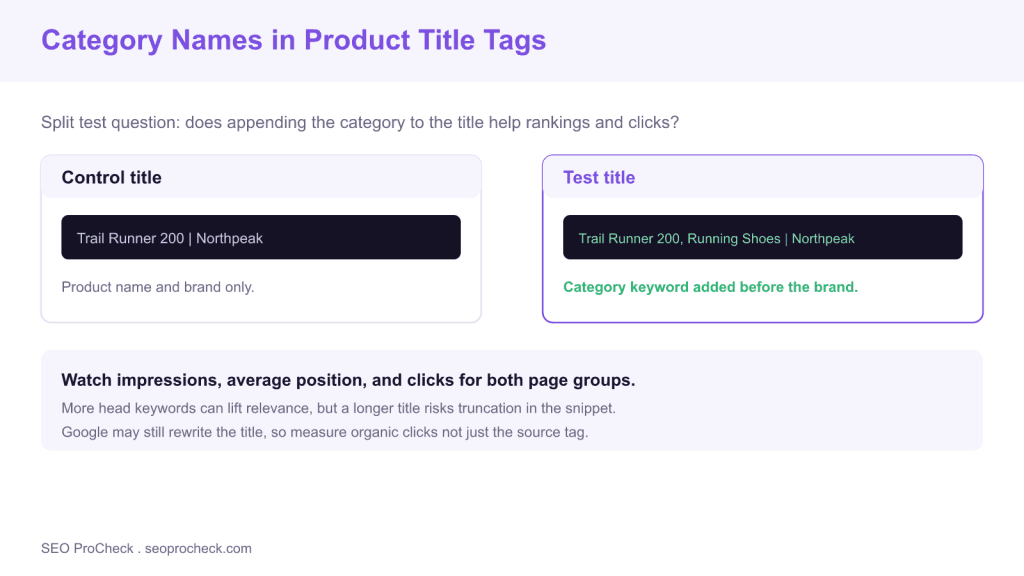
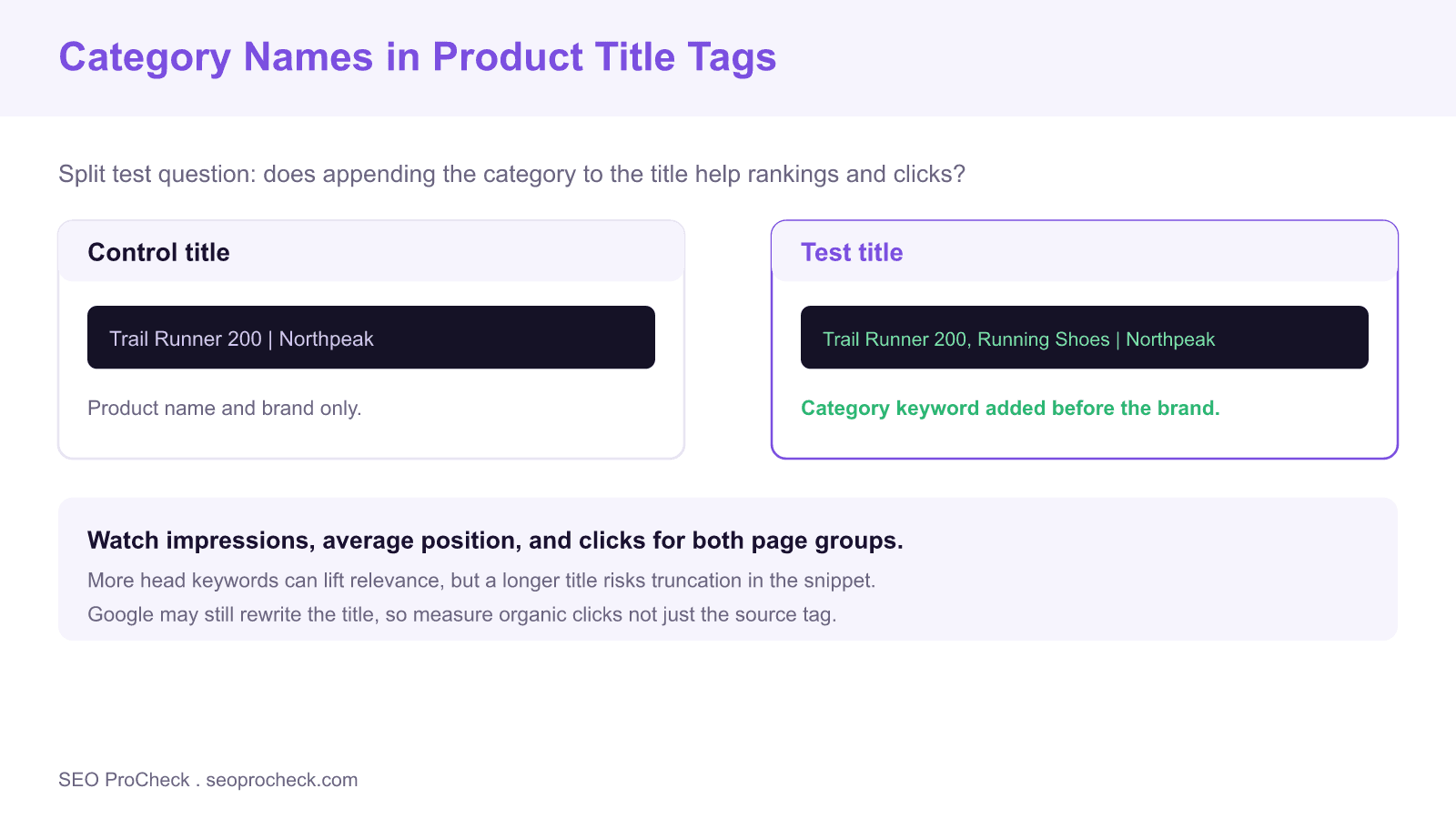
The question is precise: on an ecommerce product page, does inserting the category name into the title tag change organic performance? SearchPilot answered it with a controlled SEO split test, applying the new title pattern to one group of product pages and leaving a matched group untouched, then comparing organic clicks over time. That design matters because a title change on its own rarely moves a single tracked keyword in a clean way, and a naive before and after view would confuse the change with seasonal demand.
In the control group the title tag is the product name and the brand, for example Trail Runner 200 followed by the store name. In the test group the same title gains the category keyword, so it reads as the product name, then running shoes, then the brand. Everything else on the page is held constant, so the measured difference in clicks can be attributed to the extra category term.
Why product names are often too thin
Many product names are model numbers, invented words, or internal codes that tell a search engine nothing about what the item is. A page titled only Trail Runner 200 gives Google little to match against a query like mens trail running shoes. Adding the category term supplies the missing head keyword and the descriptive language that shoppers actually type, which can lift both relevance and the sense that the result answers the query.
The effect is strongest where the gap is largest. A page for a famous product that people search by name gains little from a category word, because the name already carries the intent. A page for an obscure model gains the most, because the category term is doing the descriptive work the name cannot.
Truncation and title rewriting
The trade off is length. Google displays roughly 580 pixels of the title on desktop, about 60 characters, and truncates the rest with an ellipsis. Wide capital letters and long brand names spend that budget quickly. If the category term pushes the meaningful words past the cut, the visible headline can look worse, which can cost clicks even if relevance improves. The rule of thumb is to front load: product name, then category keyword, then brand, so a truncation trims only the least important part.
Google also rewrites titles when it judges the source tag to be a weak match or boilerplate. That is why the source tag and the displayed title can differ, and why the honest scoreboard for this kind of test is organic clicks rather than what you typed into the field.
Where to apply it in your CMS
You rarely edit product titles one by one. In WordPress with Rank Math or Yoast you set a title template for the product post type using variables, for example the product name, then a comma, then the primary category, then the separator and the site name. In Shopify or a headless build the same logic lives in the title template for the product route. Change the template once, let it regenerate across the catalog, and you have applied a consistent pattern that a split test can measure.
Title template (product):
%title%, %primary_category% %sep% %sitename%

Renders as:
Trail Runner 200, Running Shoes | Northpeak
Title patterns compared
| Title pattern | Example | Best for | Main risk |
|---|---|---|---|
| Name and brand | Trail Runner 200 | Northpeak | Recognizable, searched by name | Thin for descriptive queries |
| Name, category, brand | Trail Runner 200, Running Shoes | Northpeak | Obscure names, category demand | Length and truncation |
| Name, attribute, category | Trail Runner 200 Waterproof Running Shoes | Specific long tail intent | Very long, brand may drop |
| Category handled by category page | Running Shoes | Northpeak | Broad category queries | Needs strong category pages |
What has changed since this test
Since 2021 Google rewrites displayed titles far more aggressively than it once did, often pulling from the visible heading or shortening long tags on its own. That raises the value of a clean, front loaded source title and lowers the value of cramming extra terms in, because the engine may simply drop them. At the same time, product results increasingly surface through merchant listings and shopping features where structured data carries the category and attribute signals, so the title tag is one lever among several rather than the only one. The durable takeaway holds: add a category keyword where the product name is descriptively thin, keep the important words first, and confirm the outcome on organic clicks.
For related metadata testing, see our study on exact numbers versus approximations in title tags, the test on an estimated read time in the result, and the full metadata case study library.
Frequently asked questions
Does the title tag still matter for SEO?
Yes. The title tag remains one of the strongest on page signals for relevance, and it heavily shapes click through because it usually becomes the blue headline in the result. Getting the leading words right is high leverage work on any product template.
How long should a product title tag be?
Keep the meaningful part within roughly 60 characters, which is about 580 pixels on desktop. Google measures width in pixels rather than characters, so wide capital letters eat the budget faster. Put the product name and the most valuable keyword first so nothing important is lost if the tag truncates.
Why does Google rewrite my title tags?
Google rewrites a displayed title when the source tag looks repetitive, keyword stuffed, boilerplate across many pages, or a poor match for the query. You influence the displayed title with a clean, descriptive source tag, but you do not fully control it, which is why organic clicks are the honest measure of a change.
Should the brand go first or last in the product title?
In most catalogs the brand goes last so the product and category words lead. Put the brand first only when the brand itself is the primary reason people search, for example a well known label where shoppers query the name directly.
Does adding a category keyword count as keyword stuffing?
Not when the category word accurately describes the product. Stuffing means repeating the same term or piling on unrelated keywords to game relevance. One descriptive category term such as running shoes on a trainers page is normal, helpful language.
How do I test a title tag change without risking traffic?
Run a controlled split test. Divide a large set of similar product pages into a control group and a variant group, apply the new title pattern only to the variant, and compare organic clicks over several weeks with a model that accounts for seasonality. That isolates the title change from everything else moving in search.
Claude Vincent is a technical SEO consultant focused on crawlability, rendering, and AI-search visibility. He writes the field guides and case studies at SEO ProCheck, with a bias toward the durable, unglamorous work that decides whether search engines and AI answer engines can actually read and cite a site.
About SEO ProCheck
Technical SEO consulting and GEO strategy with 20 years of enterprise experience. Case studies, resources, and tools for search and AI visibility.
Work With Me
Technical SEO audits, GEO strategy, site migrations, and international SEO. Hourly consulting for teams who need hands-on support, not just reports.
Subscribe to our newsletter!







Recent Posts
- Can AI Crawlers Actually Read Your Site? I Measured 400 of the Biggest September 5, 2026
- The Pre-Publish Quality Gate for AI-Assisted Content August 6, 2026
- AGENTS.md vs llms.txt vs llms-full.txt: Which Agent File Does What July 18, 2026