

Moz - 5 Secrets: How to Execute Lean SEO to Increase Qualified Leads
- July 19, 2017
- Website Architecture
AI Summary
Lean SEO applies lean startup and agile thinking to search: instead of big multi-month projects, you ship small optimizations, measure whether they move qualified leads, and scale only what works. The emphasis is on business outcomes and eliminating wasted effort, not on chasing raw traffic.
- Prioritize ideas with a simple score like ICE (Impact, Confidence, Ease) and start at the top.
- Test one lever on a subset of pages, then compare against a control or baseline.
- Optimize for qualified leads and conversions, not vanity traffic.
- Kill losing experiments fast and roll winners into a repeatable playbook.
Lean SEO is the practice of running search optimization the way a lean startup runs product: in small, measured iterations that eliminate waste and prove their value before you invest more. Rather than launching a giant six-month project and hoping the traffic follows, you form a hypothesis, test one change on a slice of pages, measure whether it actually moved qualified leads, and then scale the winners while killing the losers. The MozCon talk this page summarizes frames it as five secrets; the sections below translate that idea into a working method any team can run.
This SEO case study documents a successful optimization initiative, providing actionable insights for practitioners. The documented approach demonstrates how strategic SEO implementation drives measurable results.
What lean SEO means
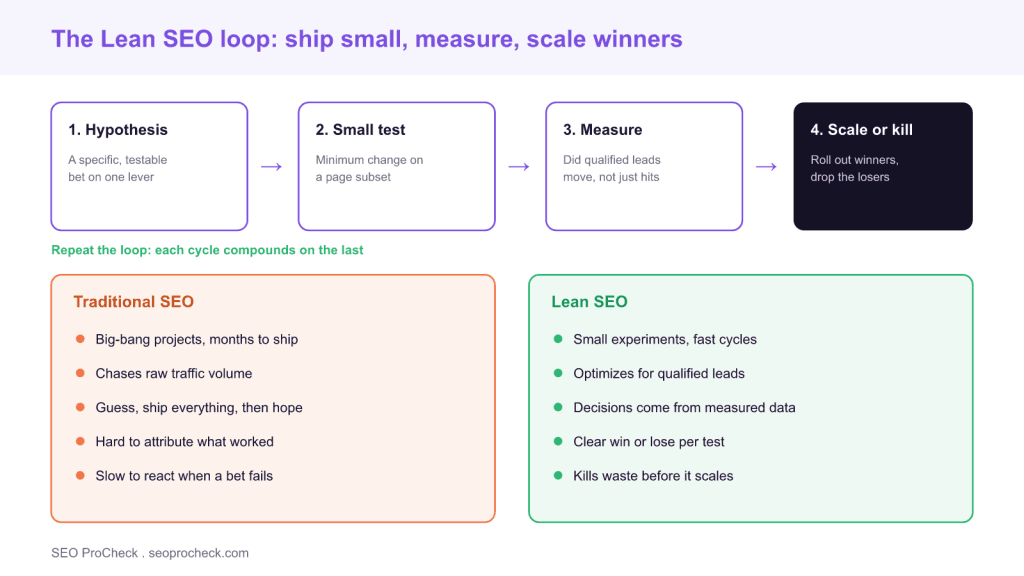
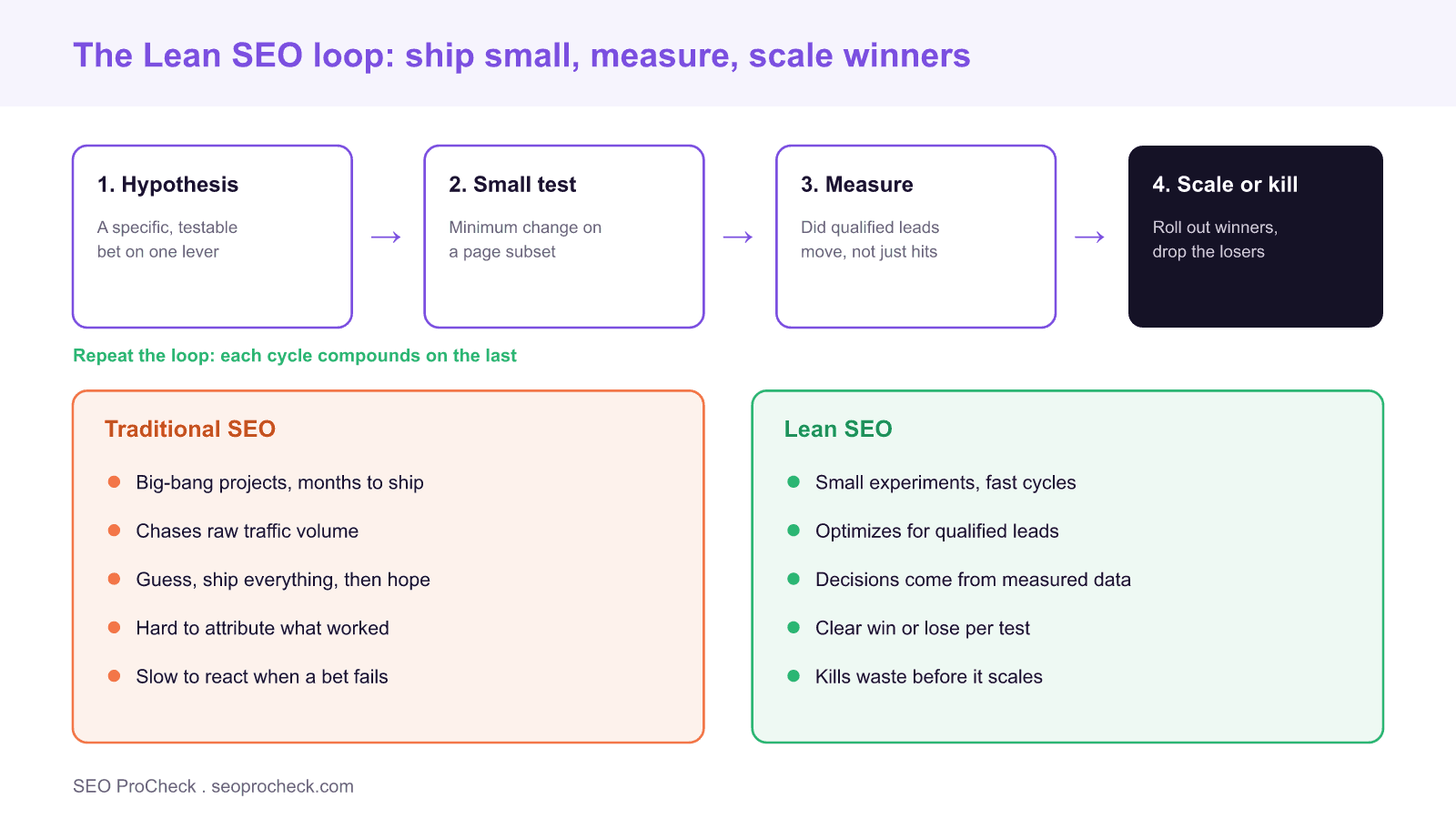
Lean SEO is not a different set of tactics; it is a different operating system for the same tactics. It borrows three ideas from lean and agile practice: minimize wasted effort, work in small validated increments, and optimize for the outcome that matters to the business. In SEO that outcome is rarely raw sessions. It is qualified leads: the visitors who match your buyer and are likely to convert. The contrast below is the whole philosophy in one view.
| Dimension | Traditional SEO | Lean SEO |
|---|---|---|
| Unit of work | Large multi-month projects | Small, fast experiments |
| Primary metric | Raw traffic volume | Qualified leads and conversions |
| Decision basis | Best-practice checklists and opinion | Measured results versus a control |
| Reaction to failure | Slow; sunk cost keeps it alive | Kill it early, learn, move on |
| Best fit | Large budgets and teams | Any team, especially small ones |
Initial Situation
Understanding the starting point is essential context for evaluating any case study. This documentation covers the initial challenges, competitive position, and business objectives that shaped the SEO strategy.
The lean starting point is an honest look at where your current effort goes and what it returns. Map your recent SEO work against results: how many hours went into large projects, and did those projects move leads or just impressions? Most teams find a long tail of half-finished big bets and very little measured evidence that any single change worked. That waste is the raw material lean SEO recycles. Pair this review with the technical fundamentals, because a fast, crawlable, indexable site is the platform every experiment runs on.
Strategy and Approach
The strategic approach combined multiple SEO disciplines to address identified opportunities. Key decisions around prioritization and resource allocation provide a template for similar initiatives.
The strategy is the loop shown in the diagram above: hypothesis, small test, measure, then scale or kill, repeated so each cycle compounds on the last. The engine that makes the loop efficient is prioritization. Before running anything, score your backlog with a simple model like ICE, which rates each idea on Impact, Confidence, and Ease, then work from the top down. Scoring stops the team from pouring months into a high-impact but low-confidence rebuild when three quick, high-confidence wins would move the metric sooner.
| Idea | Impact (1-10) | Confidence (1-10) | Ease (1-10) | ICE score |
|---|---|---|---|---|
| Rewrite title tags on top 20 money pages | 8 | 7 | 9 | 8.0 |
| Add FAQ schema to service pages | 6 | 7 | 8 | 7.0 |
| Full site information-architecture rebuild | 9 | 4 | 2 | 5.0 |
Implementation
Moving from strategy to execution required specific technical implementations, content development, and process changes. This case study documents the practical steps that translated strategy into action.
Execution means turning the top-scored idea into a real experiment. Change one lever, such as title wording or on-page copy, on a defined set of similar pages, and hold the rest constant so the result is attributable. Where you have enough comparable pages, run a proper split test rather than a before-and-after guess: this is exactly how documented studies such as replacing "price" with "cost" in the title or testing commercial versus emotional titles isolate the effect of a single change. Target intent-matched keywords so the traffic you win is the traffic that converts, and instrument the funnel so you can see leads, not just rankings.
Results and Learnings
The outcomes demonstrate effectiveness through measurable improvements in rankings, traffic, and business metrics. Analysis of successes and challenges provides learning value for practitioners.
In lean SEO the result of every experiment is knowledge, whether it wins or loses. Judge each test against the metric you defined up front: did qualified leads or conversions move, over a fair window, versus the control or baseline? Winners get scaled across the rest of the site and documented as a repeatable play; losers get retired quickly before they consume more time. Over several cycles the compounding effect, not any single test, is where the growth comes from. The MozCon session at the source below shares the specific outcomes its author measured, which reflect that team's site and market rather than a guaranteed result for yours.
Case studies like this contribute to the SEO knowledge base, helping practitioners learn from documented real-world experiences.
FAQ
Lean SEO applies lean startup and agile principles to search work. Instead of big multi-month projects, you ship small optimizations, measure whether they move a business metric, and scale only what works. The goal is to eliminate wasted effort and prioritize qualified leads over raw traffic.
Traditional SEO often runs large projects over months and measures success in traffic volume. Lean SEO runs small, fast experiments, measures the outcome against a control or baseline, and rolls out only the changes that prove themselves. It reacts faster and wastes less on ideas that do not work.
Qualified leads are visitors who match your buyer profile and are likely to convert, not just anyone who lands on the page. Lean SEO targets intent-matched keywords and conversion-focused pages rather than high-volume head terms that bring large but untargeted traffic.
Use a simple scoring model such as ICE (Impact, Confidence, Ease) or PIE (Potential, Importance, Ease) to rank ideas, then start with the highest score. Scoring forces you to concentrate limited time on the changes most likely to move the target metric.
Yes. Lean is especially well suited to small teams because it avoids large upfront bets and focuses scarce resources on validated wins. Each cycle is cheap, so a losing experiment costs little and a winning one becomes a repeatable play.
Define the metric before you start, whether that is leads, conversions, or rankings for a target intent. Change one lever on a defined set of pages and compare against a control group or the pre-change baseline over a fair time window, so the result is attributable to the change.
Source: https://moz.com/learn/seo/five-secrets-mozcon-2017
Spending months on SEO with little to show for it?
A lean audit finds the few high-confidence changes most likely to move qualified leads, so you stop pouring effort into bets that never pay off.
Claude Vincent is a technical SEO consultant focused on crawlability, rendering, and AI-search visibility. He writes the field guides and case studies at SEO ProCheck, with a bias toward the durable, unglamorous work that decides whether search engines and AI answer engines can actually read and cite a site.
About SEO ProCheck
Technical SEO consulting and GEO strategy with 20 years of enterprise experience. Case studies, resources, and tools for search and AI visibility.
Work With Me
Technical SEO audits, GEO strategy, site migrations, and international SEO. Hourly consulting for teams who need hands-on support, not just reports.
Subscribe to our newsletter!







Recent Posts
- Can AI Crawlers Actually Read Your Site? I Measured 400 of the Biggest September 5, 2026
- The Pre-Publish Quality Gate for AI-Assisted Content August 6, 2026
- AGENTS.md vs llms.txt vs llms-full.txt: Which Agent File Does What July 18, 2026