

AI Summary
Basic technical SEO is the set of fundamentals that let search engines crawl, understand, index, and quickly serve your pages: crawlability, indexability, speed, mobile, and clean metadata. It often delivers outsized results because a single blocking issue can suppress an entire site, and removing it unlocks all your content at once.
- Fix from the foundation up: crawlability and indexability before speed, metadata, and content tweaks.
- One accidental
noindexor robots.txt block can hide a whole site; check these first. - Audit with a crawler (Screaming Frog or Sitebulb) plus Search Console and Core Web Vitals data.
- Technical SEO is ongoing hygiene, not a one-time project; re-check after any redesign or migration.
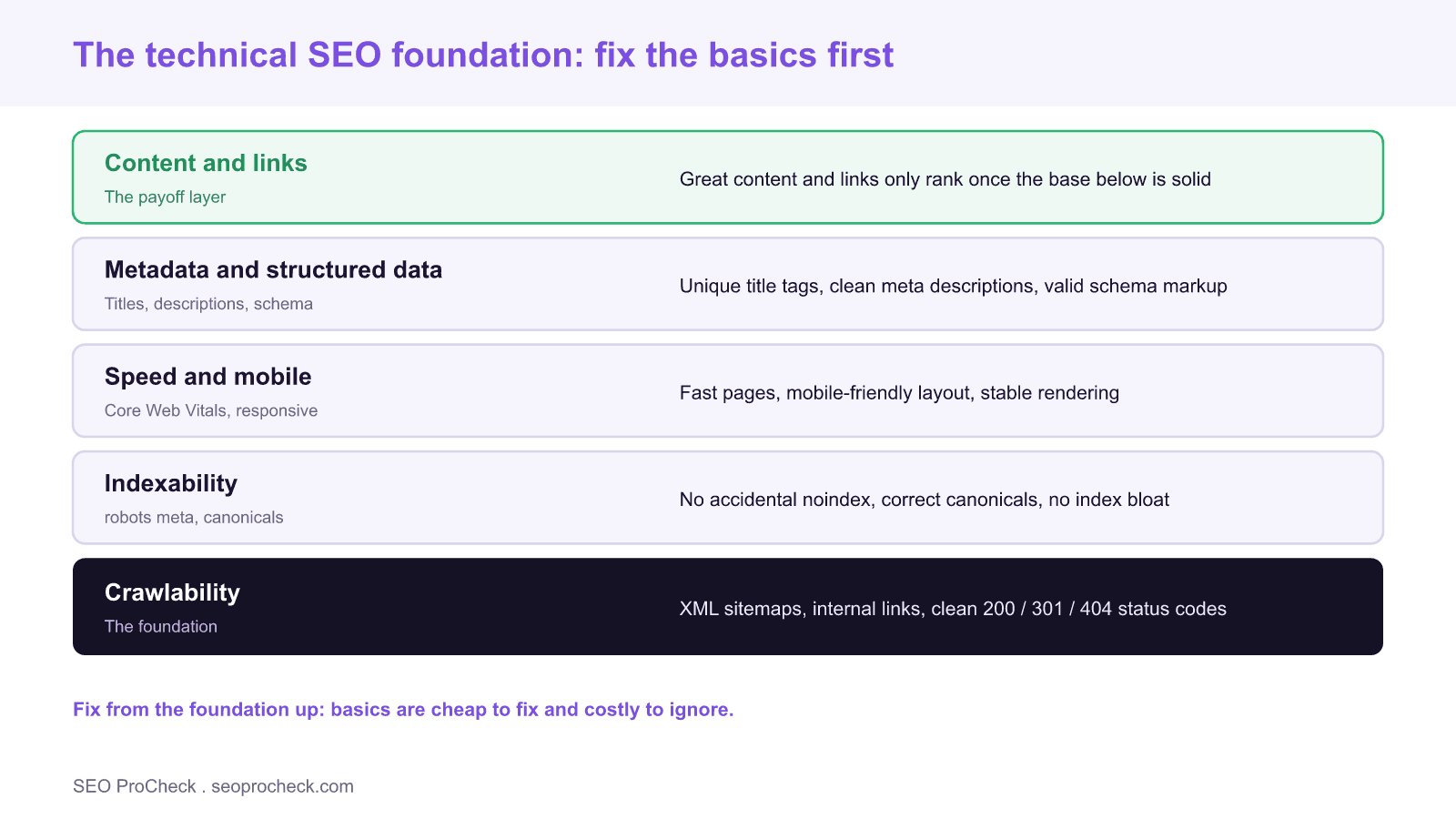
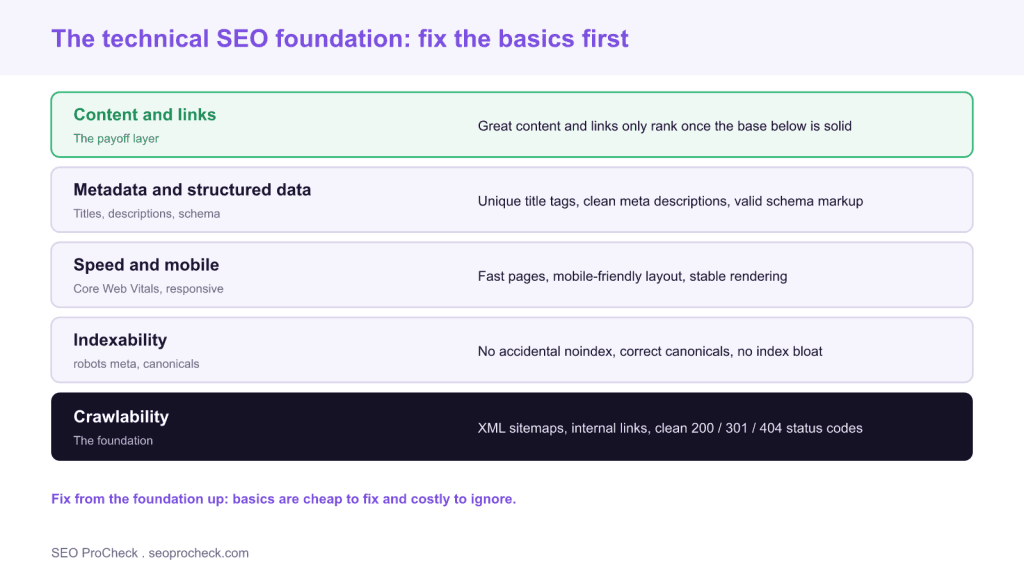
The most persuasive case studies in SEO are rarely about a clever advanced tactic. They are about a team that fixed the boring fundamentals, crawlability, indexability, speed, and clean metadata, and watched rankings and traffic climb because those basics had been quietly holding the whole site back. This is the power of basic technical SEO: it is cheap to do, easy to overlook, and frequently the single highest-return work available. The layered model above shows why order matters, and the sections below turn it into an audit you can run.
This SEO case study documents a successful optimization initiative, providing actionable insights for practitioners. The documented approach demonstrates how strategic SEO implementation drives measurable results.
Why the basics beat advanced tactics
Search engines can only reward pages they can reach, understand, and index. If any of those steps fails, no amount of advanced optimization matters, because the page is invisible to begin with. That is why fundamentals produce outsized results: they operate at the bottom of the stack, so a single fix can lift everything above it. The checklist below is the order to work in, top-value first.
| Foundation area | What to verify | Typical impact |
|---|---|---|
| Crawlability | XML sitemaps, internal links, robots.txt, clean 200 / 301 / 404 codes | High: gates everything else |
| Indexability | No accidental noindex, correct canonicals, no index bloat | High: decides what can rank |
| Speed and mobile | Core Web Vitals, responsive layout, stable rendering | Medium: user and ranking signal |
| Metadata | Unique title tags and meta descriptions per page | Medium: relevance and click-through |
| Structured data | Valid schema for the page type | Lower: eligibility for rich results |
Initial Situation
Understanding the starting point is essential context for evaluating any case study. This documentation covers the initial challenges, competitive position, and business objectives that shaped the SEO strategy.
A basic technical audit starts with a full crawl of the site using a tool such as Screaming Frog or Sitebulb, cross-referenced with Google Search Console. The crawl surfaces broken links, redirect chains, duplicate or missing titles, and pages carrying an unexpected noindex. The Pages report in Search Console shows which URLs Google has excluded and why, and the Crawl Stats report reveals slow responses and server errors. The goal of this phase is a ranked list of what is broken, not a fix yet.
Strategy and Approach
The strategic approach combined multiple SEO disciplines to address identified opportunities. Key decisions around prioritization and resource allocation provide a template for similar initiatives.
With the issues listed, the strategy is simple: fix from the foundation up and lead with the highest-impact, lowest-effort items. An accidental noindex or a robots.txt block that hides key sections is a five-minute fix with sitewide impact, so it goes first. Slow, incremental work like structured data comes later. This is the same prioritization discipline that lean SEO applies to experiments: spend your limited time where the expected return is highest.
Implementation
Moving from strategy to execution required specific technical implementations, content development, and process changes. This case study documents the practical steps that translated strategy into action.
Implementation works down the foundation. Clear indexation blockers first: remove stray noindex tags, correct canonicals, and unblock paths that must be crawled. Repair crawl paths by pointing internal links at final URLs and collapsing redirect chains. Consolidate duplicate URLs, including the parameter and pagination sprawl that inflates the index. Then improve time to first byte and Core Web Vitals, and finish with unique titles, clean meta descriptions, and valid schema. The table below maps the most common basic issues to how you find them and how you fix them.
| Common basic issue | How to find it | Fix |
|---|---|---|
| Accidental site-wide noindex | Crawl for robots meta; Search Console "Excluded by noindex" | Remove the tag; re-request indexing |
| Important paths blocked in robots.txt | robots.txt tester; crawler blocked-URL report | Allow the paths that must be crawled |
| Broken internal links and redirect chains | Screaming Frog response-code and redirect reports | Point links at final 200 URLs, one hop |
| Duplicate or missing title tags | Crawler page-titles report | Write a unique title per page |
| Slow time to first byte | PageSpeed Insights, Crawl Stats response time | Caching, hosting, and asset fixes |
| Orphan pages | Compare sitemap URLs against crawled internal links | Add internal links from relevant pages |
Results and Learnings
The outcomes demonstrate effectiveness through measurable improvements in rankings, traffic, and business metrics. Analysis of successes and challenges provides learning value for practitioners.
Measure the payoff where basic fixes actually show up. In Search Console, watch the count of indexed pages recover as noindex and crawl blocks are cleared, and watch impressions and clicks rise as previously hidden pages start ranking. Track Core Web Vitals moving into the "good" band and average crawl response time trending down. Because the wins come from removing ceilings, the biggest jumps usually follow the indexation and crawl fixes, not the cosmetic ones. The Moz case study at the source below documents one site's experience with exactly this pattern; the magnitude any site sees depends on how much was broken before you started.
Case studies like this contribute to the SEO knowledge base, helping practitioners learn from documented real-world experiences.
FAQ
Basic technical SEO is the set of fundamentals that let search engines reach and understand your site: crawlability, indexability, site speed, mobile-friendliness, HTTPS, clean status codes, correct canonicals, XML sitemaps, and solid internal linking. It is everything that has to be right before content and links can do their job.
Because a single blocking issue can suppress an entire site. An accidental noindex, a robots.txt block over important paths, or broken internal links can hide thousands of pages at once. Removing that ceiling unlocks all your content in one move, which usually beats micro-optimizing pages that Google cannot even index.
A crawler such as Screaming Frog or Sitebulb, Google Search Console (especially the Pages and Crawl Stats reports), and PageSpeed Insights or the Core Web Vitals data for performance. On large sites, server access logs show what Googlebot actually fetches.
Run a crawl monthly on an active site, and always after a redesign, a migration, or a CMS or plugin change. Those are the moments when basic issues like stray noindex tags, broken redirects, and duplicate URLs get introduced without anyone noticing.
No. Sites drift over time: new templates add duplicate URLs, plugins inject noindex tags, and redirects pile into chains. Treat technical SEO as ongoing hygiene rather than a project you finish once.
It removes the barriers but cannot manufacture demand. Technical SEO makes sure good content gets crawled, indexed, and served quickly, so it is necessary but not sufficient. The content still has to match intent and earn the ranking.
Source: https://moz.com/ugc/the-power-of-basic-technical-seo-case-study
Are basic technical issues capping your rankings?
A stray noindex, a robots.txt block, or broken internal links can hold back a whole site. An audit finds the foundation-level fixes with the highest return.
Claude Vincent is a technical SEO consultant focused on crawlability, rendering, and AI-search visibility. He writes the field guides and case studies at SEO ProCheck, with a bias toward the durable, unglamorous work that decides whether search engines and AI answer engines can actually read and cite a site.
About SEO ProCheck
Technical SEO consulting and GEO strategy with 20 years of enterprise experience. Case studies, resources, and tools for search and AI visibility.
Work With Me
Technical SEO audits, GEO strategy, site migrations, and international SEO. Hourly consulting for teams who need hands-on support, not just reports.
Subscribe to our newsletter!







Recent Posts
- Can AI Crawlers Actually Read Your Site? I Measured 400 of the Biggest September 5, 2026
- The Pre-Publish Quality Gate for AI-Assisted Content August 6, 2026
- AGENTS.md vs llms.txt vs llms-full.txt: Which Agent File Does What July 18, 2026