• Articles
    &Evergreen
    • Articles
      • Algorithm Updates
      • Analytics & Measurement
      • CMS and Platforms
      • Content Strategy
      • E-commerce SEO
      • General
      • Industry Guides
      • Keyword Research
      • Link Building
      • Local SEO
      • Mobile SEO
      • On-Page SEO
      • SEO Tools
    • Evergreen
      • AI and Search
        • AEO (Answer Engine Optimization)
        • AI Overviews and SGE
        • GEO (Generative Engine Optimization)
        • LLM Citation Optimization
      • Content SEO
        • Content Architecture
        • E-E-A-T Optimization
        • Internal Linking Strategy
      • Python and Automation
      • Technical SEO
        • Core Web Vitals and Performance
        • Crawlability and Indexation
        • International SEO and Hreflang
        • Log File Analysis
        • Schema and Structured Data
        • Site Architecture
        • Site Migrations
  • Case Studies
    & Researches
    • Case Studies
      • Content
      • Crawling and Indexing
      • Growth
      • International SEO
      • JavaScript SEO
      • Metadata
      • Migrations
      • Website Architecture
      • Web Performance
    • Research
      • AI Search
      • Cross-Industry
      • E-commerce
      • Enterprise
      • Local and Listings
      • Publisher
  • Free Tools
    & Resources
    • Free SEO Tools
      • Content Analysis
      • Developer Utilities
      • GEO & AI Visibility
      • Local SEO
      • Schema & Structured Data
      • Social & Meta
      • Technical SEO
    • Executive Briefings
      • What SEO Actually Is
      • Why SEO Takes Time
      • Technical vs Content SEO
      • What AI Search Changes
      • Is Your SEO Working?
      • Case Studies
      • Is It Worth It?
      • Hiring an Agency
      • SEO vs Paid
      • Resourcing SEO
    • Best Practices
      • Accessibility
      • AMP
      • Content & GEO
      • Duplicates
      • HTML Structure
      • hrefLang
      • Images
      • Indexation
      • Links
      • Mobile
      • On-Page SEO
      • Organic & Analytics
      • Performance
      • Redirections
      • Robots.txt
      • Security
      • Structured Data
      • Technical GEO
      • URLs
      • XML Sitemaps
    • FAQ
      • AI & Search FAQ
      • Technical SEO FAQ
      • Content SEO FAQ
      • Off-Page SEO FAQ
      • Local SEO FAQ
      • E-commerce SEO FAQ
      • Tools and Analytics FAQ
    • Glossary
      • Glossary | Algorithms
      • Glossary | Analytics
      • Glossary | Business
      • Glossary | Content SEO
      • Glossary | E-commerce
      • Glossary | Emerging
      • Glossary | GEO & AI SEO
      • Glossary | International SEO
      • Glossary | Link Building
      • Glossary | Local SEO
      • Glossary | Search Behavior
      • Glossary | Technical SEO
      • Glossary | Tools
  • Free Tools Hub
  • About
    Me
    • Consulting
      • Advanced SEO Audit
      • GEO & AI SEO
      • Performance & Indexation
      • Site Migrations
      • International SEO
    • Portfolio
    • Contact
    • Tools & Resources
    • Browser Extensions
  • Articles
    &Evergreen
    • Articles
      • Algorithm Updates
      • Analytics & Measurement
      • CMS and Platforms
      • Content Strategy
      • E-commerce SEO
      • General
      • Industry Guides
      • Keyword Research
      • Link Building
      • Local SEO
      • Mobile SEO
      • On-Page SEO
      • SEO Tools
    • Evergreen
      • AI and Search
        • AEO (Answer Engine Optimization)
        • AI Overviews and SGE
        • GEO (Generative Engine Optimization)
        • LLM Citation Optimization
      • Content SEO
        • Content Architecture
        • E-E-A-T Optimization
        • Internal Linking Strategy
      • Python and Automation
      • Technical SEO
        • Core Web Vitals and Performance
        • Crawlability and Indexation
        • International SEO and Hreflang
        • Log File Analysis
        • Schema and Structured Data
        • Site Architecture
        • Site Migrations
  • Case Studies
    & Researches
    • Case Studies
      • Content
      • Crawling and Indexing
      • Growth
      • International SEO
      • JavaScript SEO
      • Metadata
      • Migrations
      • Website Architecture
      • Web Performance
    • Research
      • AI Search
      • Cross-Industry
      • E-commerce
      • Enterprise
      • Local and Listings
      • Publisher
  • Free Tools
    & Resources
    • Free SEO Tools
      • Content Analysis
      • Developer Utilities
      • GEO & AI Visibility
      • Local SEO
      • Schema & Structured Data
      • Social & Meta
      • Technical SEO
    • Executive Briefings
      • What SEO Actually Is
      • Why SEO Takes Time
      • Technical vs Content SEO
      • What AI Search Changes
      • Is Your SEO Working?
      • Case Studies
      • Is It Worth It?
      • Hiring an Agency
      • SEO vs Paid
      • Resourcing SEO
    • Best Practices
      • Accessibility
      • AMP
      • Content & GEO
      • Duplicates
      • HTML Structure
      • hrefLang
      • Images
      • Indexation
      • Links
      • Mobile
      • On-Page SEO
      • Organic & Analytics
      • Performance
      • Redirections
      • Robots.txt
      • Security
      • Structured Data
      • Technical GEO
      • URLs
      • XML Sitemaps
    • FAQ
      • AI & Search FAQ
      • Technical SEO FAQ
      • Content SEO FAQ
      • Off-Page SEO FAQ
      • Local SEO FAQ
      • E-commerce SEO FAQ
      • Tools and Analytics FAQ
    • Glossary
      • Glossary | Algorithms
      • Glossary | Analytics
      • Glossary | Business
      • Glossary | Content SEO
      • Glossary | E-commerce
      • Glossary | Emerging
      • Glossary | GEO & AI SEO
      • Glossary | International SEO
      • Glossary | Link Building
      • Glossary | Local SEO
      • Glossary | Search Behavior
      • Glossary | Technical SEO
      • Glossary | Tools
  • Free Tools Hub
  • About
    Me
    • Consulting
      • Advanced SEO Audit
      • GEO & AI SEO
      • Performance & Indexation
      • Site Migrations
      • International SEO
    • Portfolio
    • Contact
    • Tools & Resources
    • Browser Extensions
consulting services
Home / Metadata / "Can replacing the word ""Price"" with ""Cost"" in the title tag improve organic traffic?"

"Can replacing the word ""Price"" with ""Cost"" in the title tag improve organic traffic?"

  • April 6, 2023
  • Metadata
No Comments
"can replacing the word ""price"" with ""cost"" in the title tag improve organic traffic? "

AI Summary

Whether swapping "price" for "cost" in a title tag lifts organic traffic depends on your audience and page type, so the reliable answer is to run an SEO A/B test rather than guess. A split test compares a matched control group of pages against a variant group with the one word changed, then a causal model measures the real effect.

  • SEO A/B tests split pages, not users, because you cannot serve Googlebot two versions of one URL.
  • The two words differ in meaning: "price" is the sticker number, "cost" can imply total outlay or value.
  • You need enough similar templated pages and traffic to detect an effect above noise.
  • Results rarely generalize across sites, so the documented outcome is one site's result, not a rule.
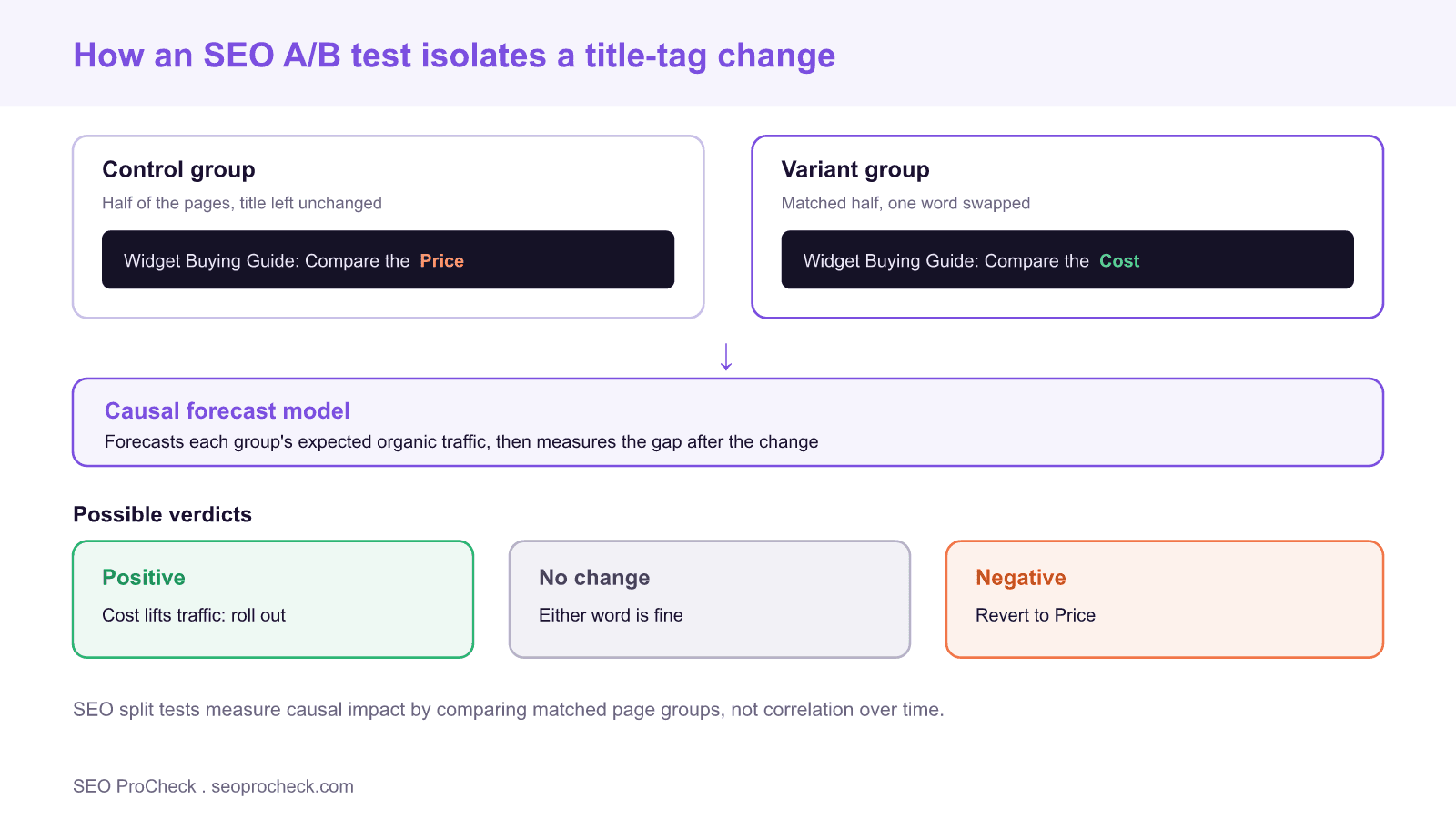
Diagram of an seo a/b test where a control group of pages keeps the word price in the title tag and a matched variant group swaps it for cost, feeding a causal forecast model that returns a positive, no change, or negative verdict.
An SEO split test swaps one title word across a matched group of pages, then a causal model measures whether Cost moved organic traffic versus Price.

Can one word in a title tag change how much organic traffic a page earns? It is a fair question, because the title tag is one of the strongest on-page relevance and click-through signals you control. Swapping "price" for "cost" sounds trivial, yet the two words carry different meaning and match different searches. The only honest way to answer it is not to argue about the words but to run a controlled SEO A/B test, which is exactly what the SearchPilot case study this page summarizes did. The diagram above shows how that kind of test is structured.

This SEO case study documents a successful optimization initiative, providing actionable insights for practitioners. The documented approach demonstrates how strategic SEO implementation drives measurable results.

Why a single title-tag word can move traffic

The title tag does two jobs at once: it helps search engines understand what a page is about, and it is the headline searchers read before deciding to click. A word that better matches the language of the query can nudge both. "Price" and "cost" are near-synonyms in casual speech, but they are not identical in search: they have different volumes, and they hint at slightly different intent. The table below sketches how each word tends to land.

WordWhat it signalsWhere it may fit best
PriceThe sticker number, a direct transactional cueProduct and comparison pages where shoppers scan for the figure
CostTotal outlay or value, often a broader considerationServices, calculators, and "how much does X cost" queries
Search languageThe two words have different query volumes and intentMatch the word your audience actually types

None of this tells you which word wins for your pages, because that depends on your specific audience. It only tells you the change is plausible enough to be worth testing rather than dismissing.

Initial Situation

Understanding the starting point is essential context for evaluating any case study. This documentation covers the initial challenges, competitive position, and business objectives that shaped the SEO strategy.

The starting point for a test like this is a clear, testable hypothesis: "changing the title word from price to cost will increase organic traffic to these pages." Before running it, confirm the preconditions. Do you have a large enough set of similar, templated pages to split into two groups? Do those pages carry enough organic traffic for an effect to show above the noise? Which word do your competitors and your own search query data suggest users prefer? Framing the bet this precisely is the same discipline that lean SEO applies to every experiment.

Strategy and Approach

The strategic approach combined multiple SEO disciplines to address identified opportunities. Key decisions around prioritization and resource allocation provide a template for similar initiatives.

The strategy is a page-level SEO A/B test, which is fundamentally different from a conversion test. You cannot show Googlebot two versions of one URL, so instead of splitting users you split pages: a control group keeps the original title, and a statistically matched variant group gets the single-word change. A forecasting model predicts what each group's organic traffic would have been without any change, then measures the gap once the variant goes live. That gap, with its confidence interval, is the causal effect. The result comes back as positive, negative, or no detectable change, as shown in the verdict row of the diagram.

Implementation

Moving from strategy to execution required specific technical implementations, content development, and process changes. This case study documents the practical steps that translated strategy into action.

Implementation means building the test cleanly so the answer is trustworthy. Split the page set into comparable control and variant groups, change only the one word in the variant titles, and leave everything else on the page untouched. Let it run long enough to reach confidence, typically several weeks, so weekly patterns and short-term noise average out. If you do not have a dedicated split-testing platform, you can approximate the method with a matched control group and Search Console baselines. The requirements below are what separate a real test from a misleading before-and-after.

Test requirementWhy it matters
Enough similar pagesYou need comparable control and variant groups, so templated pages are ideal
Sufficient trafficThe effect has to be large enough to detect above normal fluctuation
One variable changedOnly the single word changes, so the result is attributable
Adequate run timeUsually several weeks, to reach confidence and cover weekly cycles
A forecast or control baselineSeparates the change from seasonality and overall trend

Results and Learnings

The outcomes demonstrate effectiveness through measurable improvements in rankings, traffic, and business metrics. Analysis of successes and challenges provides learning value for practitioners.

Read the outcome against the three possible verdicts. A positive result means the new word lifted organic traffic beyond the confidence interval, so you roll it out. A null result means the change made no detectable difference, so either word is fine and you move on to a higher-impact test. A negative result means revert. Crucially, whatever this one test found applies to the tested pages and audience, not to every site, because search language varies by market and page type. Read the measured figures in the SearchPilot case study at the source below as that site's result. For the related question of how the framing of a title, not just one word, changes performance, see the companion study on commercial versus functional versus emotional titles, and remember that a reliable test still rests on the usual technical fundamentals.

Case studies like this contribute to the SEO knowledge base, helping practitioners learn from documented real-world experiences.

FAQ

Does changing "price" to "cost" in a title always increase organic traffic?

No. The effect depends on how your audience phrases searches and on the page type, and results do not generalize across sites. That is exactly why you run a controlled test rather than assume. The documented SearchPilot case study at the source shows one site's measured outcome, not a universal rule.

What is an SEO A/B test?

It is a test that splits a group of similar pages into a control set and a variant set, applies one change to the variant, and uses a forecasting model to measure the causal impact on organic traffic. Unlike a conversion test, it operates at the page level rather than the individual user level.

How is SEO A/B testing different from conversion-rate testing?

Conversion tests split users on a single page and measure conversions. SEO tests split pages, not users, because you cannot show Googlebot two versions of the same URL. You compare matched groups of pages over time against a forecast, which isolates the change from seasonality and trend.

How many pages do I need to run an SEO split test?

You need enough comparable, templated pages to form a control group and a variant group with sufficient combined organic traffic to detect an effect above normal fluctuation. In practice that usually means hundreds of pages on an e-commerce or listing template, not a handful of unique pages.

Why can a single word in the title tag matter at all?

The title tag is a primary relevance and click-through signal. A word that better matches how searchers actually phrase their queries can improve both how the page is understood and how often people click it in the results, and small click-through gains across many pages add up.

Can I test title tags without a platform like SearchPilot?

You can approximate it by changing titles on a defined group of pages and comparing their organic performance against a matched control group and their own baseline in Search Console. Dedicated split-testing platforms do more, modeling seasonality and reporting statistical confidence, but the core idea is reproducible by hand.

Source: https://www.searchpilot.com/resources/case-studies/replacing-price-with-cost-in-title/

Guessing at title tags instead of testing them?

Title wording can move organic clicks across thousands of pages. An audit shows where a controlled title test is worth running on your templates.

Request an Advanced SEO Audit

  • Claude Vincent

Claude Vincent is a technical SEO consultant focused on crawlability, rendering, and AI-search visibility. He writes the field guides and case studies at SEO ProCheck, with a bias toward the durable, unglamorous work that decides whether search engines and AI answer engines can actually read and cite a site.

  • E-commerce, Title Tags

About SEO ProCheck

Technical SEO consulting and GEO strategy with 20 years of enterprise experience. Case studies, resources, and tools for search and AI visibility.

Learn more about me

Work With Me

Technical SEO audits, GEO strategy, site migrations, and international SEO. Hourly consulting for teams who need hands-on support, not just reports.

Contact now

Subscribe to our newsletter!

More from our blog


Diagram of the agent-readable file stack showing AGENTS.md in the code repository read by coding agents, llms.txt and llms-full.txt at the website root read by answer engines, and robots.txt plus RSL as the access and licensing layer beneath both.

AGENTS.md vs llms.txt vs llms-full.txt: Which Agent File Does What

AGENTS.md, llms.txt and llms-full.txt look alike but serve different readers. What each…
Continue reading

Profound vs Semrush and Ahrefs: What an AI-Search Tool Actually Replaces (and What It Doesn't)

Profound vs Semrush and Ahrefs don't measure the same thing. A practitioner's…
Continue reading
SEO is the foundation everything is built on; AEO (be the answer) and GEO (get cited) are what it makes possible

SEO vs AEO vs GEO: What Each One Means and How They Actually Differ

SEO, AEO, and GEO are three different jobs: rank in search results,…
Continue reading
Google May 2026 Core Update: What We Learned After the Dust Settled

Google May 2026 Core Update: What We Learned After the Dust Settled

The May 2026 Core Update rolled out from May 21 to June…
Continue reading
Pogosticking: The Click Pattern That Quietly Decides Who Ranks

Pogosticking: The Click Pattern That Quietly Decides Who Ranks

Pogosticking is when a searcher clicks your result, bounces back to Google,…
Continue reading
Interaction to Next Paint (INP): The Complete Guide

Interaction to Next Paint (INP): The Complete Guide

Interaction to Next Paint (INP) is the Core Web Vital that replaced…
Continue reading
SSR vs CSR: Why Rendering Decides Whether AI Can Read Your Site

SSR vs CSR: Why Rendering Decides Whether AI Can Read Your Site

AI crawlers mostly don't run JavaScript, so client-side rendering hides your content…
Continue reading
Which AI Bots Are You Actually Blocking? (GPTBot, ClaudeBot, Perplexity & More)

Which AI Bots Are You Actually Blocking? (GPTBot, ClaudeBot, Perplexity & More)

Blocking 'AI bots' isn't one switch. A field guide to GPTBot, OAI-SearchBot,…
Continue reading
Prev. Post
Next Post

Recent Posts

  • AGENTS.md vs llms.txt vs llms-full.txt: Which Agent File Does What July 18, 2026
  • Profound vs Semrush and Ahrefs: What an AI-Search Tool Actually Replaces (and What It Doesn't) June 19, 2026
  • SEO vs AEO vs GEO: What Each One Means and How They Actually Differ June 15, 2026

All Website Tags

AI SEO Analytics B2B Batch Check Content Analysis Content Quality Content Strategy Core Web Vitals Crawl Budget Crawling DOM Parsing E-commerce E-E-A-T Enterprise FAQ GEO Googlebot Google Search Console High Priority Hreflang HTTP Requests Indexing Internal Linking International SEO JavaScript SEO Keyword Research Link Building Live Check Local SEO Low Priority Medium Priority Multiple APIs On-Page SEO Page Speed PageSpeed API Rich Results SaaS Schema Validation SEO Tools SERP Features Site Architecture Site Migrations Structured Data Technical SEO Title Tags

Technical SEO consulting and GEO strategy for teams who need real implementation support. 20 years of enterprise experience across major media, technology, recruitment, and ecommerce brands, and a major enterprise brand. Case studies, research, and resources for search and AI visibility.

SEO Geek since 2004. © All Rights Reserved.

Sitemap for Humans  |  Privacy Policy   |  Terms of Service