• Articles
    & Evergreen
    • Articles
      • Algorithm Updates
      • Analytics & Measurement
      • CMS and Platforms
      • Content Strategy
      • E-commerce SEO
      • General
      • Industry Guides
      • Keyword Research
      • Link Building
      • Local SEO
      • Mobile SEO
      • On-Page SEO
      • SEO Tools
    • Evergreen
      • AI and Search
        • AEO (Answer Engine Optimization)
        • AI Overviews and SGE
        • GEO (Generative Engine Optimization)
        • LLM Citation Optimization
      • Content SEO
        • Content Architecture
        • E-E-A-T Optimization
        • Internal Linking Strategy
      • Python and Automation
      • Technical SEO
        • Core Web Vitals and Performance
        • Crawlability and Indexation
        • International SEO and Hreflang
        • Log File Analysis
        • Schema and Structured Data
        • Site Architecture
        • Site Migrations
  • Case Studies
    & Researches
    • Case Studies
      • Content
      • Crawling and Indexing
      • Growth
      • International SEO
      • JavaScript SEO
      • Metadata
      • Migrations
      • Website Architecture
      • Web Performance
    • Research
      • AI Search
      • Cross-Industry
      • E-commerce
      • Enterprise
      • Local and Listings
      • Publisher
  • Free
    Tools
    • Free SEO & AI Search Tools
    • Free SEO Tools
      • Content Analysis
      • Developer Utilities
      • GEO & AI Visibility
      • Local SEO
      • Schema & Structured Data
      • Social & Meta
      • Technical SEO
    • Browser Extensions
  • Resources
    & Guides
    • Executive Briefings
      • What SEO Actually Is
      • Why SEO Takes Time
      • Technical vs Content SEO
      • What AI Search Changes
      • Is Your SEO Working?
      • Case Studies
      • Is It Worth It?
      • Hiring an Agency
      • SEO vs Paid
      • Resourcing SEO
    • Best Practices
      • Accessibility
      • AMP
      • Content & GEO
      • Duplicates
      • HTML Structure
      • hrefLang
      • Images
      • Indexation
      • Links
      • Mobile
      • On-Page SEO
      • Organic & Analytics
      • Performance
      • Redirections
      • Robots.txt
      • Security
      • Structured Data
      • Technical GEO
      • URLs
      • XML Sitemaps
    • FAQ
      • AI & Search FAQ
      • Technical SEO FAQ
      • Content SEO FAQ
      • Off-Page SEO FAQ
      • Local SEO FAQ
      • E-commerce SEO FAQ
      • Tools and Analytics FAQ
    • Glossary
      • Glossary | Algorithms
      • Glossary | Analytics
      • Glossary | Business
      • Glossary | Content SEO
      • Glossary | E-commerce
      • Glossary | Emerging
      • Glossary | GEO & AI SEO
      • Glossary | International SEO
      • Glossary | Link Building
      • Glossary | Local SEO
      • Glossary | Search Behavior
      • Glossary | Technical SEO
      • Glossary | Tools
  • Articles
    & Evergreen
    • Articles
      • Algorithm Updates
      • Analytics & Measurement
      • CMS and Platforms
      • Content Strategy
      • E-commerce SEO
      • General
      • Industry Guides
      • Keyword Research
      • Link Building
      • Local SEO
      • Mobile SEO
      • On-Page SEO
      • SEO Tools
    • Evergreen
      • AI and Search
        • AEO (Answer Engine Optimization)
        • AI Overviews and SGE
        • GEO (Generative Engine Optimization)
        • LLM Citation Optimization
      • Content SEO
        • Content Architecture
        • E-E-A-T Optimization
        • Internal Linking Strategy
      • Python and Automation
      • Technical SEO
        • Core Web Vitals and Performance
        • Crawlability and Indexation
        • International SEO and Hreflang
        • Log File Analysis
        • Schema and Structured Data
        • Site Architecture
        • Site Migrations
  • Case Studies
    & Researches
    • Case Studies
      • Content
      • Crawling and Indexing
      • Growth
      • International SEO
      • JavaScript SEO
      • Metadata
      • Migrations
      • Website Architecture
      • Web Performance
    • Research
      • AI Search
      • Cross-Industry
      • E-commerce
      • Enterprise
      • Local and Listings
      • Publisher
  • Free
    Tools
    • Free SEO & AI Search Tools
    • Free SEO Tools
      • Content Analysis
      • Developer Utilities
      • GEO & AI Visibility
      • Local SEO
      • Schema & Structured Data
      • Social & Meta
      • Technical SEO
    • Browser Extensions
  • Resources
    & Guides
    • Executive Briefings
      • What SEO Actually Is
      • Why SEO Takes Time
      • Technical vs Content SEO
      • What AI Search Changes
      • Is Your SEO Working?
      • Case Studies
      • Is It Worth It?
      • Hiring an Agency
      • SEO vs Paid
      • Resourcing SEO
    • Best Practices
      • Accessibility
      • AMP
      • Content & GEO
      • Duplicates
      • HTML Structure
      • hrefLang
      • Images
      • Indexation
      • Links
      • Mobile
      • On-Page SEO
      • Organic & Analytics
      • Performance
      • Redirections
      • Robots.txt
      • Security
      • Structured Data
      • Technical GEO
      • URLs
      • XML Sitemaps
    • FAQ
      • AI & Search FAQ
      • Technical SEO FAQ
      • Content SEO FAQ
      • Off-Page SEO FAQ
      • Local SEO FAQ
      • E-commerce SEO FAQ
      • Tools and Analytics FAQ
    • Glossary
      • Glossary | Algorithms
      • Glossary | Analytics
      • Glossary | Business
      • Glossary | Content SEO
      • Glossary | E-commerce
      • Glossary | Emerging
      • Glossary | GEO & AI SEO
      • Glossary | International SEO
      • Glossary | Link Building
      • Glossary | Local SEO
      • Glossary | Search Behavior
      • Glossary | Technical SEO
      • Glossary | Tools
consulting
Home / Metadata / Etsy Engineering | Optimizing Meta Descriptions, H1s and Title Tags: Lessons from Multivariate SEO Testing at Etsy

Etsy Engineering | Optimizing Meta Descriptions, H1s and Title Tags: Lessons from Multivariate SEO Testing at Etsy

  • January 25, 2017
  • Metadata
No Comments
Etsy engineering | optimizing meta descriptions, h1s and title tags: lessons from multivariate seo testing at etsy

AI Summary

Etsy ran multivariate SEO tests across huge groups of similar pages, changing template level variables (title tags, H1s and meta descriptions) and measuring organic clicks. The core lesson is that template testing on a large page set gives statistical power that single page edits never can.

  • Test the template, not one page: bucket thousands of similar pages and change one variable.
  • Title tag format and keyword order moved organic clicks; measure clicks in Search Console, not rankings alone.
  • Meta descriptions do not rank directly but influence click through rate, and Google rewrites them often.
  • Hold a control bucket and run long enough to clear seasonality before you trust a result.
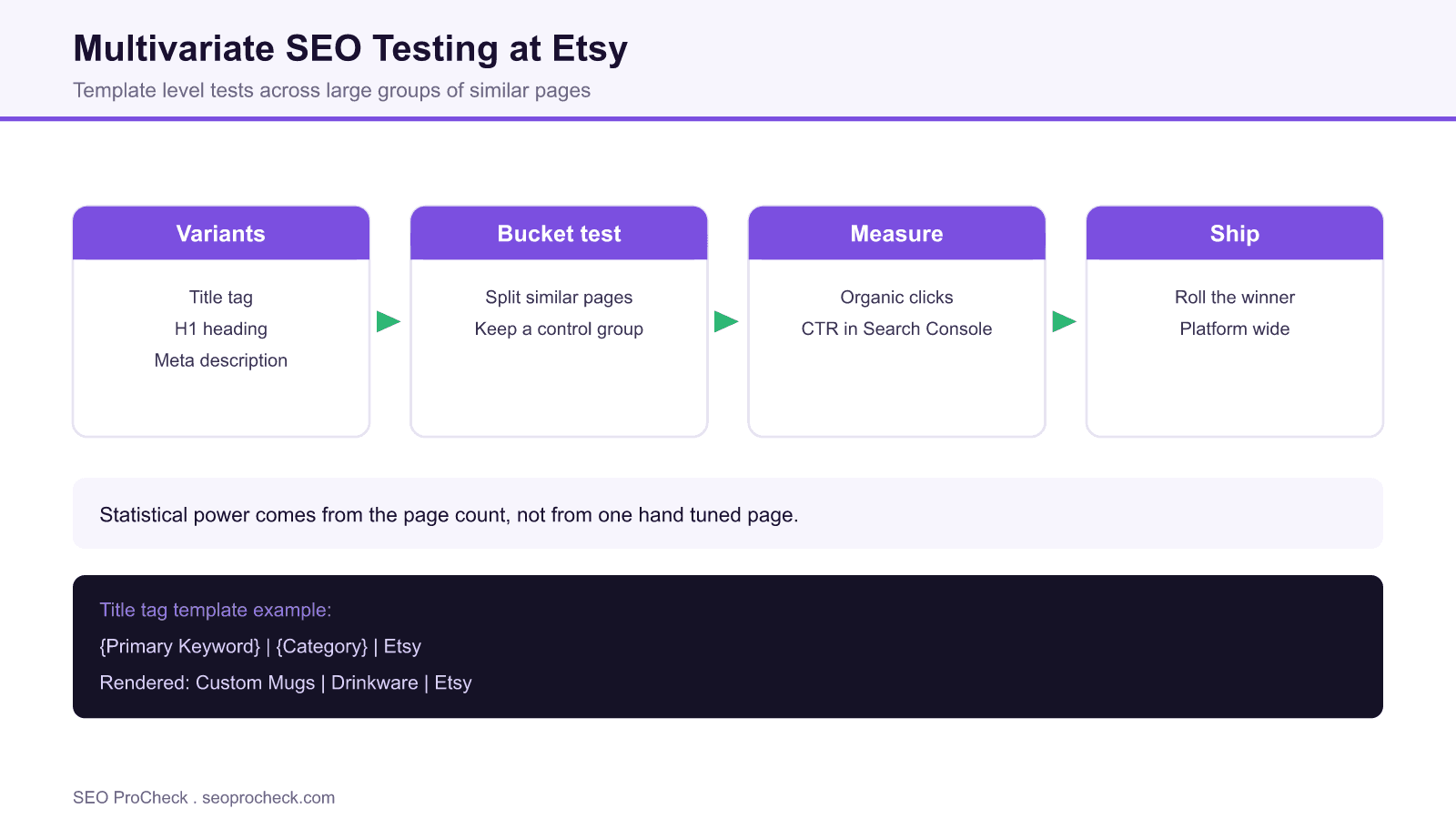
Diagram of etsy multivariate seo testing flow from title, h1 and meta description variants through bucket testing to measuring organic clicks.
How large scale multivariate SEO testing works at Etsy: test template variables across page buckets, then ship the winner platform wide.

This SEO case study documents a successful optimization initiative, providing actionable insights for practitioners. The documented approach demonstrates how strategic SEO implementation drives measurable results.

Initial Situation

Understanding the starting point is essential context for evaluating any case study. This documentation covers the initial challenges, competitive position, and business objectives that shaped the SEO strategy.

Strategy and Approach

The strategic approach combined multiple SEO disciplines to address identified opportunities. Key decisions around prioritization and resource allocation provide a template for similar initiatives.

Implementation

Moving from strategy to execution required specific technical implementations, content development, and process changes. This case study documents the practical steps that translated strategy into action.

Results and Learnings

The outcomes demonstrate effectiveness through measurable improvements in rankings, traffic, and business metrics. Analysis of successes and challenges provides learning value for practitioners.

Case studies like this contribute to the SEO knowledge base, helping practitioners learn from documented real-world experiences.

Source: https://www.etsy.com/codeascraft/optimizing-meta-descriptions-h1s-and-title-tags-lessons-from-multivariate-seo-testing-at-etsy

Practitioner Notes: Testing Metadata at Scale

The reason this Etsy work matters is scale. Etsy runs millions of listing and category pages, so the team can build true multivariate tests: take thousands of similar pages, split them into buckets, change one template variable, and hold the rest steady. A small site editing a single title tag can never reach that kind of statistical power, which is why single page before and after screenshots are so often misleading.

On title tags, the finding practitioners keep returning to is that template format and keyword order move organic clicks. Keeping the primary keyword near the front of the pattern, and measuring clicks in Google Search Console rather than average position, is the durable takeaway. Rankings can look flat while clicks rise, because a clearer title wins the same position more often.

H1 tests behave differently. Aligning the H1 with the query intent and with the title supports relevance and accessibility, but changing an H1 alone rarely swings rankings. Treat the H1 as a reinforcement of the page topic, not a lever you pull in isolation. For a related controlled example, see how brand position in the title tag changed measured performance.

Meta descriptions are the most misunderstood element here. They do not rank a page directly. They influence click through rate on the queries where Google chooses to show your text, and Google rewrites descriptions a large share of the time. Write for the high intent queries you actually want to win, and accept that Google may override you. The pattern of Google ignoring hand written descriptions is documented in the meta description rewrite testing case study.

Measurement discipline is the quiet hero of this study. Bucket the pages, keep a control group untouched, watch for seasonality (Etsy traffic swings hard around gift seasons), and run the test long enough to reach significance. Attribution on category pages is genuinely hard because those pages serve mixed intent, so isolate one variable at a time. You can browse more controlled examples in our metadata case study library.

What's Changed Since

Google now rewrites the clickable title link algorithmically, a change that rolled out in 2021. It draws on your title tag, the on page H1, and anchor text pointing at the page, so a carefully tuned title tag is now a strong suggestion rather than a guarantee. Test the template, but expect Google to sometimes prefer your H1.

Meta descriptions are still rewritten most of the time, yet they remain worth writing for high intent queries and as the fallback text for social sharing through Open Graph. On the measurement side, AI Overviews and other generative surfaces are reshaping click through rate math, because a share of queries now resolve without a click. Snippet optimization increasingly competes with zero click results, which makes a clean control bucket in Search Console more valuable, not less. If you are layering structured data on top, the FAQ schema split test is a useful companion read.

Metadata Elements at a Glance

ElementWhat to testPrimary metricCaveat
Title tagFormat, keyword order, modifiersOrganic clicks and CTRGoogle may rewrite the shown title
H1 headingIntent alignment with titleRelevance and accessibilityRarely moves rank on its own
Meta descriptionMessage and offer for the queryClick through rateRewritten a large share of the time

Frequently Asked Questions

What is multivariate SEO testing?

It is a method where you change more than one template variable across large groups of similar pages and measure the combined and individual effects on organic performance. It needs a big page set and a control group to produce trustworthy results, which is why platforms like Etsy can run it well.

Do meta descriptions affect rankings?

Not directly. A meta description is not a ranking factor, but it can influence click through rate on the queries where Google shows your text. Better clicks can indirectly support performance, so the description is still worth writing carefully.

Why did Google ignore my meta description?

Google rewrites descriptions when it thinks a snippet pulled from the page better matches the query. This is normal and happens most of the time. Focus your handwritten description on your highest intent queries and treat it as a strong hint.

Can changing the H1 improve rankings?

Usually the H1 is supportive rather than decisive. Aligning it with the title and the query intent helps relevance and accessibility, but changing the H1 alone rarely produces a clear ranking jump in controlled tests.

How many pages do you need for an SEO split test?

Enough for statistical significance, which usually means hundreds or thousands of comparable pages tested at the template level. Single page tests are too noisy to trust because ranking and click data vary day to day.

How long should an SEO test run?

Plan for several weeks at minimum and account for seasonality in your niche. You want enough data to separate the change you made from normal weekly and seasonal traffic swings before you call a winner.

  • Claude Vincent

Claude Vincent is a technical SEO consultant focused on crawlability, rendering, and AI-search visibility. He writes the field guides and case studies at SEO ProCheck, with a bias toward the durable, unglamorous work that decides whether search engines and AI answer engines can actually read and cite a site.

  • Headings, Meta Descriptions, Title Tags

About SEO ProCheck

Technical SEO consulting and GEO strategy with 20 years of enterprise experience. Case studies, resources, and tools for search and AI visibility.

Learn more about me

Work With Me

Technical SEO audits, GEO strategy, site migrations, and international SEO. Hourly consulting for teams who need hands-on support, not just reports.

Contact now

Subscribe to our newsletter!

More from our blog


Flowchart of the five check pre-publish quality gate for AI-assisted content: the anyone test, the no-AI test, says something new, the first screen, and the recommend test. All five passing leads to ship it; any failure leads back to editing.

The Pre-Publish Quality Gate for AI-Assisted Content

The five check gate we run on every AI-assisted page, built after…
Continue reading
Diagram of the agent-readable file stack showing AGENTS.md in the code repository read by coding agents, llms.txt and llms-full.txt at the website root read by answer engines, and robots.txt plus RSL as the access and licensing layer beneath both.

AGENTS.md vs llms.txt vs llms-full.txt: Which Agent File Does What

AGENTS.md, llms.txt and llms-full.txt look alike but serve different readers. What each…
Continue reading

Profound vs Semrush and Ahrefs: What an AI-Search Tool Actually Replaces (and What It Doesn't)

Profound vs Semrush and Ahrefs don't measure the same thing. A practitioner's…
Continue reading
SEO is the foundation everything is built on; AEO (be the answer) and GEO (get cited) are what it makes possible

SEO vs AEO vs GEO: What Each One Means and How They Actually Differ

SEO, AEO, and GEO are three different jobs: rank in search results,…
Continue reading
Google May 2026 Core Update: What We Learned After the Dust Settled

Google May 2026 Core Update: What We Learned After the Dust Settled

The May 2026 Core Update rolled out from May 21 to June…
Continue reading
Pogosticking: The Click Pattern That Quietly Decides Who Ranks

Pogosticking: The Click Pattern That Quietly Decides Who Ranks

Pogosticking is when a searcher clicks your result, bounces back to Google,…
Continue reading
Interaction to Next Paint (INP): The Complete Guide

Interaction to Next Paint (INP): The Complete Guide

Interaction to Next Paint (INP) is the Core Web Vital that replaced…
Continue reading
SSR vs CSR: Why Rendering Decides Whether AI Can Read Your Site

SSR vs CSR: Why Rendering Decides Whether AI Can Read Your Site

AI crawlers mostly don't run JavaScript, so client-side rendering hides your content…
Continue reading
Prev. Post
Next Post

Recent Posts

  • The Pre-Publish Quality Gate for AI-Assisted Content August 6, 2026
  • AGENTS.md vs llms.txt vs llms-full.txt: Which Agent File Does What July 18, 2026
  • Profound vs Semrush and Ahrefs: What an AI-Search Tool Actually Replaces (and What It Doesn't) June 19, 2026

All Website Tags

AI SEO Analytics B2B Batch Check Content Analysis Content Quality Content Strategy Core Web Vitals Crawl Budget Crawling DOM Parsing E-commerce E-E-A-T Enterprise FAQ GEO Googlebot Google Search Console High Priority Hreflang HTTP Requests Indexing Internal Linking International SEO JavaScript SEO Keyword Research Link Building Live Check Local SEO Low Priority Medium Priority Multiple APIs On-Page SEO Page Speed PageSpeed API Rich Results SaaS Schema Validation SEO Tools SERP Features Site Architecture Site Migrations Structured Data Technical SEO Title Tags

Case studies, research, best practices and free tools for technical SEO, GEO and AI search.

Free tools: SEO & AI search tools · GitHub · browser extensions

SEO Geek since 2004. © All Rights Reserved.

About Me  |  Sitemap for Humans  |  Privacy  |  Terms