

Placing the Brand Name First in Title Tags: SEO Split Testing Lessons from SearchPilot
- January 13, 2021
- Metadata
AI Summary
Whether the brand name should lead the title tag depends on brand strength and query type, and the effect shows up in organic click through rate rather than rankings. Strong brands often win by leading with the name, while lesser known brands usually win by leading with the primary keyword.
- Brand first spends prominent pixels on the name, brand last favours the keyword
- Keep the primary keyword within the first sixty characters to survive truncation
- Google may reorder or add the site name since the 2021 title update
- Test brand position on templated pages against a matched control
This SEO case study documents a successful optimization initiative, providing actionable insights for practitioners. The documented approach demonstrates how strategic SEO implementation drives measurable results.
Initial Situation
Understanding the starting point is essential context for evaluating any case study. This documentation covers the initial challenges, competitive position, and business objectives that shaped the SEO strategy.
Strategy and Approach
The strategic approach combined multiple SEO disciplines to address identified opportunities. Key decisions around prioritization and resource allocation provide a template for similar initiatives.
Implementation
Moving from strategy to execution required specific technical implementations, content development, and process changes. This case study documents the practical steps that translated strategy into action.
Results and Learnings
The outcomes demonstrate effectiveness through measurable improvements in rankings, traffic, and business metrics. Analysis of successes and challenges provides learning value for practitioners.
Case studies like this contribute to the SEO knowledge base, helping practitioners learn from documented real-world experiences.
Practitioner commentary
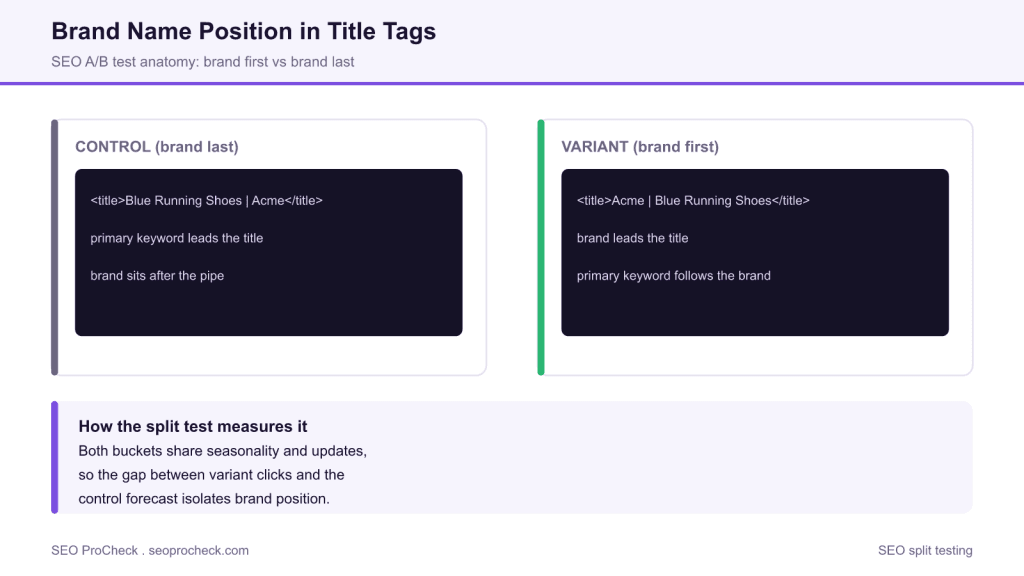
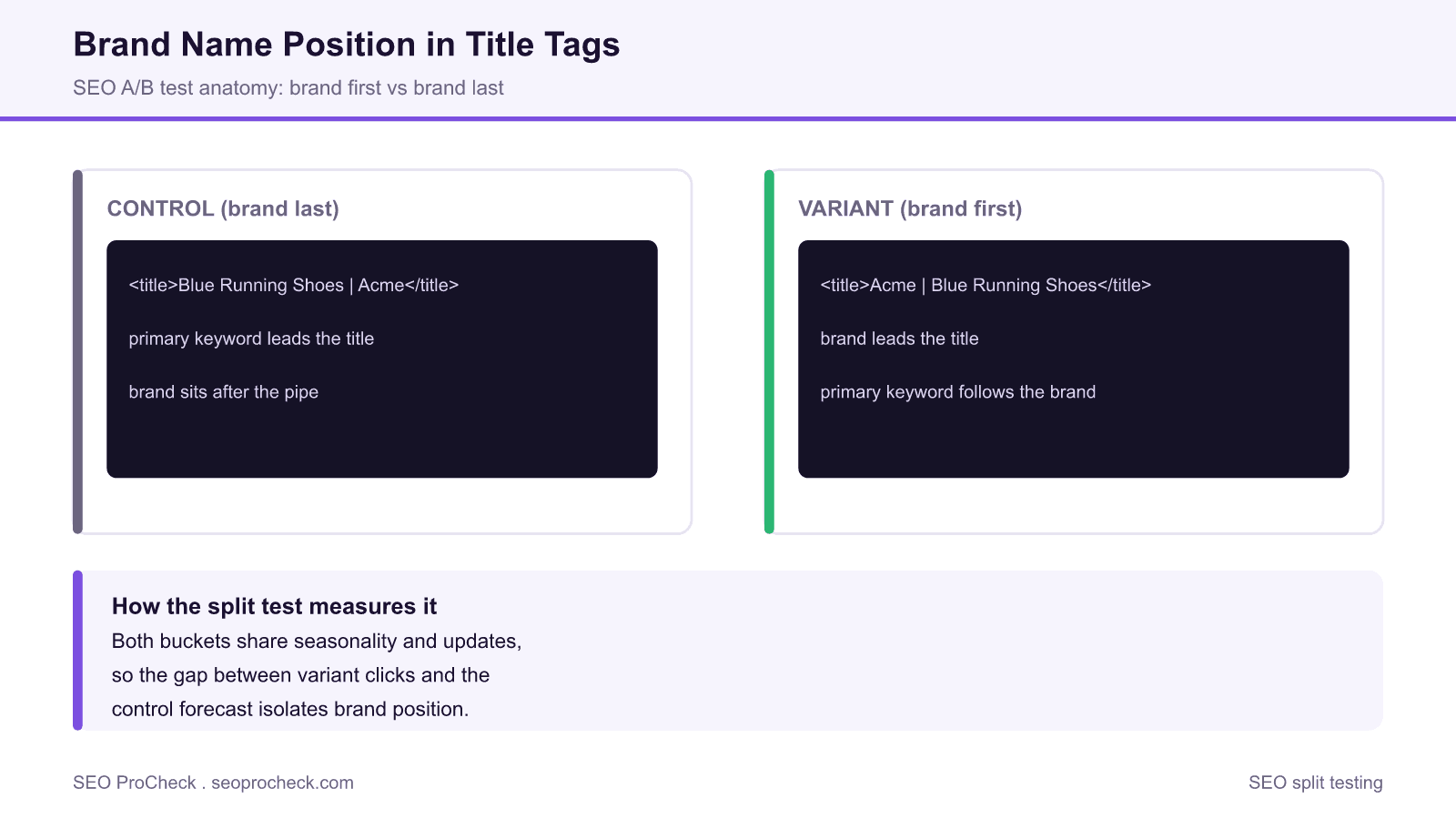
This case study tests a question every in house SEO eventually argues about: should the brand name sit at the front of the title tag or at the end, and does the position actually move organic click through rate.
The real tradeoff behind brand position
Putting the brand first spends pixel width and keyword prominence on a word that most searchers who clicked already recognise. Putting the primary keyword first keeps the terms a searcher scanned for closest to the left edge, where the eye lands. For a strong, trusted brand the front position can lift click through rate because the name is itself a trust signal. For a weak or unknown brand the same position wastes prime space and can suppress clicks. This is why the answer is site specific and belongs in a test.
There is also a truncation angle. Google truncates title links at roughly 600 pixels on desktop, so anything you push to the front survives and anything at the end can be cut. If the brand leads, a long keyword may be clipped. If the keyword leads, the brand may vanish behind an ellipsis, which is usually the safer thing to lose.
How SearchPilot isolates the effect
The platform assigns comparable pages, for example all pages on one template, to control and variant buckets at random. The variant flips the brand to the front of the title while the control keeps it at the end. Because both buckets experience the same demand seasonality and the same algorithm updates, a forecast built from the control predicts what the variant would have done unchanged, and the residual is the effect of brand position. This is the only clean way to separate a copy change from the noise of everyday ranking movement.
To reproduce the logic without the tool, hold every other variable steady. Change brand position on one coherent set of templated pages, keep a matched set untouched, and compare click through rate for the identical date window in Search Console. Do not mix in pages where you also changed the keyword or the description, or you will not know which change moved the metric.
Applying the lesson on your own site
Treat brand position as a decision that depends on brand strength and query type. Strong brands often win by leading with the name on navigational and mid funnel queries. Everyone else usually wins by leading with the primary keyword and letting the brand trail after a separator. Standardise the pattern in your title template so the choice is applied consistently and is easy to reverse, and re check the live SERP because Google may rewrite the title and undo your ordering.
Whatever you choose, keep the primary keyword within the first sixty or so characters so it survives truncation, and keep the separator consistent so your brand presentation looks deliberate across the SERP.
Brand first versus brand last: when each tends to win
| Factor | Brand first tends to win | Brand last tends to win |
|---|---|---|
| Brand strength | Well known, trusted name | New or low awareness brand |
| Query type | Navigational or branded | Non branded, keyword driven |
| Truncation risk | Short primary keyword | Long primary keyword |
| Click through goal | Reassurance and trust | Keyword match and scannability |
What has changed since this test
Since the August 2021 title update Google frequently rewrites title links, and one of its habits is to append or move the site name. That means the brand can appear even when you removed it, and your carefully chosen order can be reshuffled, so the live result is the only source of truth.
Google now derives the site name for the brand portion of some results from structured data and consistent site wide signals, which reduces the payoff of manually forcing the brand into every title. Getting site name and Organization data right can matter more than the raw ordering you set in the tag.
Related reading
Frequently asked questions
Should the brand name go first or last in a title tag?
It depends on brand strength and query type. Strong, trusted brands often gain click through rate by leading with the name, while lesser known brands usually do better leading with the primary keyword and placing the brand after a separator. Test it on your own templates rather than following a universal rule.
Does brand position affect rankings or only click through rate?
The primary, measurable effect is on click through rate, because position changes what a searcher sees and scans first. Any ranking effect is indirect and small, driven by keyword prominence, so treat this as a click through rate optimisation.
Will Google keep the brand order I set?
Not always. Since 2021 Google rewrites titles and may move, add, or remove the site name. Always verify on the live search result that your intended order is the one being shown.
Where should the primary keyword sit if the brand goes first?
Immediately after the brand and separator, and within the first sixty or so characters, so it survives the roughly 600 pixel desktop truncation limit and stays visible to searchers scanning the results.
Does putting the brand first waste space?
For an unknown brand, often yes, because it spends the most prominent pixels on a word searchers do not recognise. For a trusted brand the name itself is a trust signal that can earn the click, which is why the answer is site specific.
How do I test brand position without SearchPilot?
Change brand order on one set of templated pages, keep a matched set unchanged, and compare click through rate in Search Console for the same date range. Avoid changing anything else on those pages during the test.
Take this with you
The assistant links open with a question about this page already written. Nothing is sent until you press enter.
Claude Vincent is a technical SEO consultant focused on crawlability, rendering, and AI-search visibility. He writes the field guides and case studies at SEO ProCheck, with a bias toward the durable, unglamorous work that decides whether search engines and AI answer engines can actually read and cite a site.
About SEO ProCheck
Technical SEO consulting and GEO strategy with 20 years of enterprise experience. Case studies, resources, and tools for search and AI visibility.
Work With Me
Technical SEO audits, GEO strategy, site migrations, and international SEO. Hourly consulting for teams who need hands-on support, not just reports.
Subscribe to our newsletter!







Recent Posts
- Finding a Competitor's Sitemap, and Turning It Into a Change Log September 15, 2026
- AI Crawler User Agents: The Current Names, and Which Ones Sites Actually Block September 9, 2026
- Can AI Crawlers Actually Read Your Site? I Measured 400 of the Biggest September 5, 2026