

We moved the HotPads blog from subdomain blog to /blog guess what happened?
- February 7, 2015
- Migrations
AI Summary
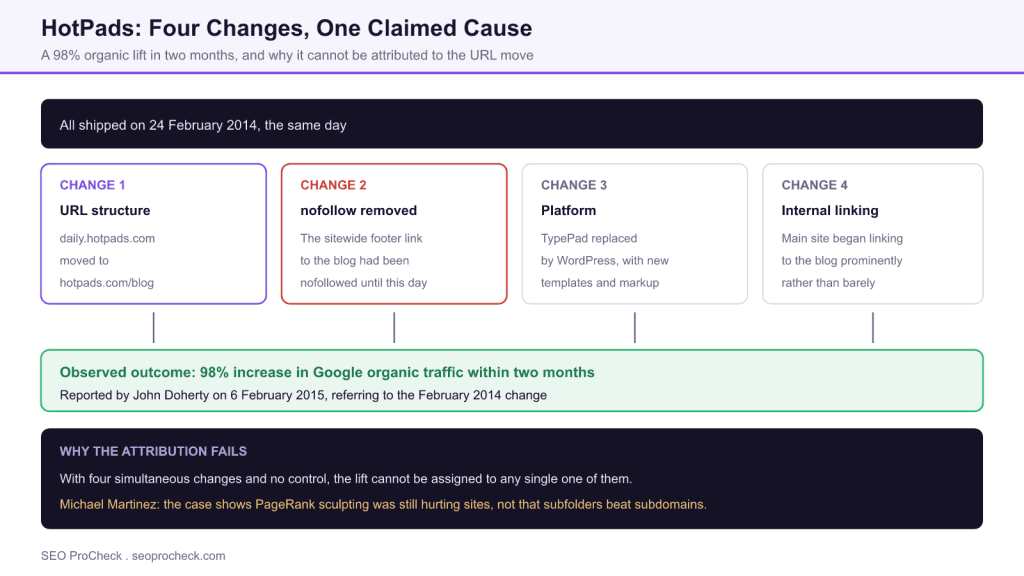
HotPads moved its blog from a subdomain to hotpads.com/blog on 24 February 2014 and reported a 98% increase in Google organic traffic within two months. The same release also removed a nofollow from the sitewide footer link to the blog, replatformed from TypePad to WordPress and added prominent internal links, so the URL change cannot be credited for the lift.
- John Doherty reported the 98% two month organic increase on Twitter in February 2015.
- Michael Martinez of SEO Theory dated the move to 24 February 2014 and identified the origin as daily.hotpads.com.
- A
rel="nofollow"on the footer link to the blog was removed on the same day as the migration. - Martinez's conclusion: the case shows PageRank sculpting was still hurting sites, not that subfolders beat subdomains.
- The cited source URL is a dead Google cache link, so the primary record is the original tweets and the SEO Theory analysis.

This is probably the single most cited data point in the subdomain versus subfolder argument, and it is a useful case study for a reason its citers do not intend. It is a textbook demonstration of what happens when you ship several changes at once and then attribute the result to your favourite one.
A note on the source
The source recorded for this entry is a Google cache URL pointing at a February 2015 tweet from John Doherty. Google retired the cache feature, so that URL no longer resolves to anything. The primary record now consists of the original tweets, in which Doherty wrote that HotPads moved the blog from the blog subdomain to a /blog subfolder, replatformed from TypePad to WordPress, and saw a 98% increase in Google organic traffic in two months. That is the claim, and it is worth stating exactly, because the version that circulates has usually shed the replatform clause.
What else shipped that day
Michael Martinez examined the case at SEO Theory and reconstructed the release. His findings, confirmed in part by Doherty in the comments, are that the move happened on 24 February 2014, that the blog had been at daily.hotpads.com, and critically that the rel="nofollow" attribute on the footer link pointing to the blog was removed on the same day.
That last detail reframes everything. HotPads had been running PageRank sculpting on its own footer, which is to say it had deliberately blocked internal link equity from reaching its blog. Martinez also noted the root domain's poor internal linking overall: the main site barely surfaced the blog while the blog linked prominently back to the main site, an entirely one directional relationship.
| Change shipped 24 Feb 2014 | Plausible traffic effect on its own | How often it gets mentioned in the retelling |
|---|---|---|
| Blog moved to hotpads.com/blog | Contested; Google states hostname is not a ranking factor | Always, and usually as the sole cause |
| nofollow removed from the sitewide footer link | Large: restores internal link flow to a starved section | Almost never |
| TypePad replaced with WordPress | Large: templates, markup, speed and crawlability all change | Sometimes, in the original tweet |
| Main site began linking to the blog prominently | Large: internal link prominence drives discovery and evaluation | Rarely |
| Site redesign following in later months | Moderate: further link prominence and PageRank flow changes | Never |
Four independent mechanisms, one attributed cause. This is the pattern to look for in any migration case study you are asked to act on.
Martinez's actual conclusion
His summary is worth quoting because it is more useful than the claim it rebuts. He wrote that the case study does not prove that subdomains are better or that subfolders are better, and that all it shows is that PageRank sculpting is still around and still hurting sites.
That is the transferable lesson. Somewhere in most large sites there is a section that has been quietly starved of internal links, either by a nofollow left over from a 2010 era sculpting strategy, by a navigation redesign that dropped it, or by a template that never linked to it in the first place. Finding that section and reconnecting it is one of the highest yield technical wins available, and it does not require moving anything.
Finding your own sculpted or starved sections
Two checks. The first hunts for surviving nofollows on internal links, which still exist far more often than people expect, particularly in footers, faceted navigation and login or account links.
# Screaming Frog: crawl, then
# Bulk Export > Links > Internal Nofollow Inlinks

# Or a quick single page check
curl -s https://example.com/ \
  | grep -oE ']*rel="[^"]*nofollow[^"]*"[^>]*>' \
  | grep -oE 'href="[^"]*"' \
  | sort -u
The second finds sections that are technically followed but effectively invisible, by comparing crawl depth and inlink count against organic performance. Anything with high commercial value and a single digit inlink count is a candidate.
| Diagnostic | Where the data comes from | Threshold worth investigating |
|---|---|---|
| Unique internal inlinks per URL | Crawler internal link report | Fewer than 10 inlinks on a page you consider important |
| Crawl depth from the homepage | Crawler, Site Structure tab | Depth of 4 or more for a revenue relevant template |
| Internal nofollow inlinks | Crawler bulk export | Any count above zero on a page you want indexed |
| Link position | Crawler link position or manual template review | Links appearing only in the footer, never in main content or navigation |
| Crawl frequency | Search Console crawl stats, or server logs | Sections Googlebot visits monthly rather than weekly |
Run these against the section you are tempted to migrate. In a meaningful share of cases the internal linking fix delivers the result and the migration becomes unnecessary.
How to run a migration you can actually learn from
The reason this case is still argued about eleven years later is that nobody can settle it from the data that exists. If you want your own migration to produce an answer rather than a talking point, the design requirements are not complicated.
| Requirement | What it means in practice |
|---|---|
| One variable per release | Fix the internal linking first, measure, then move the URLs in a separate release |
| A control group | Hold back a comparable set of pages that do not move, and track them on the same chart |
| Precise annotation | Record the deploy timestamp in analytics and note it against the Search Console date range |
| A long enough window | 90 days minimum. Two months is inside the noise for a seasonal content site |
| Pre registered expectation | Write down the predicted effect before the release, so you cannot retrofit the story afterwards |
| Honest reporting of the bundle | If you had to ship changes together, say so, and say which one you believe did the work and why |
The last row is the one that separates a case study from marketing.
What's changed since
The mechanism at the heart of this case is largely historical. PageRank sculpting through internal nofollow stopped working as intended when Google changed how nofollow is treated, and in 2019 nofollow moved from a directive to a hint alongside the introduction of the more specific ugc and sponsored attributes. A site nofollowing its own footer links today is not conserving anything, it is just adding noise.
The legacy attributes are still out there though. They sit in themes, in old template partials and in plugin defaults, quietly signalling something nobody intended. That makes the internal nofollow audit above a genuinely worthwhile exercise on any site older than about eight years, and it is a five minute crawl rather than a project.
Related reading on this site
The Blogging Flail subdomain versus subdirectory guide covers the same argument from a different single site test and reaches the same confound. For the architectural decision itself, see how a subdomain strategy can harm your SEO, and the migrations index collects the rest of these cases.
FAQ
John Doherty reported on Twitter in February 2015 that moving the HotPads blog from a subdomain to the hotpads.com/blog subfolder, alongside a replatform from TypePad to WordPress, produced a 98% increase in Google organic traffic within two months. The change itself was made on 24 February 2014.
Because four significant changes shipped simultaneously. Michael Martinez of SEO Theory documented that the same release removed a rel=nofollow attribute from the sitewide footer link to the blog, replaced the CMS, and substantially improved internal linking from the main site. With no control and four variables, the 98% cannot be assigned to the URL change.
PageRank sculpting was the practice of adding rel=nofollow to internal links to try to steer link equity toward the pages you cared about. HotPads had nofollowed the footer link to its own blog, which meant the blog was structurally starved of internal authority. Removing that nofollow is a far more direct explanation for a traffic jump than moving the hostname.
The public accounts differ. Doherty's tweets describe moving from a blog subdomain, while Martinez's deconstruction identifies the origin specifically as daily.hotpads.com. The discrepancy does not change the analysis but it is worth flagging, because it illustrates how thin the primary record for a widely cited case study can be.
Usually yes, but for the right reasons. Consolidating onto one hostname simplifies internal linking, keeps Search Console reporting in one property, and removes the separate robots.txt scope. Those benefits are real and independent of any claimed ranking effect from the hostname string itself, which Google says does not exist.
Ship one variable at a time where the business allows it, annotate the exact deploy timestamp in your analytics and Search Console, hold a comparable set of pages back as a control, and measure for at least 90 days rather than two. If you must bundle changes, document the bundle honestly rather than crediting the change you were hoping would work.
Additional analysis referenced above: Michael Martinez, Deconstructing the HotPads Subdomain Move, SEO Theory.
Before you migrate, check whether internal linking is the real problem.
An advanced audit measures inlink counts, crawl depth and surviving nofollows across your templates.
Take this with you
The assistant links open with a question about this page already written. Nothing is sent until you press enter.
Claude Vincent is a technical SEO consultant focused on crawlability, rendering, and AI-search visibility. He writes the field guides and case studies at SEO ProCheck, with a bias toward the durable, unglamorous work that decides whether search engines and AI answer engines can actually read and cite a site.
About SEO ProCheck
Technical SEO consulting and GEO strategy with 20 years of enterprise experience. Case studies, resources, and tools for search and AI visibility.
Work With Me
Technical SEO audits, GEO strategy, site migrations, and international SEO. Hourly consulting for teams who need hands-on support, not just reports.
Subscribe to our newsletter!








Recent Posts
- Most Top Sites Never Say Who They Are in Structured Data October 14, 2026
- Homepage Titles Are Mostly Too Short, Not Too Long October 8, 2026
- Who Actually Serves an llms.txt? 184 Top Sites Measured September 29, 2026