

You have to know the past to understand the present - Case Study Patient.co.uk - SISTRIX
- December 6, 2018
- Migrations
AI Summary
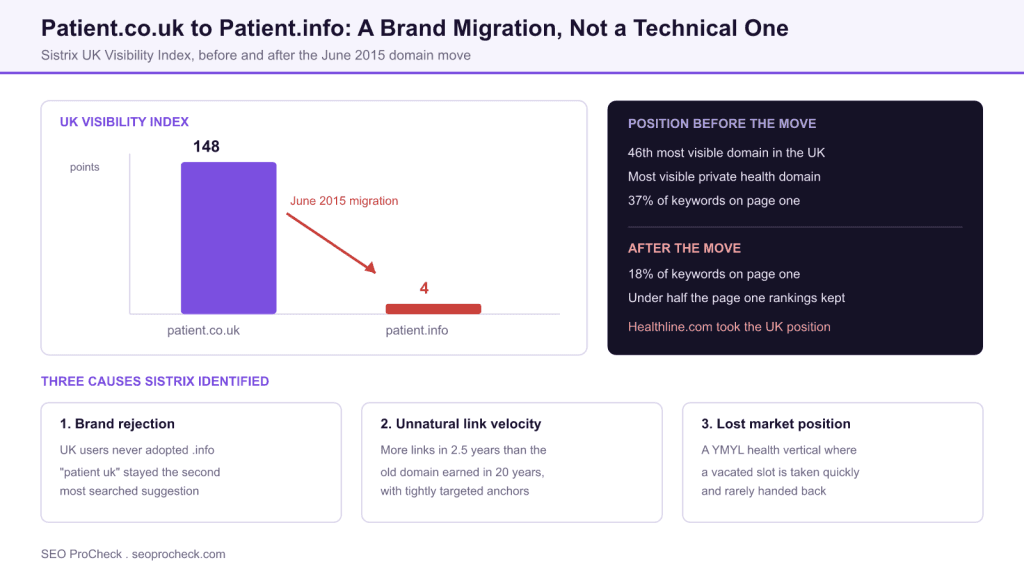
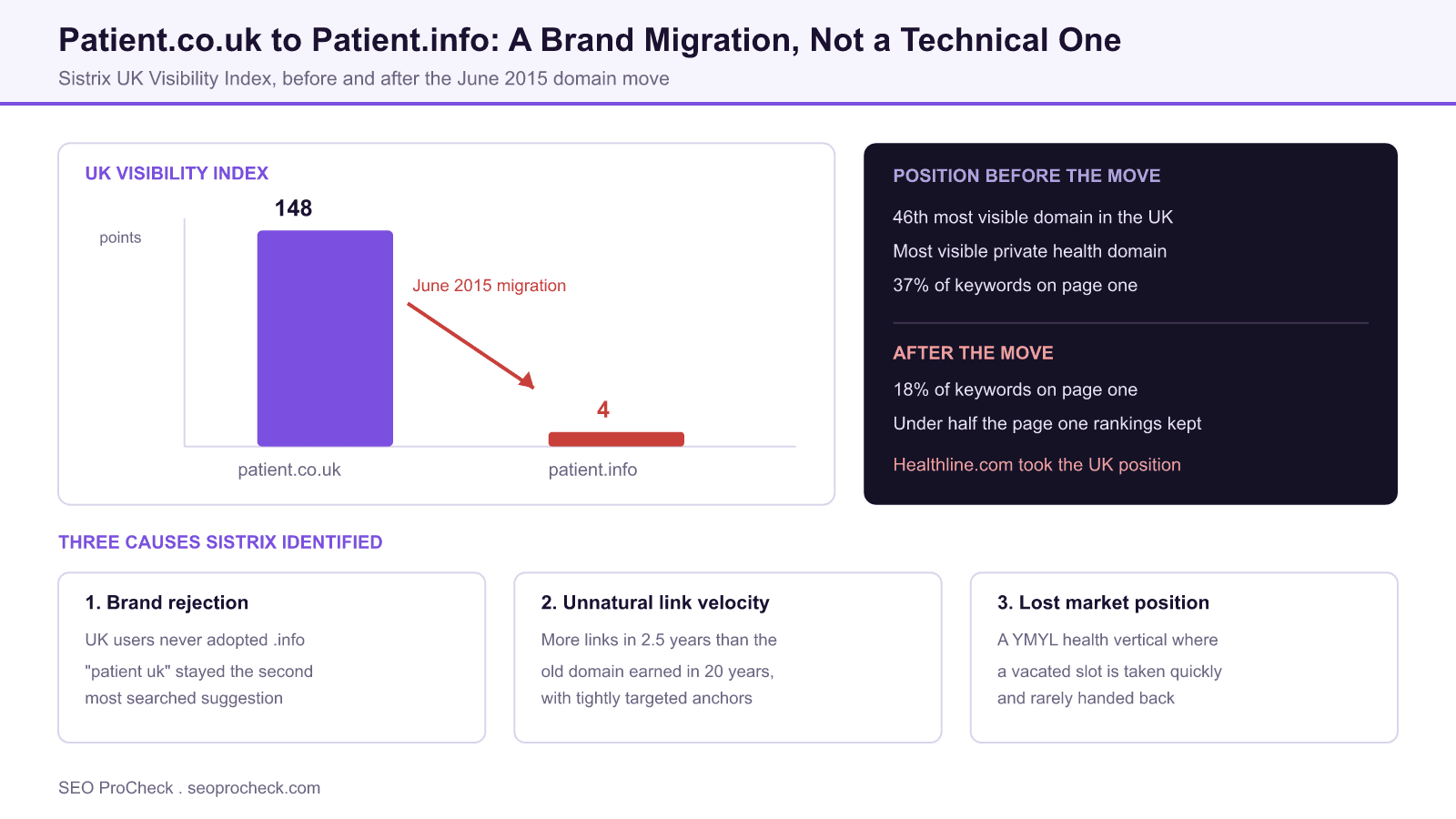
Patient.co.uk moved to patient.info in June 2015 and Sistrix measured UK visibility collapsing from 148 points to around 4. The failure was not a redirect fault: it was a brand identity change that UK users rejected, compounded by an unnatural link acquisition push and a competitor moving into the vacated position.
- Before the move, patient.co.uk was the 46th most visible domain in the UK and the most visible private health domain.
- Page one keyword share fell from 37% to 18%, with under half the original page one rankings retained in absolute terms.
- Google Suggest continued to show patient uk as a leading variant, evidence that users never adopted the new brand.
- patient.info gathered more backlinks in about 2.5 years than patient.co.uk had in 20, with unnaturally targeted anchors.
- Healthline.com ultimately took over the UK market position Patient had vacated.
Most migration post mortems are stories about redirects. This one is not, and that is precisely why it is worth studying. Patient executed a domain change from patient.co.uk to patient.info in June 2015 for a stated strategic reason: the organisation wanted a top level international domain to serve what it described as an increasingly global audience. That is a rational business objective. The SEO outcome was still catastrophic, because the migration changed something that redirects cannot carry across, which is what the brand looks like to the people typing the query.
Sistrix's framing in the original piece, that you have to know the past to understand the present, is the operative point. The visibility chart alone tells you a site fell over. Only the history explains why it never got back up.
The numbers
| Measure | patient.co.uk before June 2015 | patient.info after | Direction |
|---|---|---|---|
| Sistrix UK Visibility Index | 148 points | approximately 4 points | Collapse |
| UK domain visibility rank | 46th most visible domain in the UK | Outside the leading set | Collapse |
| Position in the health vertical | Most visible private health domain in the UK | Displaced by Healthline.com | Lost |
| Keywords ranking on page one | 37% of ranking keywords | 18% of ranking keywords | Roughly halved in relative terms |
| Absolute page one rankings retained | Baseline | Under 50% of the original count | Lost |
Figures as reported by Sistrix. Visibility Index is a weighted measure of ranking positions against a fixed keyword set, so it is comparable across time for one domain but is not a traffic count.
Cause one: the brand, not the redirect
A domain migration is a request to the search engine to transfer the accumulated signals of one hostname to another. Redirects handle the machine readable half of that. They do nothing about the half that lives in people's heads.
Patient.co.uk had spent two decades becoming the thing a British person typed when they wanted to check a symptom without going to the GP. The .co.uk suffix was load bearing in that identity: it signalled local, established and institutional in a vertical where those signals decide whether a user clicks. The .info suffix carries close to the opposite association for a UK audience, and Sistrix's evidence for the rejection was direct rather than theoretical: Google Suggest kept showing patient uk as a leading search variant long after the migration, which means users were still trying to navigate to a brand that no longer existed at that address.
The practitioner test before a rebrand is cheap. Pull the branded query set from Search Console and check how much of it contains a geographic or TLD cue, then ask whether the new name preserves that cue.
# Search Console API: how much demand is tied to the old brand string?
# Filter Performance by query containing your legacy brand token,
# then compare against total clicks.

dimensions: ["query"]
dimensionFilterGroups:
  filters:
    dimension: QUERY
    operator: CONTAINS
    expression: "patient uk"

# If legacy branded demand is a double digit share of clicks,
# a name change is a demand risk, not a technical one.
Cause two: forcing recovery with links
Sistrix's second finding is the one most likely to be repeated by anyone reading this. Patient.info acquired more backlinks in roughly two and a half years than patient.co.uk had earned in twenty, with anchor text that was tightly targeted rather than naturally varied.
Read that as a response to panic. Visibility falls, the obvious lever is authority, so budget goes into acquisition. But link velocity that outstrips a brand's actual public prominence is one of the clearest patterns a spam system can learn, and concentrated commercial anchors make it clearer still. The intervention intended to fix the drop plausibly deepened it.
| Profile characteristic | Natural growth | The pattern seen here | Why it matters |
|---|---|---|---|
| Links per year | Roughly tracks brand mentions and coverage | Two decades of acquisition compressed into 2.5 years | Velocity outruns any plausible real world cause |
| Anchor text mix | Majority brand, URL and generic phrases | Heavily weighted to targeted keyword anchors | Editorial links rarely use exact commercial phrasing |
| Referring domain quality | Broad spread including hard to obtain sources | Concentrated in obtainable placements | Distribution shape betrays procurement |
| Timing relative to the drop | Independent of ranking events | Ramps immediately after visibility falls | Correlation is visible to anyone with historical data |
The comparison is a general practitioner framework applied to the characteristics Sistrix reported, not a claim about specific link sources.
Cause three: the slot does not stay open
The third finding is the strategic one. Sistrix reported that Healthline.com ended up taking the UK position Patient had held. This is what makes health and finance migrations different in kind rather than degree from a migration in a low competition niche.
When a dominant domain in a your money or your life vertical vacates the top of the results, the traffic does not go unserved. It flows to whoever is next, and that competitor then accumulates its own engagement history, its own link acquisition off the back of the new position, and its own quality rater exposure. Recovery is not a matter of restoring your former signals, because the benchmark has moved. You now have to beat an incumbent that is measurably stronger than it was when you left.
What a defensible version of this migration would have looked like
| Decision | What was done | Lower risk alternative |
|---|---|---|
| Target audience | Move the whole brand to an international TLD | Keep patient.co.uk for the UK and add localised subdirectories or new ccTLDs for other markets |
| Cutover | Single global switch | Phase by section, measuring each phase before proceeding |
| Brand equity | New domain string replaces the old one | Retain the legacy string in the new brand where possible, or run both with clear hreflang |
| Post launch response | Aggressive link acquisition | Diagnose whether the loss is technical, demand side or quality driven before spending |
| Legacy domain | Redirected | Redirected permanently, with registration and certificate maintained indefinitely |
The right hand column is standard migration practice, not hindsight invented for this write up.
The checks worth stealing from this case
Three of these are technical and two are not, which is roughly the correct ratio for a domain change.
# 1. Every legacy URL resolves in exactly one hop to a 200
while read u; do
  printf '%s ' "$u"
  curl -s -o /dev/null -w '%{num_redirects} %{http_code} %{redirect_url}\n' -L "$u"
done < legacy_urls.txt | awk '$2 != 1 || $3 != 200'

# 2. Legacy domain still resolves and its certificate is valid
curl -sI https://patient.co.uk/ | head -1

# 3. Branded demand share, from Search Console, before you commit
The two non technical checks: measure how much of your click volume arrives on branded queries that contain the element you are about to discard, and identify who ranks immediately below you in your top thirty commercial terms, because that is who inherits the traffic if the migration slips.
Related reading on this site
The Clarks international consolidation is the technical counterpart to this case, where the strategy was sound and the redirects were not. The Home Depot Canada geo blocking case shows a third failure mode, access rather than architecture or brand, and the migrations case study index collects the set.
FAQ
Patient migrated in June 2015 to reach what it described as an increasingly global audience on a top level international domain. Sistrix recorded UK visibility falling from 148 points, which made it the 46th most visible domain in the country, to roughly 4 points. The share of its keywords ranking on page one dropped from 37% to 18%.
The top level domain is not itself a ranking factor in the way people assume, but it is a trust and click signal for users, and user behaviour feeds back into rankings. In a UK health context a .co.uk carries an implicit local and institutional credibility that .info does not. Sistrix argued that UK users simply never accepted the new domain, and Google Suggest data still showed patient uk as a top search variant long afterwards.
Yes, routinely, when the migration is one to one and the destination brand is at least as credible as the origin. Google has stated that a clean domain change with correct redirects should recover within weeks. What does not recover reliably is a migration that also changes the perceived identity of the brand, because that is a demand problem, not a redirect problem.
Sistrix noted that patient.info accumulated more backlinks in about two and a half years than patient.co.uk had earned in twenty, with heavily targeted anchor text. A link profile that grows far faster than the brand's actual public prominence, with anchors concentrated on commercial phrases, is the pattern spam systems are built to detect. Trying to force recovery through link acquisition compounded the problem.
In health, finance and other your money or your life verticals, the quality bar is higher and the vacancy does not stay open. Sistrix reported that Healthline.com moved into the UK position Patient had held. Once a competitor has occupied the slot and accumulated its own engagement history there, reclaiming it costs far more than holding it would have.
Yes. Redirects from a legacy domain should be treated as permanent infrastructure, not a twelve month transition cost. Keep the registration renewed, keep the certificate valid and keep the one to one map in place indefinitely, because links from 2015 still pass value in 2026 and letting the domain lapse hands your historical authority to whoever buys it next.
Planning a domain change or a rebrand?
An advanced audit quantifies branded demand and maps every legacy URL before the name changes.
Take this with you
The assistant links open with a question about this page already written. Nothing is sent until you press enter.
Claude Vincent is a technical SEO consultant focused on crawlability, rendering, and AI-search visibility. He writes the field guides and case studies at SEO ProCheck, with a bias toward the durable, unglamorous work that decides whether search engines and AI answer engines can actually read and cite a site.
About SEO ProCheck
Technical SEO consulting and GEO strategy with 20 years of enterprise experience. Case studies, resources, and tools for search and AI visibility.
Work With Me
Technical SEO audits, GEO strategy, site migrations, and international SEO. Hourly consulting for teams who need hands-on support, not just reports.
Subscribe to our newsletter!








Recent Posts
- Most Top Sites Never Say Who They Are in Structured Data October 14, 2026
- Homepage Titles Are Mostly Too Short, Not Too Long October 8, 2026
- Who Actually Serves an llms.txt? 184 Top Sites Measured September 29, 2026