

Adding Internal Links to Home Page Footer: SEO Split Testing Lessons from SearchPilot
- September 15, 2021
- Website Architecture
AI Summary
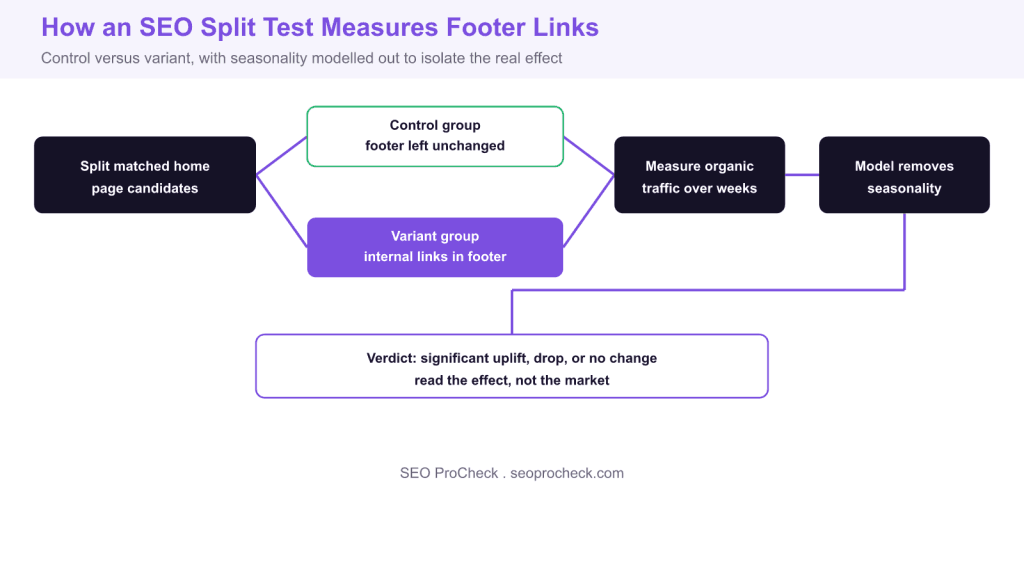
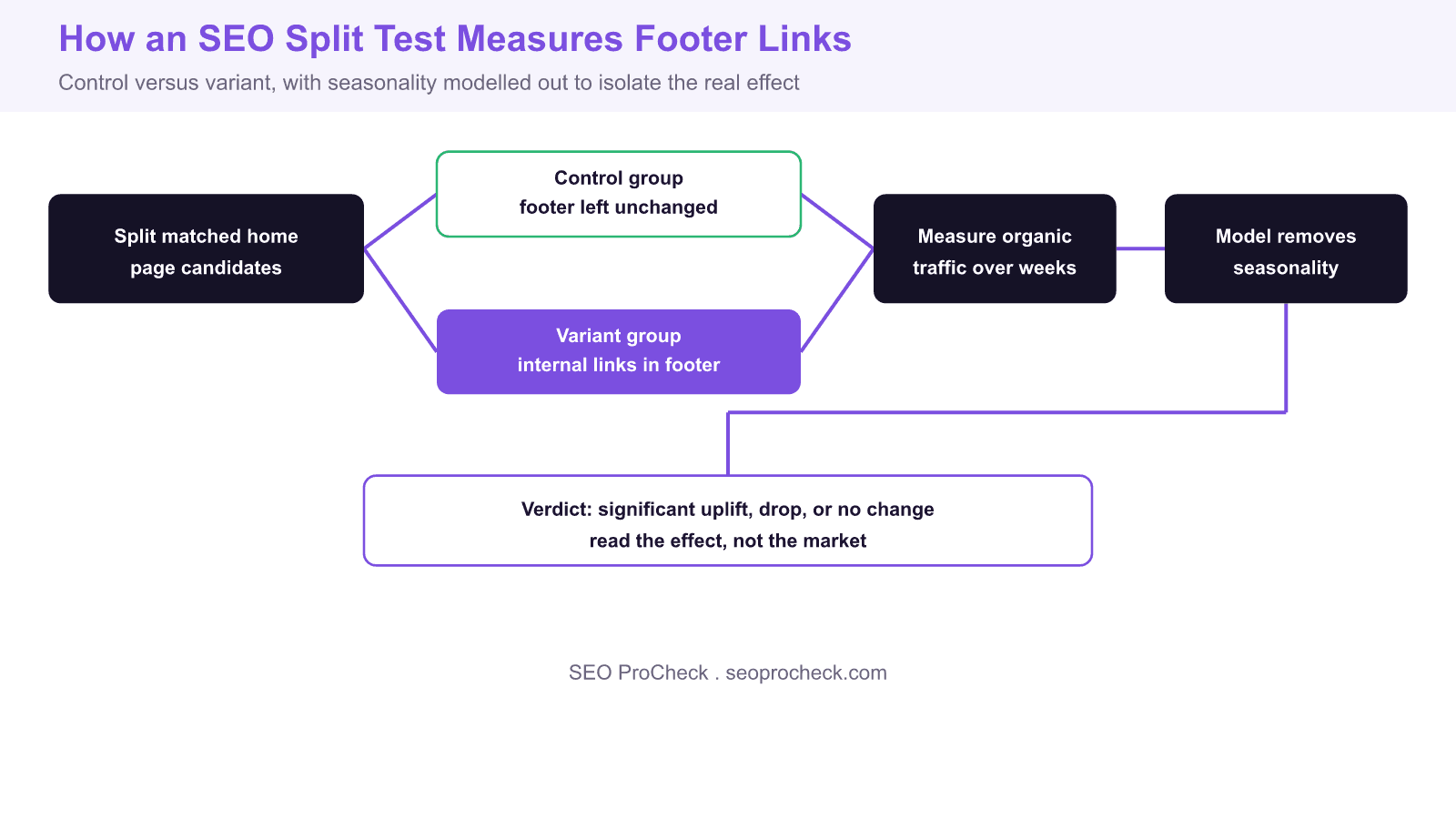
An SEO split test measures whether a change like adding footer internal links actually moves organic traffic, by splitting pages into an unchanged control and a variant and modelling out seasonality. The lesson from this SearchPilot case is the method itself: footer links sit in a low value location, so their impact should be tested rather than assumed.
- SEO split tests split pages, not users, and measure organic traffic over several weeks.
- Footer links usually carry less weight than body content links and can be discounted sitewide.
- A statistical model separates the change from seasonality and algorithm updates.
- A null result is useful evidence, not a failure: it prevents shipping changes on faith.
SearchPilot runs SEO split tests, controlled experiments that measure whether a change actually moves organic traffic rather than assuming it will. This case study covers one such test: adding internal links to the home page footer. The value here is less any single result and more the method, because SEO split testing is the closest the discipline gets to proving cause and effect, and footer links are exactly the kind of change practitioners argue about without evidence.
How SEO split testing works
Unlike a conversion A/B test, where users are split, an SEO split test splits pages. A set of similar pages, or in a case like this the treatment applied to the home page and comparable templates, is divided into a control group left untouched and a variant group that receives the change. Both groups are tracked over several weeks, and a statistical model, in SearchPilot case a causal forecasting approach, predicts what the variant traffic would have been without the change and compares it to what actually happened. That is what lets the test separate the effect of the footer links from seasonality, algorithm updates, and general market movement.
Why footer internal links are worth testing
Internal links pass authority and help search engines understand site structure, but not all links are equal. Links placed in the main content of a page generally carry more weight than boilerplate links repeated site wide in a footer, and Google has long been able to discount sitewide footer links. That tension is precisely why a footer link change deserves a test rather than a guess: the intuition that more internal links must help can be wrong when the links sit in a low value template location. Measuring it removes the argument.
Reading the result honestly
The outcomes of these tests fall into three buckets: a statistically significant uplift, a significant negative, or a null result where the change made no measurable difference. A null result is not a failed test, it is useful evidence that the effort is better spent elsewhere, and it can save a team from rolling out a change sitewide on faith. When you read any split test case study, including this one, focus on whether the result reached significance and over what period, rather than the headline direction alone, because a small or noisy sample can produce a misleading swing.
Applying the lesson without a testing platform
Most sites cannot run formal SEO split tests, but the mindset still applies. Before adding links sitewide, ask where the link will sit and whether that location is likely to carry weight, prefer contextual links in body content over boilerplate footer links, and roll changes out to a subset first while watching the Search Console Performance report for the affected pages. Give any change enough time, typically several weeks, before judging it, and compare against a similar unchanged section rather than against the same pages last month, since that crude before and after ignores seasonality entirely.
What has changed since this case study
SEO split testing has become more mainstream, and the reasoning behind footer link caution has only strengthened. Google representatives have reiterated that internal links help establish page importance, while also confirming that not every link is weighted the same and that boilerplate placement matters. The broader move toward testing rather than best practice by assertion fits the current landscape, where core updates and AI driven results make cause and effect harder to read from raw traffic charts. The durable takeaway is unchanged: measure structural changes where you can, and be skeptical of link advice that has never been tested.
SEO split testing at a glance
| Aspect | Conversion A/B test | SEO split test |
|---|---|---|
| What is split | Users into two groups | Pages into control and variant |
| Metric | Conversion rate | Organic search traffic |
| Main confounder | Traffic source mix | Seasonality and algorithm updates |
| Typical duration | Days to weeks | Several weeks to reach significance |
| A null result means | No conversion effect | No ranking effect, useful evidence |
Related reading
- Home page design and internal linking for publishers
- Technical SEO issues that affect internal linking
- More website architecture case studies
Frequently asked questions
What is an SEO split test?
An SEO split test is a controlled experiment that splits pages, not users, into a control group left unchanged and a variant group that receives a change, then measures the difference in organic traffic. A statistical model forecasts what the variant would have done without the change, which isolates the effect from seasonality and algorithm movement.
Do internal links in the footer help SEO?
Footer internal links can help crawling and structure, but they usually carry less weight than links placed in the main content, and Google can discount repetitive sitewide footer links. That is exactly why the change is worth testing rather than assuming, since the intuition that more links must help can be wrong for low value template locations.
How is an SEO split test different from an A/B test?
A conversion A/B test splits users and measures conversion rate over days to weeks. An SEO split test splits pages and measures organic search traffic over several weeks, because search effects take longer to appear and must be separated from seasonality and algorithm updates using a statistical model rather than simple randomisation.
What does a null result in an SEO test mean?
A null result means the change produced no statistically measurable effect on organic traffic. It is not a wasted test: it is useful evidence that the change is not worth rolling out sitewide and that effort belongs elsewhere. Null results protect teams from shipping changes on faith.
How long should an SEO split test run?
Typically several weeks, long enough for search engines to recrawl and reprocess the change and for the model to reach statistical significance. Ending a test early risks reading noise as a result, so patience and a clear significance threshold matter more than the first few weeks of movement.
Can I test SEO changes without a platform like SearchPilot?
You cannot run a formal split test without tooling, but you can apply the mindset: roll a change out to a subset of pages first, compare it against a similar unchanged section rather than the same pages last month, watch the Search Console Performance report, and give it several weeks before judging. That is a rougher but still evidence based approach.
Link acquisition remains a critical ranking factor. This case study documents effective approaches to earning links that improved domain authority and supported ranking growth.
Link Building Context
Every link building initiative operates within specific constraints: industry, resources, existing authority, and competitive landscape. This case study establishes the context that shaped link building strategy and tactics.
Strategy and Tactics
Sustainable link building requires approaches that earn editorial links rather than manufacture artificial signals. This case study details the specific tactics employed: content-driven outreach, digital PR, resource creation, or relationship building.
Outreach and Execution
Link building requires efficient outreach processes and compelling value propositions. This case study documents outreach methodology, response rates, and relationship development approaches that yielded results.
Impact Assessment
Link building value manifests in domain authority growth, ranking improvements for target keywords, and referral traffic from acquired links. This case study quantifies the impact of link building efforts and their contribution to overall SEO success.
Link building case studies help practitioners understand effective approaches in an increasingly sophisticated link landscape.
Source: https://www.searchpilot.com/resources/case-studies/adding-internal-links-to-home-page-footer/
Take this with you
The assistant links open with a question about this page already written. Nothing is sent until you press enter.
Claude Vincent is a technical SEO consultant focused on crawlability, rendering, and AI-search visibility. He writes the field guides and case studies at SEO ProCheck, with a bias toward the durable, unglamorous work that decides whether search engines and AI answer engines can actually read and cite a site.
About SEO ProCheck
Technical SEO consulting and GEO strategy with 20 years of enterprise experience. Case studies, resources, and tools for search and AI visibility.
Work With Me
Technical SEO audits, GEO strategy, site migrations, and international SEO. Hourly consulting for teams who need hands-on support, not just reports.
Subscribe to our newsletter!








Recent Posts
- Most Top Sites Never Say Who They Are in Structured Data October 14, 2026
- Homepage Titles Are Mostly Too Short, Not Too Long October 8, 2026
- Who Actually Serves an llms.txt? 184 Top Sites Measured September 29, 2026