

Homepage Design & Linking Strategy For Publishers [SEO Case Study]
- February 9, 2022
- Website Architecture
![Homepage design & linking strategy for publishers [seo case study]](https://seoprocheck.com/wp-content/uploads/publisher-homepage-internal-linking-architecture-1024x576.png "Homepage design & linking strategy for publishers [seo case study] 3")
AI Summary
For publishers the home page is the strongest internal link hub, so its design decides how authority reaches section hubs and key articles. Reserve deliberate homepage and hub links for topic hubs and evergreen cornerstones, not only the newest stories, and link articles back up and across so important pages stay shallow.
- The home page is usually the highest authority page, so links from it are the strongest internal signal.
- Real section hubs concentrate topical authority and rank for broad terms better than tag archives.
- Contextual, descriptive internal links keep new articles from becoming orphaned.
- Keep key pages one or two clicks deep to improve crawl frequency and visibility.
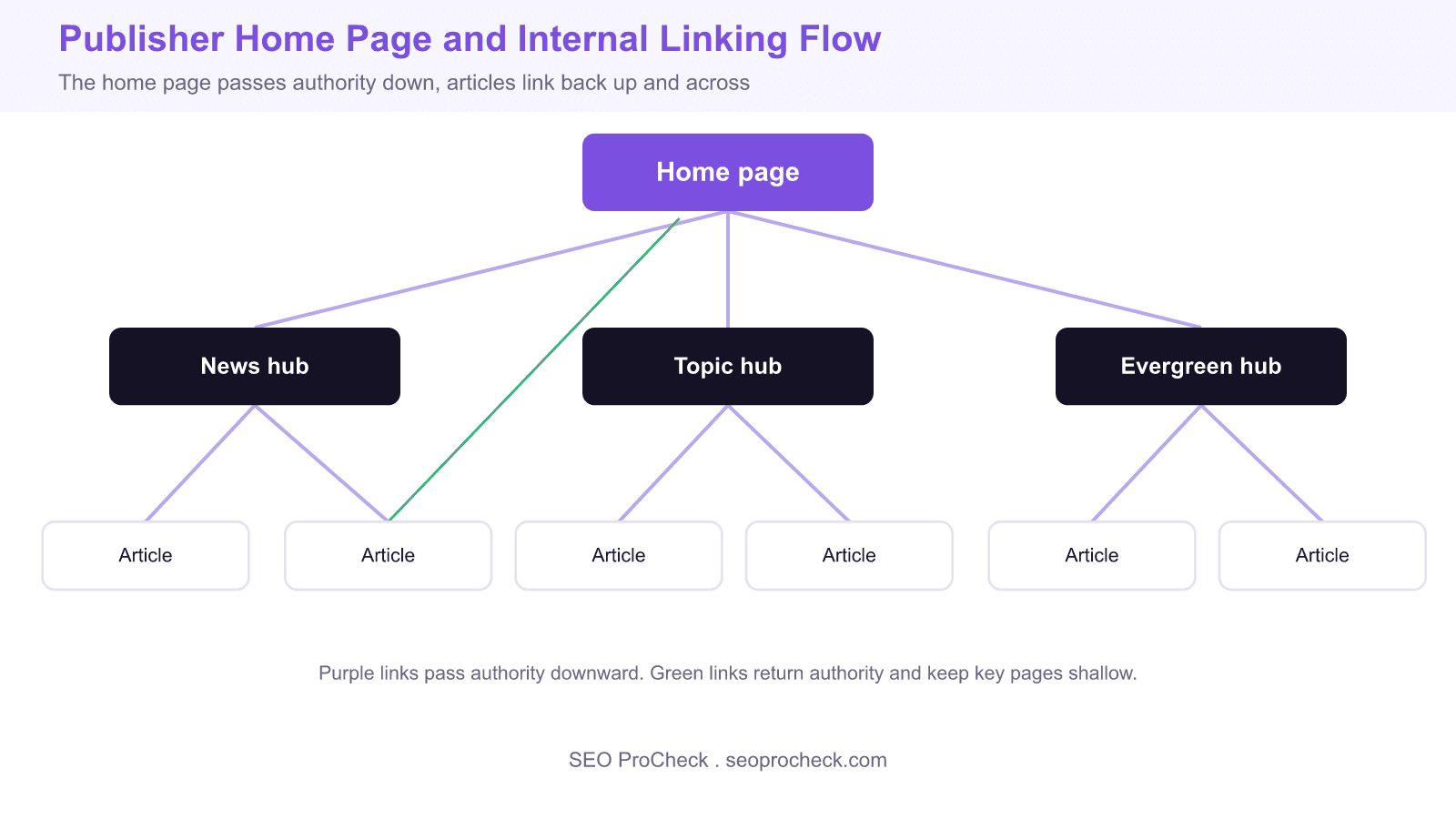
For a publisher, the home page is almost always the most linked to and highest authority page on the site, which makes it the primary lever for internal linking. How you design it, and what you choose to link from it, decides how that authority flows to section hubs and individual articles. This case study, from Search Engine Journal, examines exactly that relationship, and the practical lesson is that homepage design is an SEO decision, not only an editorial or visual one.
Why the home page matters most for publishers
Publishers produce a high volume of articles, and the challenge is not creating pages, it is keeping the important ones from sinking out of reach. Every internal link from the home page is a strong signal about what matters, and pages linked directly from it sit one click deep, which helps both crawlers and users. When a home page links only to the newest few stories, older evergreen articles and section hubs can drift many clicks away, crawl less often, and slowly lose visibility. Treating the home page as a deliberate distribution point, rather than a rolling feed, is the core shift this case study encourages.
Section hubs concentrate topical authority
Between the home page and thousands of articles sit section or category hubs, and they are the most underused asset in publisher architecture. A well built hub links to the strongest articles in its topic, receives a link from the home page and the main navigation, and becomes the page most likely to rank for the broad category term. It also shortens the path to deep articles: instead of home to feed to archive to article, a reader reaches an important piece in home to hub to article. Give each major topic a real hub page with a genuine internal linking role, not just an auto generated tag archive.
Editorial and contextual links do the deep work
Navigation and the home page handle the top of the structure, but the links inside articles handle depth and relevance. When a news story links contextually to the relevant evergreen explainer, and that explainer links back to current coverage, you build topic clusters that concentrate authority and help search engines understand relationships. The practical rules are simple: link with descriptive anchor text, point to the most relevant related page rather than the highest traffic one, and make sure every published article gains at least a few internal links soon after publishing so it never becomes orphaned.
Balancing design, users, and crawl efficiency
A homepage redesign for SEO is a negotiation between three interests: editors want freshness and prominence, users want to find what they came for, and search engines reward shallow, well linked structures. The way through is to reserve deliberate homepage slots for evergreen hubs and cornerstone articles alongside the rolling news modules, so both freshness and durable authority get representation. Keep the total link count reasonable so authority is not diluted across hundreds of links, and confirm the outcome by watching crawl depth and impressions for hub and evergreen pages after the change, rather than assuming the design worked.
What has changed since this case study
The internal linking principles are durable, but the surrounding context has moved. Google has been explicit that internal links help it understand which pages a site considers important and how they relate, which raises the stakes on hub design. The rise of AI overviews and generative answers rewards clearly structured topic clusters that make relationships obvious, so the hub and spoke pattern is more valuable, not less. And with crawl budget under more scrutiny for large publisher sites, keeping key pages shallow through smart homepage and hub linking has a measurable effect on how often they are refreshed in the index.
Homepage linking roles for publishers
| Page type | Linking role | Ideal click depth |
|---|---|---|
| Home page | Distributes authority to hubs and cornerstones | 0 |
| Section hub | Concentrates a topic, ranks for broad terms | 1 |
| Cornerstone article | Evergreen authority, linked from home and hub | 1 to 2 |
| News article | Links up to hubs and across to explainers | 2 to 3 |
| Archive or tag page | Aids discovery, weaker than a real hub | 2 plus |
Related reading
- Split testing internal links in the home page footer
- Fix the technical issues behind poor crawling
- More website architecture case studies
Frequently asked questions
Why is the home page important for a publisher SEO strategy?
The home page is usually the most linked to and highest authority page on a publisher site, so every link from it is a strong signal about what matters and puts that page one click deep. Using homepage slots deliberately for section hubs and cornerstone articles, not only the newest stories, keeps important pages visible to both crawlers and readers.
What is a section hub and why does it matter?
A section or topic hub is a page that links to the strongest articles in a subject and receives links from the home page and navigation. It concentrates topical authority, is well placed to rank for the broad category term, and shortens the click path from the home page to deep articles. Real hubs outperform auto generated tag archives.
How do internal links pass authority on a publisher site?
Internal links pass authority along the paths they create: the home page sends authority to hubs and cornerstones, hubs pass it to their best articles, and contextual links inside articles route it to the most relevant related pages. Descriptive anchor text and links to the most relevant page, rather than the highest traffic one, make that flow work harder.
How do I stop articles from becoming orphaned?
Ensure every new article gains a few internal links soon after publishing, from the relevant hub, from related current and evergreen articles, and where appropriate from the home page. Run a periodic crawl to find pages with no incoming internal links and add contextual links to them from related content.
How many links should a publisher home page have?
There is no fixed number, but keep it reasonable so authority is not spread too thin across hundreds of links. Prioritise a deliberate mix of current news modules plus reserved slots for section hubs and cornerstone evergreen pages, so both freshness and durable authority are represented rather than one crowding out the other.
Does homepage design really affect SEO?
Yes. Homepage design determines which pages receive the strongest internal links and how shallow the overall structure is, both of which influence crawling, indexing, and rankings. Treating a redesign purely as a visual or editorial exercise, without considering what it links to, can quietly bury hubs and evergreen articles that used to perform well.
Link acquisition remains a critical ranking factor. This case study documents effective approaches to earning links that improved domain authority and supported ranking growth.
Link Building Context
Every link building initiative operates within specific constraints: industry, resources, existing authority, and competitive landscape. This case study establishes the context that shaped link building strategy and tactics.
Strategy and Tactics
Sustainable link building requires approaches that earn editorial links rather than manufacture artificial signals. This case study details the specific tactics employed: content-driven outreach, digital PR, resource creation, or relationship building.
Outreach and Execution
Link building requires efficient outreach processes and compelling value propositions. This case study documents outreach methodology, response rates, and relationship development approaches that yielded results.
Impact Assessment
Link building value manifests in domain authority growth, ranking improvements for target keywords, and referral traffic from acquired links. This case study quantifies the impact of link building efforts and their contribution to overall SEO success.
Link building case studies help practitioners understand effective approaches in an increasingly sophisticated link landscape.
Source: https://www.searchenginejournal.com/publisher-internal-linking/436599/
Take this with you
The assistant links open with a question about this page already written. Nothing is sent until you press enter.
Claude Vincent is a technical SEO consultant focused on crawlability, rendering, and AI-search visibility. He writes the field guides and case studies at SEO ProCheck, with a bias toward the durable, unglamorous work that decides whether search engines and AI answer engines can actually read and cite a site.
About SEO ProCheck
Technical SEO consulting and GEO strategy with 20 years of enterprise experience. Case studies, resources, and tools for search and AI visibility.
Work With Me
Technical SEO audits, GEO strategy, site migrations, and international SEO. Hourly consulting for teams who need hands-on support, not just reports.
Subscribe to our newsletter!







Recent Posts
- Finding a Competitor's Sitemap, and Turning It Into a Change Log September 15, 2026
- AI Crawler User Agents: The Current Names, and Which Ones Sites Actually Block September 9, 2026
- Can AI Crawlers Actually Read Your Site? I Measured 400 of the Biggest September 5, 2026