

How We Increased Traffic 110% By Reducing Content Cannibalization
- November 14, 2023
- Website Architecture
AI Summary
This case study documents how fixing keyword cannibalization, where several URLs competed for the same query, lifted organic traffic by 110 percent. The core move was consolidating the competing pages into one authoritative URL with 301 redirects and aligned internal links.
- Cannibalization splits click and relevance signals across competing URLs.
- Detect it in Search Console by filtering a query and adding the Pages dimension.
- Consolidate with 301 redirects and merged content when one page is clearly stronger.
- Align internal anchor text on the single URL you want to rank.
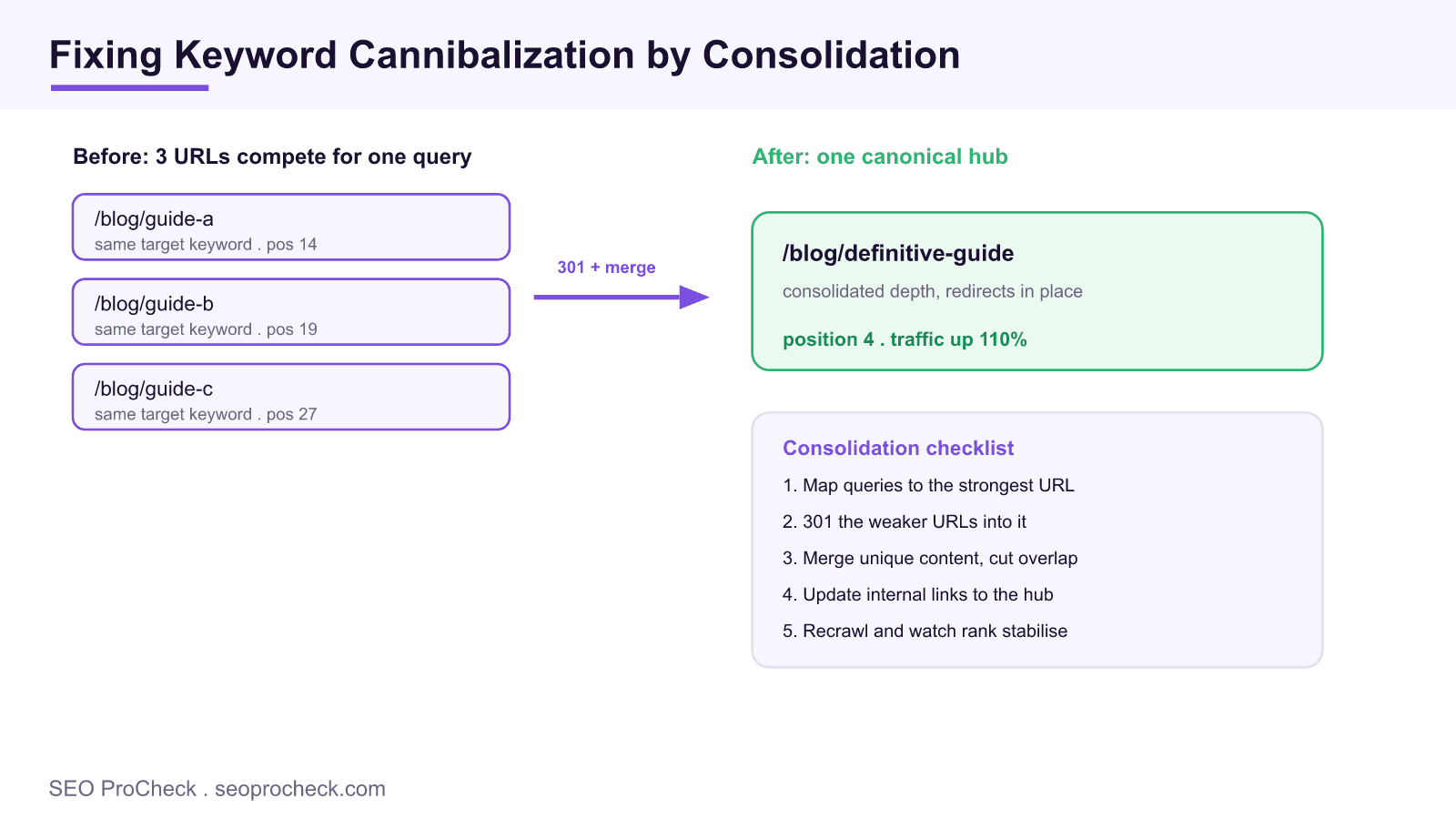
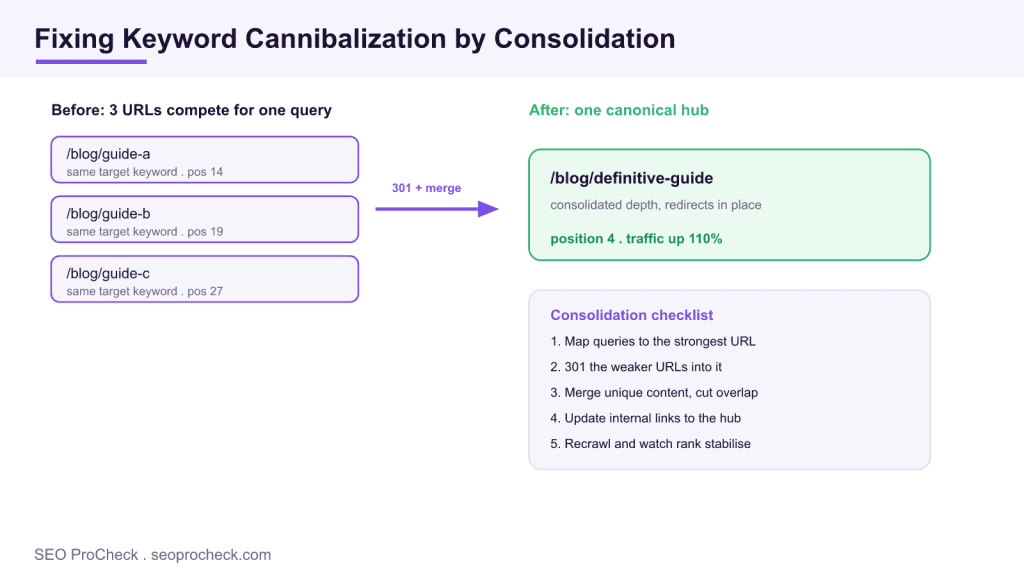
This case study documents a repeatable fix for one of the most common causes of stalled organic growth: keyword cannibalization, where several pages on the same site compete for the same query and none of them ranks as well as a single consolidated page would. The source study below reports a 110 percent traffic increase from untangling exactly this pattern. The sections that follow break down how the problem starts, how to diagnose it, and the exact consolidation steps that produced the result, framed as a playbook you can run on your own site.
Source: https://www.keywordinsights.ai/blog/how-we-increased-traffic-by-fixing-content-cannibalization/
Initial Situation
The starting point in cannibalization cases is almost always the same shape. A topic gets covered more than once over the years: an early blog post, a later guide, maybe a landing page, each written by a different person at a different time, each targeting the same core query without anyone noticing the overlap. Individually the pages look fine. Together they compete. Google is forced to pick which one to show for the query, it often rotates between them week to week, and the click, link, and engagement signals that could have concentrated on one authoritative page are split three or four ways. The visible symptom is a cluster of URLs parked near the bottom of page one or across page two, none of them strong enough to break into the positions that actually earn clicks.
Strategy and Approach
The strategy is not to write more, it is to concentrate. Before touching anything, the competing URLs are mapped to the query they fight over, then ranked by their existing authority: backlinks, current best position, conversion history, and how complete the content is. One URL is chosen as the survivor, the page that will absorb the others. The decision for each remaining page is one of three moves: redirect it, canonicalise it, or deliberately differentiate it so it targets a genuinely separate intent. Getting that classification right per page is the whole game, because the wrong move either throws away useful pages or leaves the cannibalization in place.
Implementation
Implementation runs in a fixed order. First, confirm the diagnosis in Search Console, covered in detail below, so you are consolidating on evidence rather than a hunch. Second, merge any unique, valuable content from the weaker pages into the survivor so nothing worth keeping is lost. Third, apply 301 redirects from every retired URL to the survivor so their accumulated link equity and history transfer. Fourth, sweep the site for internal links that pointed at the old URLs and repoint them at the survivor, aligning the anchor text on the phrase you want that page to own. Fifth, resubmit the survivor for crawling and update the sitemap so the change is discovered quickly.
Results and Learnings
In the source case, this sequence produced a 110 percent increase in organic traffic as the consolidated page climbed into positions that had been out of reach while the signals were split. The broader learning generalises well beyond one site: consolidation wins because relevance is a scarce resource, and spreading it thin is self defeating. The main caution is patience. Rankings do not jump the day the redirects go live; Google needs a few weeks to recrawl, process the redirects, and settle the query on the surviving URL. Measure the survivor, not the retired pages, and resist the urge to reverse the change during the recrawl lag.
What keyword cannibalization really costs you
Keyword cannibalization happens when two or more pages on the same site chase the same query. Google has to choose which one to show, it may rotate them, and the click and link signals that could have concentrated on a single strong page get spread thin instead. The result is a cluster of URLs stuck on page two rather than one page breaking into the top five. Beyond rankings, the cost is diluted authority: every internal link, every earned backlink, and every snippet impression that lands on a duplicate is a signal that did not reinforce the page you actually want to win.
Detecting cannibalization in Search Console
The fastest diagnosis lives in Google Search Console. Open the Performance report, filter by the exact query you are worried about, then add the Pages dimension. If several URLs collect impressions and clicks for that one query, and their average positions swap places month to month, you have cannibalization rather than healthy topic coverage. Cross check by searching site:yourdomain.com plus the keyword to see which pages Google associates with it, and note whether the URL that ranks keeps changing, which is the clearest fingerprint of the problem.
| Signal | What you see | What it means |
|---|---|---|
| Position swapping | Different URLs rank for the same query across weeks | Google cannot settle on one canonical page |
| Multiple URLs per query | Two or more of your pages draw impressions for one query in GSC | Your own pages split the signals |
| Stalled clicks | Impressions hold but clicks flatten for the topic | Fragmented pages sit below the click threshold |
| Overlapping titles | Several pages use near identical title tags and headings | Content and intent are duplicated, not differentiated |
Choosing consolidate, canonicalise, or differentiate
Not every overlap needs a redirect. When one URL is clearly stronger and the others add little, 301 the weak URLs into the strong one and merge any unique content worth keeping. When both pages serve users but only one should rank, point a canonical from the weaker to the stronger; the canonical keeps the page reachable while telling Google which version to index. When the pages genuinely target different intent, for example a commercial comparison versus an informational definition, keep both and differentiate the content and, crucially, the internal anchor text so you stop sending mixed relevance signals. After consolidation, expect a few weeks for Google to recrawl and settle rankings on the surviving URL, and monitor that page rather than the retired ones.
| Situation | Recommended action | Signal to watch |
|---|---|---|
| Duplicate pages, one clearly stronger | 301 the weaker URLs into the strong one | Redirects processed, rankings merge |
| Both pages useful to users | Canonical the weaker to the stronger | Canonical respected in Search Console |
| Pages serve different intent | Differentiate content and internal anchors | Each page ranks for its own query |
What has changed since
Cannibalization matters as much in the AI search era as it did when this case study was written, arguably more. When answer engines and AI overviews assemble a response, fragmented duplicate pages give them a weaker, less consistent source to cite, whereas a single consolidated hub is easier to trust and quote. One practical shift: keep the surviving URL fast and internally well linked, because AI systems and classic crawlers both reward a clear canonical signal. For related work, see our explainer on index bloat, the internal linking guide, how a 301 differs from a 302 redirect, and more website architecture case studies.
Frequently asked questions
What is keyword cannibalization?
It happens when two or more pages on the same site target the same query, so they compete with each other in search. Google may rotate which URL ranks, split click signals, and hold all of them below where a single strong page could rank.
How do I detect cannibalization in Search Console?
Open Performance, filter by the target query, then add the Pages dimension. If several URLs collect impressions and clicks for that one query, and their positions swap over time, you likely have cannibalization.
Should I use a canonical, a redirect, or a merge?
Redirect and merge when the weaker URLs add little unique value, use a canonical when you must keep both pages live but want one to rank, and differentiate the content when both genuinely serve different intent.
How long until traffic recovers after consolidation?
Expect a few weeks for Google to recrawl, process the redirects, and settle rankings on the surviving URL. Watch the consolidated page in Search Console rather than the retired URL.
Can internal linking cause cannibalization?
Yes. If your internal anchor text points the same phrase at multiple URLs, you send mixed relevance signals. Align internal anchors on the one page you want to rank.
Do I lose backlinks when I redirect cannibalizing pages?
No. A 301 redirect passes the large majority of link equity from the retired URL to the survivor, which is much of why consolidation lifts the surviving page. Keep the redirects permanent, since removing them later strands those links.
Take this with you
The assistant links open with a question about this page already written. Nothing is sent until you press enter.
Claude Vincent is a technical SEO consultant focused on crawlability, rendering, and AI-search visibility. He writes the field guides and case studies at SEO ProCheck, with a bias toward the durable, unglamorous work that decides whether search engines and AI answer engines can actually read and cite a site.
About SEO ProCheck
Technical SEO consulting and GEO strategy with 20 years of enterprise experience. Case studies, resources, and tools for search and AI visibility.
Work With Me
Technical SEO audits, GEO strategy, site migrations, and international SEO. Hourly consulting for teams who need hands-on support, not just reports.
Subscribe to our newsletter!








Recent Posts
- Most Top Sites Never Say Who They Are in Structured Data October 14, 2026
- Homepage Titles Are Mostly Too Short, Not Too Long October 8, 2026
- Who Actually Serves an llms.txt? 184 Top Sites Measured September 29, 2026