

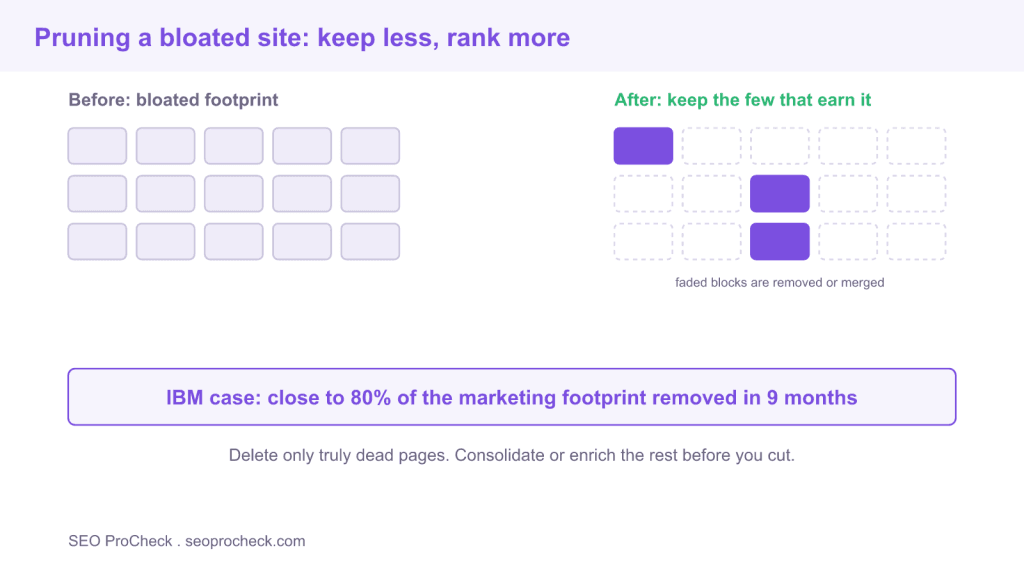
Over the last 9 months we’ve deleted close to 80% of the marketing footprint off IBM.
- May 20, 2023
- Website Architecture
AI Summary
This case note describes a team that removed close to 80 percent of a large marketing footprint from IBM over nine months, on the premise that a smaller, stronger site outperforms a sprawling one. Aggressive pruning can lift quality signals and free crawl budget, but it is a scalpel, not a chainsaw: cut only genuinely dead pages and consolidate or enrich the rest first.
- Bloat hurts through wasted crawl budget, diluted authority, and sitewide quality signals dragged down by thin pages.
- Most pages deserve consolidation or enrichment before deletion, since a merged or improved page keeps the equity a delete throws away.
- Retire a page with a
301redirect to the best alternative, or a410when nothing relevant remains. - Measure crawl coverage, impressions, and conversions before and after so you can prove the cut helped rather than hurt.
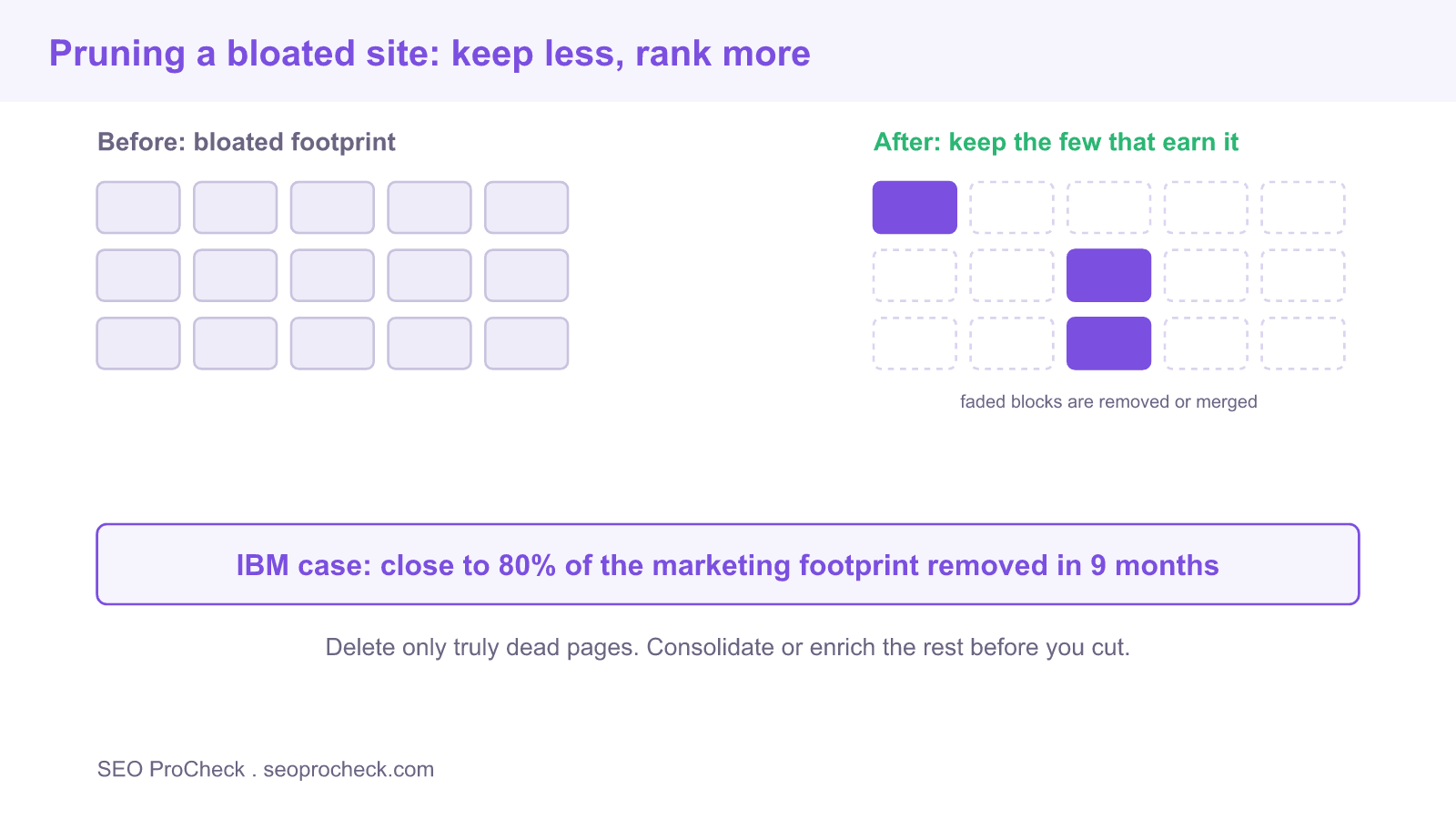
The claim in this case note is striking: over nine months a team deleted close to 80 percent of the marketing footprint off a site the size of IBM. Numbers like that get shared because they feel bold, but the tactic underneath is ordinary technical SEO hygiene applied at unusual scale. A large organisation accumulates landing pages, campaign microsites, gated assets, and abandoned sections for years, and eventually the dead weight starts to drag on the pages that still matter. Pruning is the disciplined reversal of that accumulation. Done well it lifts quality and crawl efficiency, and done carelessly it deletes traffic and revenue you needed.
What deleting most of a footprint actually means
Removing 80 percent of pages does not mean torching the site. In practice a footprint that large is dominated by pages that get no organic clicks, no conversions, no internal links, and barely any crawls. These are the campaign pages that ended, the duplicate regional variants, the thin syndicated posts, and the auto generated tag archives. Cutting them concentrates authority and crawl attention on the pages that earn their place. The headline figure is really a statement about how much of a big site is inactive, not a recommendation to delete four fifths of everything you own.
Why a bloated site underperforms
Bloat costs you in three concrete ways. First, crawl budget: Googlebot spends a finite amount of effort on your site, and every crawl wasted on a dead page is a crawl not spent on a page you want fresh in the index. Second, quality signals: Google assesses sites partly at the aggregate level, so a large mass of thin or duplicate pages can weigh on the perception of the whole domain. Third, dilution: internal links and authority spread across thousands of low value URLs give less lift to the pages that convert. Trimming the dead weight addresses all three at once, which is why the effect can look dramatic on a site that had drifted badly.
Prune, consolidate, or enrich: choose the right action
Deletion is only one of three responses, and usually not the first one to reach for. Match the action to the state of the page.
| Page state | Best action | How to execute |
|---|---|---|
| Traffic, links, and a job to do | Keep and improve | Refresh, expand, and strengthen internal links in |
| Thin but on a useful topic | Enrich | Add depth, examples, and structure until it earns rankings |
| Overlaps a stronger page | Consolidate | Merge the content, then 301 redirect the weaker URL |
| No traffic, no relevance, no equity | Retire | Redirect to the nearest match, or return 410 if none exists |
| Useful to users, not for search | Keep, deindex | Apply noindex and leave the page live and crawlable |
The reason to prefer consolidation and enrichment is simple: deletion throws away whatever links and history a page carried, while a merge or a rewrite keeps that equity working for you. Reserve outright removal for pages that genuinely have nothing left to give.
How to run a safe content prune
Treat it as a measured project, not a spring clean.
- Build a full inventory of URLs and join it to data: organic clicks and impressions, conversions, internal links in, backlinks, and last crawl date.
- Score each page and sort into keep, enrich, consolidate, deindex, or retire, using the table above as the rule set.
- Never judge a page on traffic alone. A page with few visits but strong backlinks should be consolidated so its links survive, not deleted.
- Execute in waves, not one giant release, so you can watch each batch and roll back a mistake before it spreads.
- Keep a record of every removed URL and its redirect target, so you can audit and reverse decisions later.
The redirect and status code rules
How you retire a page decides whether you keep or lose its value. Use a 301 redirect when a relevant replacement exists, because it passes the old page equity to the target and sends users somewhere useful. Use a 410 Gone, or a 404, only when nothing on the site is a reasonable match, since a redirect to an unrelated page is treated as a soft error and helps no one. Apply noindex when the page should stay available to users but out of search, such as internal utility pages. Whatever you choose, update internal links and your sitemap so you are not pointing crawlers at URLs you just removed.
FAQ
It can, when the deleted pages are genuinely dead weight that wastes crawl budget and drags on sitewide quality. It hurts when you delete pages that hold traffic, conversions, or backlinks. Always consolidate or enrich a page before deciding to remove it, and reserve deletion for pages with no value left.
Content pruning is the deliberate review of every URL on a site to decide whether to keep, improve, merge, deindex, or retire it. The goal is a smaller, stronger site where crawl budget and authority concentrate on pages that earn rankings and conversions rather than being spread thin.
Use a 301 redirect when a relevant replacement page exists, because it passes the old equity and sends users somewhere useful. Use a 410, or a 404, only when nothing on the site is a sensible match, since redirecting to an unrelated page is treated as a soft error.
Enrichment improves a thin page until it deserves to rank, keeping and strengthening it. Pruning removes or merges pages that cannot be saved. Enrichment is usually the better first move for any page on a useful topic, because it preserves links and history that a delete would discard.
Deleting a page discards the value of any backlinks it held unless you redirect it. If a low traffic page has strong backlinks, consolidate its content into a stronger page and 301 redirect the old URL so the link equity transfers instead of being lost.
There is no fixed percentage. Large neglected sites can carry a huge share of inactive pages, so a big cut is sometimes justified, but the right amount is whatever is genuinely dead. Decide page by page from data, work in waves, and monitor the results rather than chasing a target number.
Tools and further reading
- Spot overlapping pages to merge with the duplicate content checker.
- Decide what to enrich instead of cut using the content gap finder.
- Confirm deindex directives on retired pages with the meta robots checker.
- Read more website architecture case studies.
Reference: original case note
This SEO case study documents a successful optimization initiative, providing actionable insights for practitioners. The documented approach demonstrates how strategic SEO implementation drives measurable results.
Initial Situation
Understanding the starting point is essential context for evaluating any case study. This documentation covers the initial challenges, competitive position, and business objectives that shaped the SEO strategy.
Strategy and Approach
The strategic approach combined multiple SEO disciplines to address identified opportunities. Key decisions around prioritization and resource allocation provide a template for similar initiatives.
Implementation
Moving from strategy to execution required specific technical implementations, content development, and process changes. This case study documents the practical steps that translated strategy into action.
Results and Learnings
The outcomes demonstrate effectiveness through measurable improvements in rankings, traffic, and business metrics. Analysis of successes and challenges provides learning value for practitioners.
Case studies like this contribute to the SEO knowledge base, helping practitioners learn from documented real-world experiences.
Source: https://twitter.com/bryanfcasey/status/1659941975519375360
Take this with you
The assistant links open with a question about this page already written. Nothing is sent until you press enter.
Claude Vincent is a technical SEO consultant focused on crawlability, rendering, and AI-search visibility. He writes the field guides and case studies at SEO ProCheck, with a bias toward the durable, unglamorous work that decides whether search engines and AI answer engines can actually read and cite a site.
About SEO ProCheck
Technical SEO consulting and GEO strategy with 20 years of enterprise experience. Case studies, resources, and tools for search and AI visibility.
Work With Me
Technical SEO audits, GEO strategy, site migrations, and international SEO. Hourly consulting for teams who need hands-on support, not just reports.
Subscribe to our newsletter!








Recent Posts
- Most Top Sites Never Say Who They Are in Structured Data October 14, 2026
- Homepage Titles Are Mostly Too Short, Not Too Long October 8, 2026
- Who Actually Serves an llms.txt? 184 Top Sites Measured September 29, 2026