

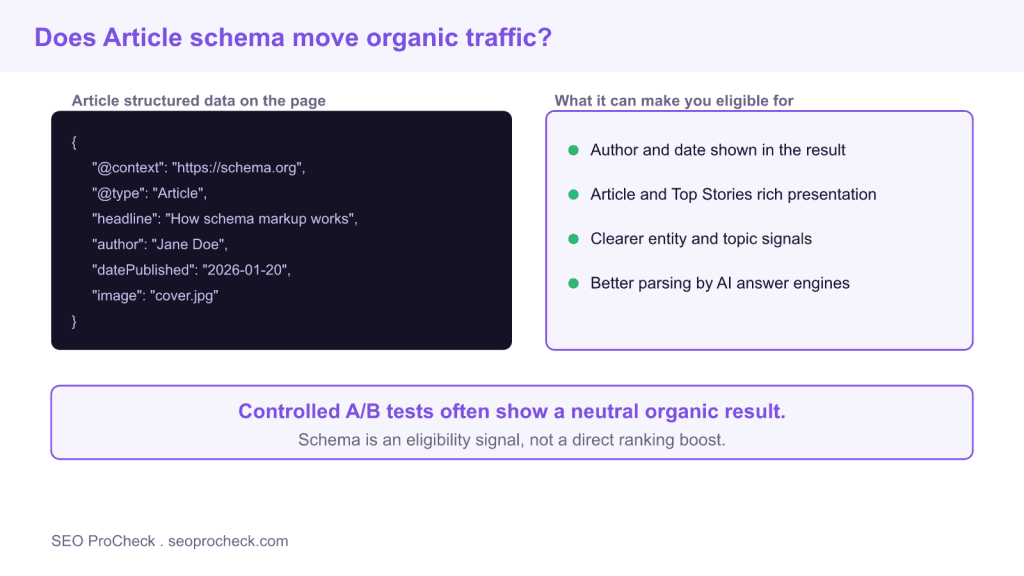
AI Summary
Adding Article structured data rarely moves organic traffic on its own, and controlled split tests like the one behind this case study commonly return a neutral result. Article schema is an eligibility signal that helps Google understand and present a page, not a ranking factor that lifts positions by itself.
- Structured data earns eligibility for features such as author, date, and Top Stories, it does not directly raise rankings.
- A neutral test result is normal and does not mean the markup is worthless, only that its value is indirect.
- The traffic upside shows up where a feature actually appears, most clearly for news and Top Stories.
- Test schema the same way you test titles: on a group of pages, against a forecast, not one URL.
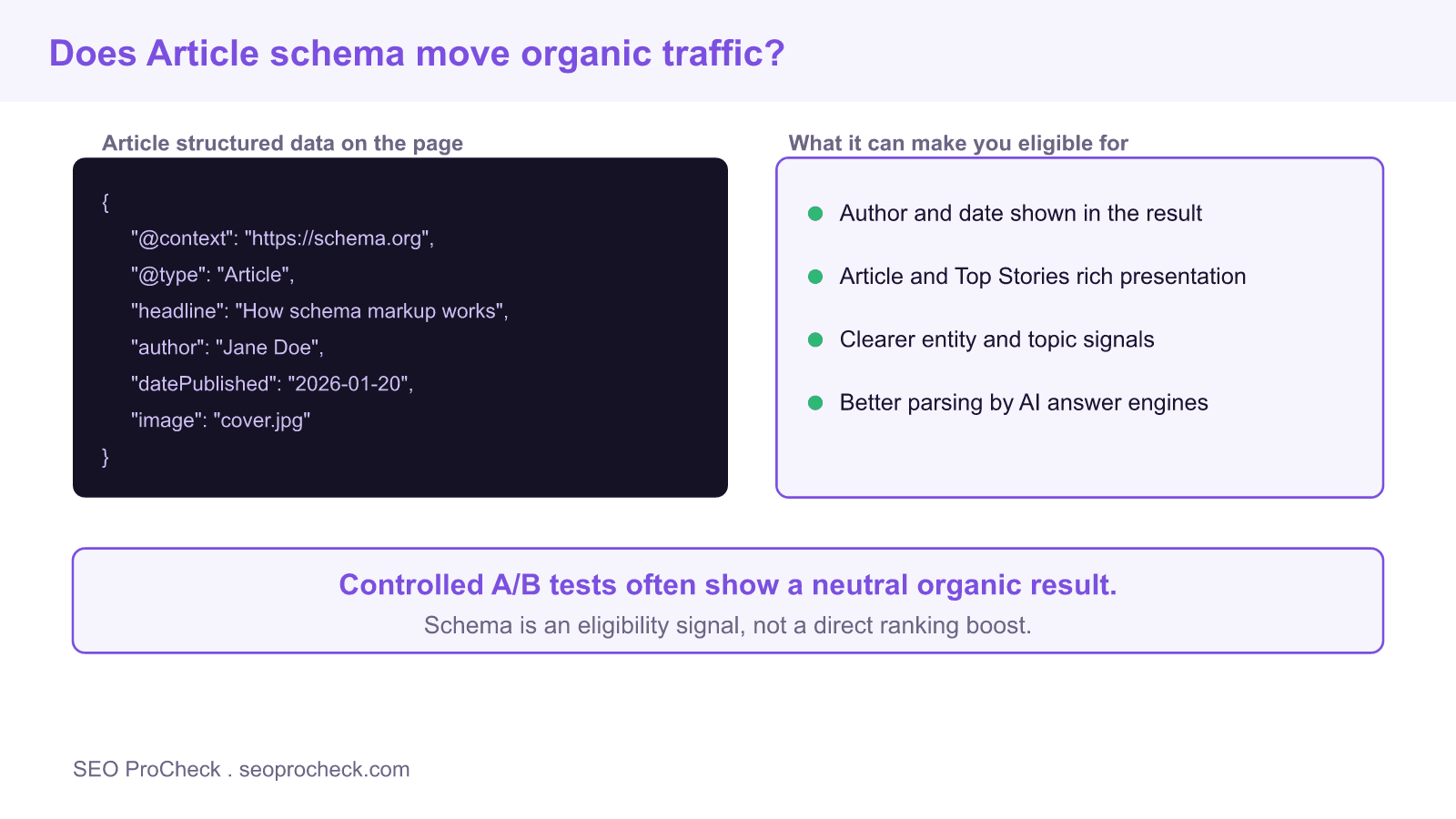
This is one of the most useful questions in technical SEO because the honest answer disappoints people who expected a magic lever. The case study behind this note ran a controlled test to see whether adding Article structured data to article pages changed organic traffic. Controlled tests of this kind frequently land on a neutral result, and understanding why is more valuable than the single number. Article schema is a communication and eligibility layer, not a direct ranking factor, so it earns its keep in specific places rather than lifting every page across the board.
What Article schema actually does
Article structured data is a block of JSON-LD that labels the parts of a page a search engine would otherwise have to guess: the headline, the author, the publish and modified dates, the publisher, and the main image. Google uses this to understand the page with more confidence and, where the content qualifies, to present it with richer detail or in a dedicated feature. The key word is eligibility. Correct markup can make a page eligible for an enhanced appearance, but Google still decides whether to show it, and the underlying ranking is set by the usual relevance and quality signals.
Why the organic result is often neutral
If schema does not raise rankings, a well designed test on ordinary article pages should often show little movement, which is exactly what many of these experiments find. There are three reasons. First, Article rich results are largely visual enhancements rather than position changes, so on standard blue link results the searcher experience barely shifts. Second, Google can already infer much of the same information from a clean page, so adding explicit markup confirms rather than reveals. Third, the biggest visual feature that Article markup supports, Top Stories, is limited to approved news publishers, so most sites never unlock it. A neutral test result is therefore the expected outcome, not a sign that structured data is pointless.
Required and recommended Article properties
If you implement Article schema, get the properties right so the page is actually eligible for the features it can support. This table lists the ones that matter.
| Property | Status | Why it matters |
|---|---|---|
headline | Recommended | Names the article, keep it concise, since Google has no length limit but long titles may be truncated on some devices |
image | Recommended | Enables an image in supported rich results |
datePublished | Recommended | Lets Google show a date and judge freshness |
dateModified | Recommended | Signals genuine updates, keep it truthful |
author | Recommended | Use a Person or Organization with a name, aids entity clarity |
publisher | Recommended | Identifies the brand behind the article |
Validate the output with the Rich Results Test and Search Console, since a malformed block earns nothing. Never mark up an author or a date that is not genuinely present on the page, because fabricated properties can trigger a manual action.
When Article schema does move the needle
The markup pays off in defined situations. News publishers eligible for Top Stories gain real estate and clicks when the carousel appears. Entity clarity improves when the author and publisher are described consistently, which increasingly matters for how AI answer engines attribute and cite content. And on pages where a date genuinely helps the searcher, showing it can lift click through rate even without a ranking change. The lesson is to expect value where a feature or a signal actually surfaces, not as a blanket uplift on every article.
How to test schema on your own site
Test structured data with the same rigor you would apply to a title change. Split a large set of similar article pages into a control group and a group that gets the markup, run it over several clean weeks, and compare clicks and impressions against a forecast rather than a raw before and after. Watch for the specific feature you are targeting in the results, not just aggregate traffic, because a Top Stories appearance or a shown date is where the effect lives. If the result is neutral, keep the valid markup anyway for its eligibility and entity benefits, and move your testing energy to changes that move rankings more directly.
FAQ
No, not directly. Structured data helps Google understand a page and can make it eligible for richer results, but it is not a ranking factor that raises positions on its own. Rankings are still driven by relevance, quality, and links, so a neutral organic test result is normal.
Because Article markup is largely an eligibility and clarity signal rather than a ranking lever. On standard results the searcher experience barely changes, Google can already infer much of the same information, and the biggest feature it supports, Top Stories, is limited to approved news publishers, so most pages see little movement.
Yes, in most cases. Valid markup makes a page eligible for enhancements, clarifies the author and publisher entities, and helps AI answer engines parse and attribute your content. Keep it accurate and validated even when a controlled test shows a neutral organic result.
Headline, image, datePublished, dateModified, author, and publisher are the properties that matter most. Fill them from information genuinely present on the page, keep the headline concise, and never invent an author or a date, since fabricated values can trigger a manual action.
Correct markup does not hurt, but inaccurate or spammy markup can. Marking up content that is not visible on the page, or claiming features you do not offer, breaches Google guidelines and can lead to a structured data manual action. Validate every implementation before shipping it.
Treat it like a title test. Split a large group of similar pages into control and variant, apply the markup to the variant, run it for several clean weeks, and compare against a forecast. Watch for the specific rich feature you are targeting rather than only aggregate traffic.
Tools and further reading
- Build valid markup with the schema markup generator.
- Add supporting FAQ markup using the FAQ schema generator.
- Keep indexing directives clean so eligible pages can appear, see the meta robots and X-Robots-Tag reference.
- Read more metadata case studies.
Reference: original case note
This SEO case study documents a successful optimization initiative, providing actionable insights for practitioners. The documented approach demonstrates how strategic SEO implementation drives measurable results.
Initial Situation
Understanding the starting point is essential context for evaluating any case study. This documentation covers the initial challenges, competitive position, and business objectives that shaped the SEO strategy.
Strategy and Approach
The strategic approach combined multiple SEO disciplines to address identified opportunities. Key decisions around prioritization and resource allocation provide a template for similar initiatives.
Implementation
Moving from strategy to execution required specific technical implementations, content development, and process changes. This case study documents the practical steps that translated strategy into action.
Results and Learnings
The outcomes demonstrate effectiveness through measurable improvements in rankings, traffic, and business metrics. Analysis of successes and challenges provides learning value for practitioners.
Case studies like this contribute to the SEO knowledge base, helping practitioners learn from documented real-world experiences.
Take this with you
The assistant links open with a question about this page already written. Nothing is sent until you press enter.
Claude Vincent is a technical SEO consultant focused on crawlability, rendering, and AI-search visibility. He writes the field guides and case studies at SEO ProCheck, with a bias toward the durable, unglamorous work that decides whether search engines and AI answer engines can actually read and cite a site.
About SEO ProCheck
Technical SEO consulting and GEO strategy with 20 years of enterprise experience. Case studies, resources, and tools for search and AI visibility.
Work With Me
Technical SEO audits, GEO strategy, site migrations, and international SEO. Hourly consulting for teams who need hands-on support, not just reports.
Subscribe to our newsletter!








Recent Posts
- Most Top Sites Never Say Who They Are in Structured Data October 14, 2026
- Homepage Titles Are Mostly Too Short, Not Too Long October 8, 2026
- Who Actually Serves an llms.txt? 184 Top Sites Measured September 29, 2026