

AI Overview Click-Through Optimization
- January 20, 2025
- AI Overviews and SGE, AI and Search
AI Summary
AI Overview click through optimization means earning one of the cited source links inside the overview and concentrating effort on queries where users still need to click. You do that by answering the specific sub question crisply, surfacing unique data high on the page, matching headings to the query, and keeping the page fast, crawlable, and richly structured.
- The cited source chips carry the clicks that survive an AI Overview.
- Commercial, comparison, and transactional queries keep the most click value.
- Watch Search Console for rising impressions with falling clicks to spot cannibalization.
- Unique data and clean schema make your page easier to cite.
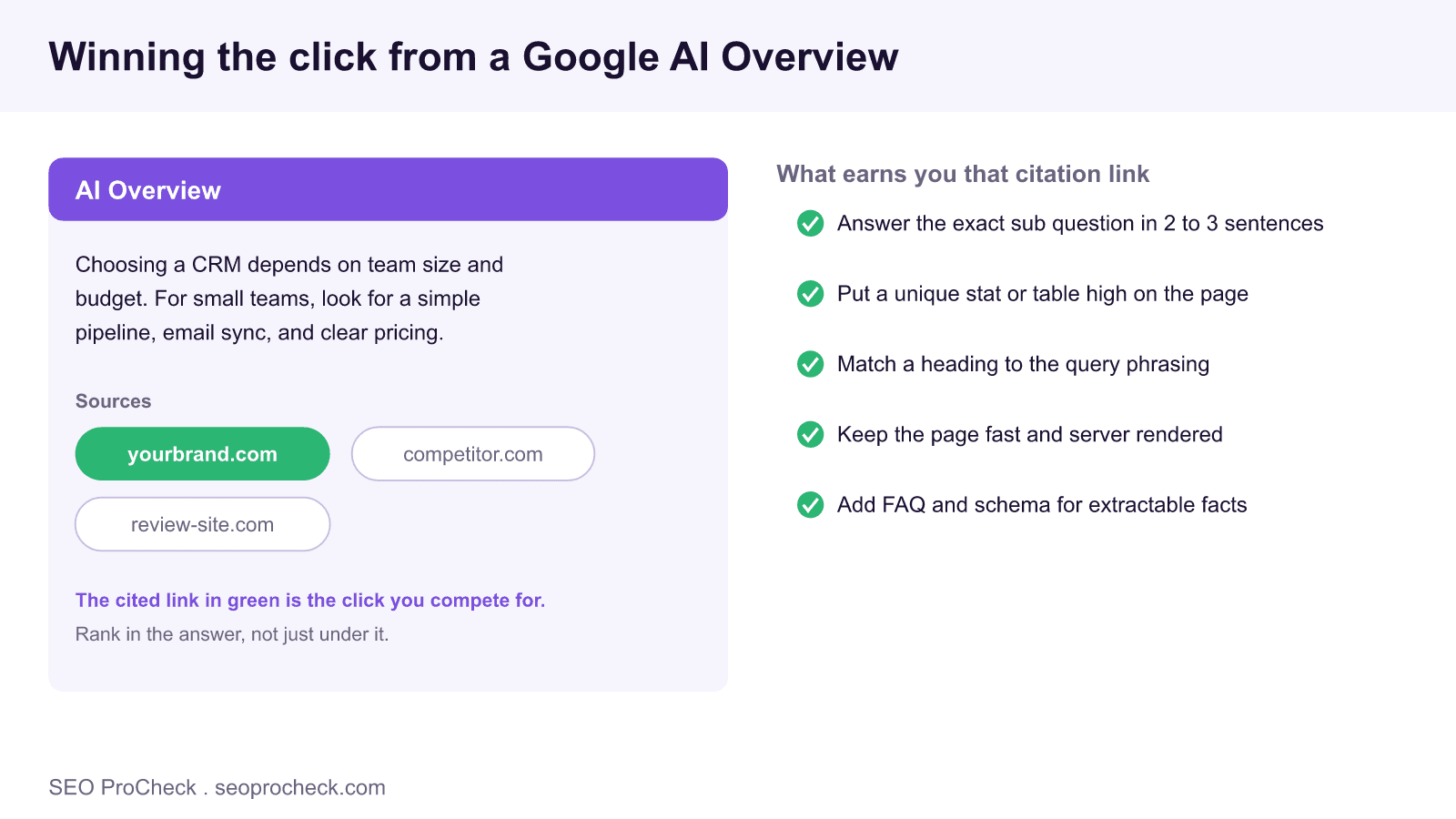
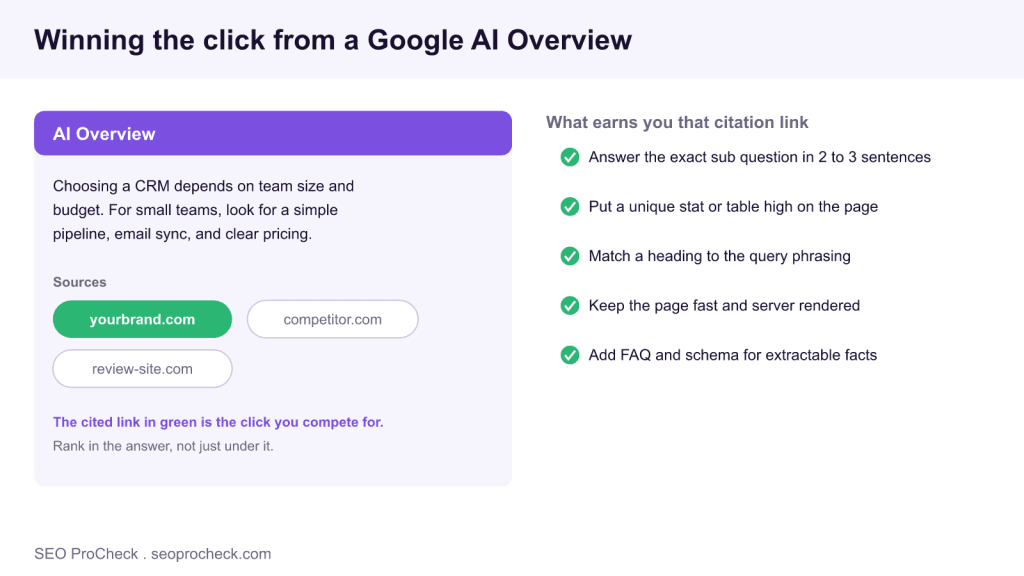
A Google AI Overview answers the query at the top of the page and offers a handful of cited source links off to the side. That format quietly rewires the click economics of search: for some queries the user never scrolls, and for others the only clicks left flow through those citation chips. AI Overview click through optimization is the practice of making sure your page is one of those cited sources, and of concentrating your effort on the queries where a click still happens at all.
Understand where the clicks actually go
Stop thinking about ranking under the overview and start thinking about ranking inside it. When an overview appears, the visible organic results are pushed down and the citation chips become the highest value real estate on the page. Your job is to be selected as one of those cited sources. Everything downstream, your title, your structure, your data, exists to raise the probability that Google picks your page to attribute the answer to.
Pick the right battles by intent
Not every query is worth the same effort once an overview is present. A pure definition query is often fully answered in the overview, so a citation there is nice but the residual click volume is small. Comparison, commercial, and transactional queries are different: the overview whets the appetite but the user still needs to choose, buy, or dig deeper, so the cited link is worth far more. Triage your target queries with this lens before you spend a day rewriting a page.
| Query intent | Overview click risk | Priority | Play |
|---|---|---|---|
| Definition ("what is X") | High, answer is self contained | Low | Win the citation, do not over invest |
| Comparison ("X vs Y") | Medium, user wants detail | High | Deep comparison table, be the cited source |
| Commercial ("best X for Y") | Medium, decision pending | High | Unique data, clear picks, strong title |
| Transactional ("buy X") | Low, overview rarely resolves it | High | Classic conversion and rank work |
| How to ("how to do X") | High for simple, low for complex | Medium | Target complex multi step tasks |
Make your page the easiest one to cite
Google cites pages it can extract cleanly and attribute confidently. Five moves consistently raise your citation odds. First, answer the exact sub question in the first two or three sentences under a heading that mirrors the query, so the extractable answer is unambiguous. Second, put a unique statistic, original table, or first hand result high on the page, because overviews lean on distinctive facts they cannot get elsewhere. Third, structure the page with descriptive H2 and H3 headings that map to the sub questions a user actually asks. Fourth, keep the page fast and server rendered, since content that only appears after heavy client side rendering is harder for the system to read. Fifth, add FAQ and relevant schema so your facts are machine readable and quotable.
Write titles and snippets for the residual click
When a user has read the overview and is deciding whether any link is worth a click, your title and the snippet Google shows for your citation are the deciding factor. Promise something the overview did not give: the full comparison, the pricing, the template, the data set, the hands on verdict. A title that simply restates the definition the user already read earns nothing. A title that signals depth, specificity, or a decision the reader still has to make earns the click. For the mechanics of writing these, see our full guide to titles and meta descriptions.
Measure cannibalization, then respond
The clearest evidence of overview impact lives in Google Search Console. Filter to queries where impressions are flat or rising while clicks and click through rate fall. That divergence is the fingerprint of an overview absorbing the answer. For each affected cluster, decide deliberately: if the intent is definitional, accept the lower click volume and protect the citation; if the intent is commercial or comparative, invest in unique value and a stronger snippet to recapture the click that is still there to win.
Related reading
AI Overview optimization overlaps heavily with broader AI search work. Go deeper with our guides on optimizing for AI Overview citations, winning featured snippets that feed AI, and writing titles and meta descriptions that earn the residual click. You can also browse our full library on AI Overviews and generative search.
Frequently asked questions
Do AI Overviews really reduce clicks?
They reduce clicks on informational queries where the answer is fully contained in the overview, because the user gets what they need without scrolling. They reduce clicks far less on queries with commercial intent, comparison intent, or a need for tools, current data, or a decision, where the user still wants to visit a source. The strategy is to earn the cited link and to compete on queries the overview cannot fully resolve.
What is the single biggest lever for AI Overview clicks?
Becoming one of the linked sources inside the overview. Google shows a small set of citation chips, and those links carry the clicks that remain. Everything else, from titles to structure, is in service of getting your page selected as one of those cited sources.
Should I try to block AI Overviews?
For most sites, no. Blocking the Google-Extended or overview crawling removes you from the cited source pool without stopping the overview from appearing, so you lose the click opportunity and keep the click loss. The exception is a small set of publishers with a specific licensing or strategic reason, and that is a business decision, not a default.
Which pages should I optimize first?
Prioritize pages that target queries with a next step: comparisons, alternatives, pricing, how to complete a task, and product or service pages. These are the queries where an overview leaves the user with a reason to click, so your citation there is worth far more than a citation on a purely definitional query.
How do I know if my clicks are being cannibalized?
In Google Search Console, watch for queries where impressions hold or rise while clicks and click through rate fall. That divergence is the classic fingerprint of an overview absorbing the answer. Segment those queries and check whether an overview appears for them, then decide whether to compete for the citation or to shift effort to click worthy intents.
Does schema help me get cited in AI Overviews?
Indirectly but meaningfully. Clear structured data, FAQ markup, and clean HTML make your facts easy to extract and attribute, which raises the odds Google selects your page as a source. Schema is not a guaranteed ticket, but poorly structured pages are much harder to cite reliably.
Claude Vincent is a technical SEO consultant focused on crawlability, rendering, and AI-search visibility. He writes the field guides and case studies at SEO ProCheck, with a bias toward the durable, unglamorous work that decides whether search engines and AI answer engines can actually read and cite a site.
About SEO ProCheck
Technical SEO consulting and GEO strategy with 20 years of enterprise experience. Case studies, resources, and tools for search and AI visibility.
Work With Me
Technical SEO audits, GEO strategy, site migrations, and international SEO. Hourly consulting for teams who need hands-on support, not just reports.
Subscribe to our newsletter!







Recent Posts
- Can AI Crawlers Actually Read Your Site? I Measured 400 of the Biggest September 5, 2026
- The Pre-Publish Quality Gate for AI-Assisted Content August 6, 2026
- AGENTS.md vs llms.txt vs llms-full.txt: Which Agent File Does What July 18, 2026