

GEO Fundamentals: The Complete Guide to Generative Engine Optimization
- October 15, 2024
- GEO (Generative Engine Optimization), AI and Search
AI Summary
Generative Engine Optimization (GEO) is the practice of structuring and building content so AI engines like ChatGPT, Perplexity, and Google AI Overviews cite it as a source. Unlike SEO, where success is a top ranking, in GEO success is being the cited source, and research shows only 12 percent overlap between AI cited pages and Google's top 10.
- The Princeton and Georgia Tech 2023 study showed specific techniques raise AI visibility 30 to 40 percent.
- Statistics, explicit citations, and authority help, while keyword stuffing decreased visibility by 10 percent.
- GEO complements SEO rather than replacing it, and winners usually have strong classic SEO too.
- AI referral traffic is small but high converting, with 6 to 27 times higher conversion in some studies.

Generative Engine Optimization (GEO) represents a fundamental shift in how content is discovered and consumed. As AI-powered search experiences become mainstream through ChatGPT, Perplexity, Google AI Overviews, and Claude, optimizing for these platforms has become essential alongside traditional SEO.
What Is Generative Engine Optimization?
GEO is the practice of optimizing content to be discovered, cited, and accurately represented by AI language models and generative search engines. Unlike traditional SEO which focuses on ranking in a list of links, GEO aims to have your content become the source that AI systems reference when answering user queries.
The term was formalized by researchers at Princeton and Georgia Tech in their 2023 paper, which demonstrated that specific optimization techniques could boost visibility in AI-generated responses by 30-40%. This established GEO as a measurable, optimizable discipline rather than speculation.
How GEO Differs From Traditional SEO
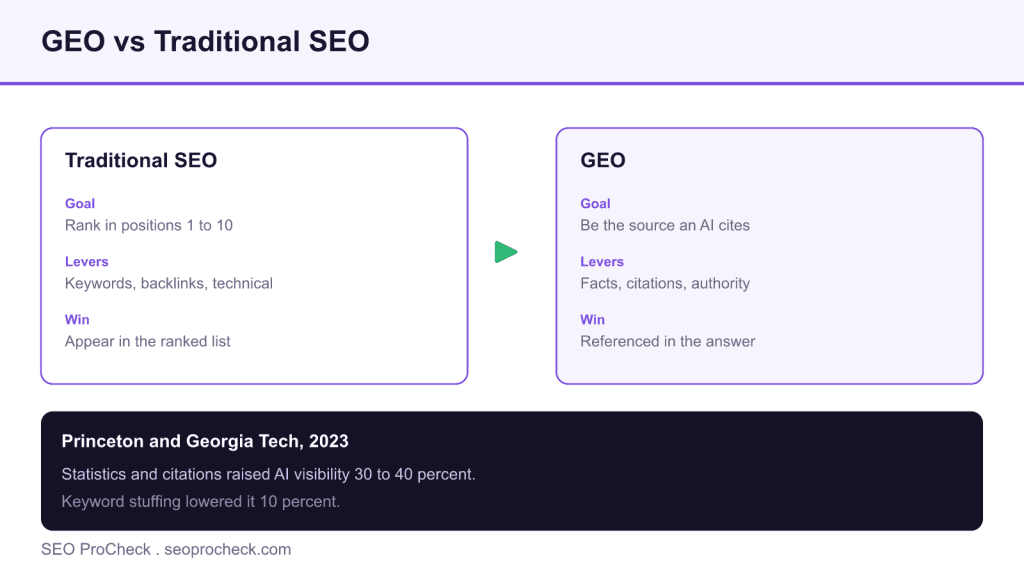
While GEO shares foundations with SEO, critical differences exist. In traditional search, success means ranking in positions 1-10 for a query. In generative search, success means being the source an AI cites when synthesizing an answer. There's no position ranking; either you're cited or you're not.
Traditional SEO emphasizes keywords, backlinks, and technical optimization. GEO emphasizes factual accuracy, citation-worthy content structure, and establishing your content as an authoritative source that AI systems trust. The ranking factors differ significantly: research shows only 12% overlap between pages cited by AI systems and Google's top 10 results.
Core GEO Principles
The Princeton research identified several high-impact techniques. Adding statistics and data improved visibility by 30-40%. Including source citations within content boosted citation rates. Authoritative tone and expertise signals mattered significantly. Importantly, keyword stuffing actually decreased AI visibility by 10%, reversing traditional SEO intuition.
Content structure matters differently in GEO. AI systems extract passages to cite, so content must be structured in citable chunks. Clear, direct answers to questions perform better than content requiring significant interpretation. Factual precision is paramount because AI systems are increasingly fact-checking against multiple sources.
The Business Case for GEO
AI search usage is growing rapidly. Adobe documented 1,200% growth in AI referral traffic to retail sites in one year. While AI still represents a small percentage of total traffic, conversion rates from AI referrals are significantly higher: studies show 6-27x higher conversion rates for AI-referred visitors versus traditional search.
Early movers in GEO are establishing citation presence that will be difficult for latecomers to displace. AI systems develop associations between topics and authoritative sources; building those associations now provides compounding benefits as AI search usage grows.
Getting Started with GEO
Begin by auditing your current AI visibility. Search your brand and key topics in ChatGPT, Perplexity, and Google AI Overviews. Note whether you're cited, and if competitors are cited instead. This baseline reveals opportunities.
Prioritize content that answers specific questions with factual, citable information. Structure content with clear sections that AI can extract. Include relevant statistics with sources. Build topical authority through comprehensive coverage rather than thin keyword-targeted pages.
GEO is not replacing SEO; it's a complementary discipline. The sites winning in AI search typically also have strong traditional SEO foundations. Think of GEO as an additional channel requiring specific optimization while continuing to invest in proven SEO practices.
GEO and SEO Side by Side
GEO does not discard SEO, it changes the definition of winning. The table below maps the same dimensions across both disciplines so you can see where effort transfers and where it has to shift.
| Dimension | Traditional SEO | Generative Engine Optimization |
|---|---|---|
| Goal | Rank in positions 1 to 10 | Be the source an AI cites |
| Primary levers | Keywords, backlinks, technical health | Facts, citations, authority, clean structure |
| Definition of a win | Appear in the ranked list | Get referenced in the generated answer |
| Content shape | Comprehensive pages | Extractable, citable passages |
| Measurement | Position and clicks | Citation presence across AI platforms |
What the Princeton Research Actually Found
The techniques below come from the Princeton and Georgia Tech study. Treat them as a priority list: the first two move the needle most, and the last is a warning that traditional keyword habits can backfire in generative search.
| Technique | Effect on AI visibility |
|---|---|
| Adding statistics and quantitative data | Improved visibility by 30 to 40 percent |
| Including explicit source citations | Boosted citation rates |
| Authoritative tone and expertise signals | Significant positive effect |
| Keyword stuffing | Decreased AI visibility by 10 percent |
Turning these principles into per page edits is the job of citation optimization, our LLM citation optimization guide covers the answer capsule pattern in detail, and because each engine sources differently, the platform tactics in our ChatGPT SEO guide show how to earn citations from the engine that leans on the Bing index.
Frequently Asked Questions
What is Generative Engine Optimization (GEO)?
GEO is the practice of optimizing content so AI language models and generative search engines discover, cite, and accurately represent it. Unlike SEO, which aims to rank in a list of links, GEO aims to make your content the source an AI references when answering a query.
How is GEO different from traditional SEO?
In SEO, success means ranking in positions 1 to 10. In GEO, success means being cited when an AI synthesizes an answer, and there is no position, either you are cited or you are not. Research shows only 12 percent overlap between pages cited by AI systems and Google's top 10 results.
Does GEO replace SEO?
No. GEO is a complementary discipline, not a replacement. The sites winning in AI search typically also have strong traditional SEO foundations, so treat GEO as an additional channel while continuing to invest in proven SEO practices.
Which techniques boost AI visibility the most?
The Princeton and Georgia Tech study found that adding statistics and data improved visibility by 30 to 40 percent and that source citations boosted citation rates. Notably, keyword stuffing decreased AI visibility by 10 percent, reversing traditional SEO intuition.
Is AI search traffic worth optimizing for yet?
Increasingly, yes. Adobe documented 1,200 percent growth in AI referral traffic to retail sites in one year, and studies show 6 to 27 times higher conversion rates for AI referred visitors versus traditional search. The volume is small but high intent and growing fast.
How do I start with GEO?
Audit your current AI visibility by searching your brand and key topics in ChatGPT, Perplexity, and Google AI Overviews and noting whether you are cited. Then prioritize factual, citable content with clear extractable sections and build topical authority rather than thin keyword targeted pages.
Take this with you
The assistant links open with a question about this page already written. Nothing is sent until you press enter.
Claude Vincent is a technical SEO consultant focused on crawlability, rendering, and AI-search visibility. He writes the field guides and case studies at SEO ProCheck, with a bias toward the durable, unglamorous work that decides whether search engines and AI answer engines can actually read and cite a site.
About SEO ProCheck
Technical SEO consulting and GEO strategy with 20 years of enterprise experience. Case studies, resources, and tools for search and AI visibility.
Work With Me
Technical SEO audits, GEO strategy, site migrations, and international SEO. Hourly consulting for teams who need hands-on support, not just reports.
Subscribe to our newsletter!








Recent Posts
- Most Top Sites Never Say Who They Are in Structured Data October 14, 2026
- Homepage Titles Are Mostly Too Short, Not Too Long October 8, 2026
- Who Actually Serves an llms.txt? 184 Top Sites Measured September 29, 2026