

Geo-Modified Keyword Strategy
- January 20, 2025
- GEO (Generative Engine Optimization), AI and Search
AI Summary
A geo modified keyword strategy targets searches that combine a service term with a location, then maps each keyword pattern to exactly one page so you rank for high intent local queries without cannibalizing yourself. You build keywords from an intent modifier, a core service, and a geo modifier, and you serve near me demand through Google Business Profile rather than dedicated pages.
- Geo modified keywords carry high commercial intent and clear local demand.
- Map one keyword pattern to one page to prevent cannibalization.
- Near me queries are won through Google Business Profile, not a near me page.
- Build city pages only where you can offer genuinely distinct local content.
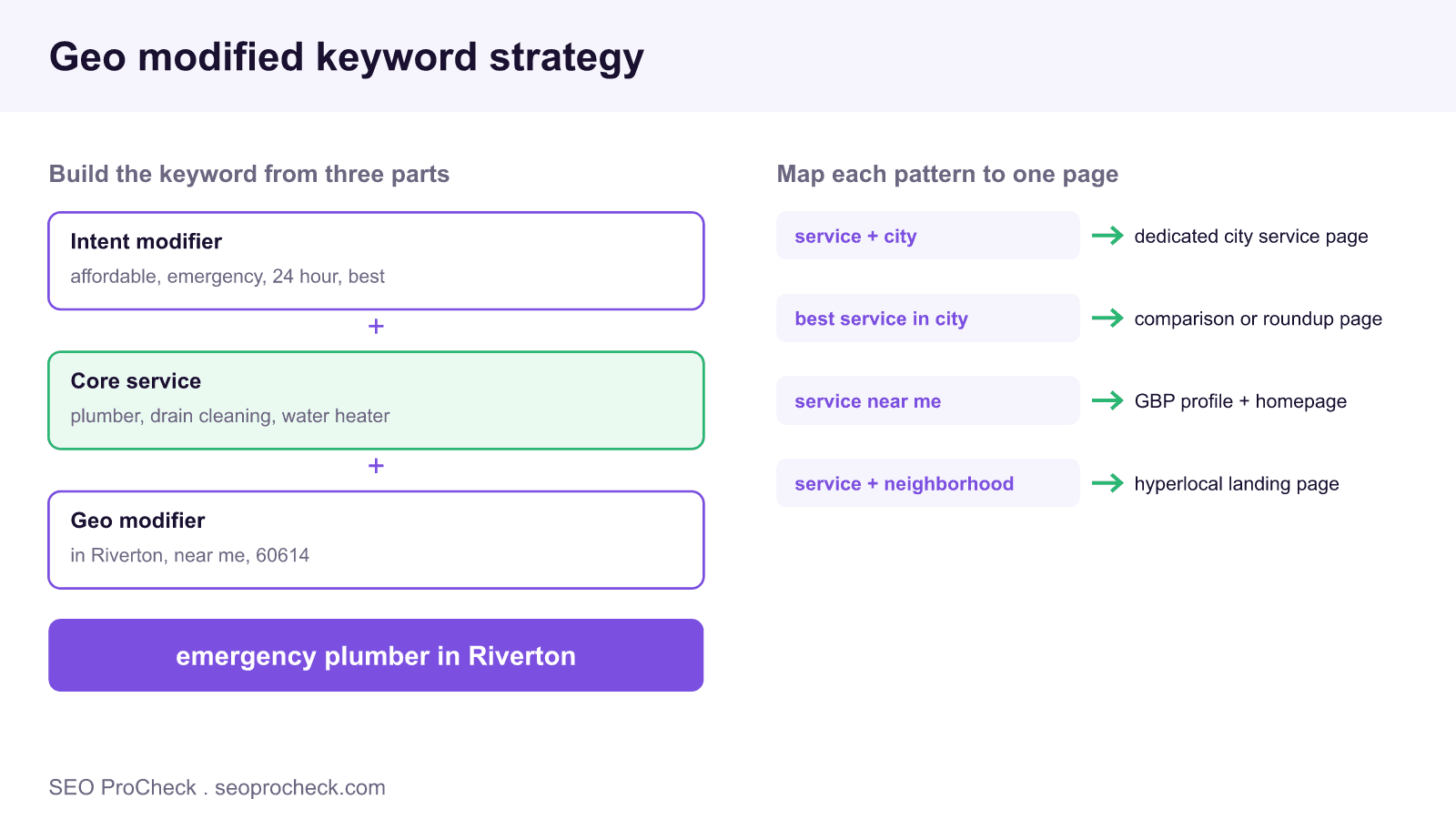
Local searchers rarely type a bare service term. They add a place, an urgency word, or a quality qualifier, and each of those additions changes what result they expect. A geo modified keyword strategy is the discipline of decomposing those queries into their parts, matching each pattern to the one page that should own it, and covering the implicit near me demand you cannot target with a page at all. Done well, it captures the highest intent traffic in local search. Done carelessly, it collapses into a farm of thin city pages that Google ignores.
Anatomy of a geo modified keyword
Almost every local query is built from three interchangeable parts: an intent modifier, a core service, and a geo modifier. The intent modifier signals urgency or quality, words like emergency, affordable, 24 hour, or best. The core service is the job itself, such as plumber, water heater repair, or drain cleaning. The geo modifier is the location, expressed as an explicit city, a neighborhood, a zip code, or the implicit near me. When you see keywords this way, research stops being a guessing game and becomes a combinatorial exercise: take your real services, multiply by the areas you serve, and filter to the combinations with genuine demand.
Explicit versus implicit local intent
The geo modifier splits into two families that you optimize for very differently. Explicit local intent is when the user names the place, as in electrician Springfield. You win these with dedicated, well optimized pages that carry the city in the title, the heading, the URL, and the body. Implicit local intent is when the query has no location but the searcher clearly wants something nearby, as in a plain search for electrician that returns a local pack. You win these through proximity, a complete Google Business Profile, reviews, and strong general service pages, not through a page that pretends to be about a location the query never stated.
Map every pattern to exactly one page
The organizing rule of the whole strategy is one keyword pattern, one page. When two pages chase the same pattern, they split link equity and force Google to guess which to rank, which usually means neither ranks well. The mapping below assigns each common pattern to its natural home.
| Keyword pattern | Example | Intent | Target page |
|---|---|---|---|
| service + city | plumber Riverton | Explicit local, high intent | Dedicated city service page |
| modifier + service + city | emergency plumber Riverton | Urgent, ready to convert | Emergency variant of the city page |
| best + service + in city | best plumber in Riverton | Comparison, researching | Comparison or roundup page |
| service + near me | plumber near me | Implicit local, proximity | Google Business Profile plus homepage |
| service + neighborhood | plumber Old Town | Hyperlocal, high specificity | Neighborhood landing page |
Notice that near me maps to your Google Business Profile and homepage, not to a page. Notice too that emergency and best are different intents from the plain city query, so they earn their own pages rather than being stuffed into one.
Do keyword research the combinatorial way
Start with a clean list of the services you actually sell and the cities and neighborhoods you truly serve. Generate the combinations, then validate each against real search volume in a keyword tool, discarding the ones with no demand. Enrich the list from Google autocomplete, the related searches at the bottom of the results page, and the queries in your own Search Console report, which reveal geo variants you already rank for and could win outright with a focused page. Group every surviving keyword under the single page that should own it, and you have both your content plan and your internal linking map.
Avoid the doorway page trap
The failure mode of geo modified strategies is scale for its own sake: auto generating a page for every city within fifty miles, each identical except for the swapped place name. Google classifies those as doorway pages and suppresses them. Build a city page only when you can fill it with distinct value: work you have done there, local conditions that affect the job, area specific considerations, and real detail. Ten substantive city pages will always outperform two hundred templated ones. When you cannot say anything unique about a location yet, leave it to your general service pages and Google Business Profile until you can.
On page execution
For each explicit geo page, put the full pattern in the title tag and the H1, use a clean URL that includes the city, and write body copy that references the location naturally rather than repeating it mechanically. Add LocalBusiness schema with the relevant areaServed, link the page from your main navigation or a location hub, and support it with reviews that mention the area. This is where keyword strategy meets the mechanics of local landing pages and service area setup.
Related reading
Geo modified keywords are one pillar of a local program. Pair this with our guides to service area business SEO strategy, building local landing pages, and the broader local SEO glossary.
Frequently asked questions
What is a geo modified keyword?
A geo modified keyword is a search query that pairs a product or service term with a location, such as emergency plumber in Riverton or dentist near me. The location component, whether an explicit city, a zip code, or an implicit near me, tells the search engine the user wants a local result. These queries carry high commercial intent because the searcher is usually ready to act.
What is the difference between explicit and implicit local intent?
Explicit local intent is when the user types the location themselves, as in accountant Denver. Implicit local intent is when the query has no location but the search engine infers it from the user position, as in a plain search for accountant that returns a local pack. You optimize for explicit intent with geo modified pages and for implicit intent through a strong Google Business Profile and general service pages.
Should I make a separate page for every city and keyword combination?
Only for combinations you can support with genuinely distinct, useful content. One strong page per city or per service plus city pairing is the goal. Generating hundreds of near identical pages that swap only the city name is doorway page behavior that Google devalues, so prioritize the combinations with real search demand and real substance to say.
How do I find geo modified keywords to target?
Start from your core service terms and layer on the cities and neighborhoods you serve, then validate demand in a keyword tool by checking search volume for each combination. Mine Google autocomplete and the related searches section for local variants, and review Search Console for geo queries you already rank for. Group the results by the page that should own each pattern.
Do near me searches need their own pages?
No, near me queries do not map to a near me page. Google resolves near me by the user location and serves local results, so you win them through Google Business Profile optimization, proximity, reviews, and a solid homepage or service page. Do not create pages literally titled service near me, since they add no value and can look manipulative.
How do I avoid keyword cannibalization with city pages?
Map one dominant keyword pattern to exactly one page and keep the intent distinct across pages. A city service page targets service plus that city, while a comparison page targets best service in that city. If two pages chase the same pattern, consolidate them, since competing pages split link equity and confuse which one Google should rank.
Claude Vincent is a technical SEO consultant focused on crawlability, rendering, and AI-search visibility. He writes the field guides and case studies at SEO ProCheck, with a bias toward the durable, unglamorous work that decides whether search engines and AI answer engines can actually read and cite a site.
About SEO ProCheck
Technical SEO consulting and GEO strategy with 20 years of enterprise experience. Case studies, resources, and tools for search and AI visibility.
Work With Me
Technical SEO audits, GEO strategy, site migrations, and international SEO. Hourly consulting for teams who need hands-on support, not just reports.
Subscribe to our newsletter!







Recent Posts
- Finding a Competitor's Sitemap, and Turning It Into a Change Log September 15, 2026
- AI Crawler User Agents: The Current Names, and Which Ones Sites Actually Block September 9, 2026
- Can AI Crawlers Actually Read Your Site? I Measured 400 of the Biggest September 5, 2026