

AI Summary
Faceted navigation is the filter system on category pages that lets users narrow results by color, size, brand, price, and more. Left unmanaged it multiplies into thousands of near duplicate crawlable URLs that waste crawl budget and dilute rankings, so the strategy is to index only the facet pages with real search demand and contain the rest.
- Facets combine multiplicatively, so four filters with a few options each create thousands of URL variants.
- Index facet pages that people search for, such as a color or brand; canonical or noindex the rest.
- Block truly infinite spaces, such as price sliders and sort orders, from being crawled at all.
- Never noindex a URL you also block in robots.txt, because the crawler never reads the noindex.

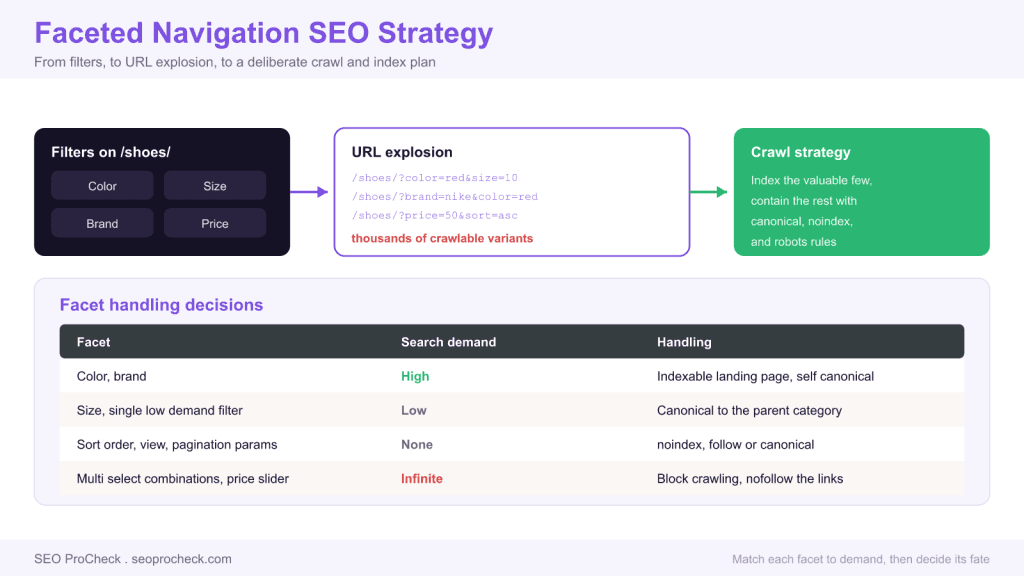
Faceted navigation is the filter panel on a category page: the checkboxes and sliders that let a shopper narrow a shoe listing to red, size 10, Nike, under 100 dollars. It is excellent for users and a notorious hazard for SEO, because every filter combination usually generates its own URL. A category with four facets of a handful of options each can spawn thousands of crawlable, near duplicate pages. Those pages soak up crawl budget, split ranking signals across duplicates, and can bury your real category pages. This guide is the decision framework for keeping the value and cutting the waste.
Why facets explode
The damage is combinatorial, not additive. Filters multiply. Take a shoes category with these facets: 6 colors, 8 sizes, 10 brands, and 5 price bands. If any combination is a crawlable URL, that is 6 times 8 times 10 times 5, which is 2,400 URL variants from a single category, before you add sort order and pagination. Multiply that across every category on the site and a small catalog becomes a crawl of hundreds of thousands of thin, overlapping pages. Google spends its crawl budget fetching them instead of your important pages, and it may pick the wrong variant to rank.
The core question: does this facet have search demand?
Every facet decision comes down to one question. Do people search for this filtered view? If shoppers search "red running shoes" or "Nike trainers," the color and brand facet pages are valuable landing pages and should be indexable. If nobody searches "size 10 shoes sorted by newest," that view has no search demand and should not compete in the index. Match the handling to the demand.
| Facet type | Search demand | Recommended handling |
|---|---|---|
| Color, brand, category attribute people search | High | Indexable landing page with a self referencing canonical and a unique title |
| Single low demand filter such as size | Low | Canonical to the parent category page |
| Sort order, view mode, pagination parameter | None | noindex, follow, or canonical to the unsorted view |
| Multi facet combinations, price sliders | Infinite variants | Block crawling and nofollow the links so they are never generated |
The four tools and when each applies
Self referencing canonical (index this facet)
For a facet page you want to rank, give it a canonical that points to itself, a unique title and heading, and ideally a short block of intro copy. This tells Google the page is the authoritative version for "red running shoes" and should stand on its own.
Canonical to parent (consolidate a low demand facet)
For a low value filter, set the canonical to the parent category. The filtered page still works for users, but Google consolidates its signals into the main category and does not treat it as a separate rankable page. Note that a canonical is a hint, not a directive; Google can ignore it if the pages differ too much, so reserve it for genuinely near duplicate views.
noindex, follow (keep it out but keep link flow)
When a view should never rank but you still want Google to crawl through it to products, use a robots meta tag of noindex, follow. The page stays out of the index while its links continue to pass crawl paths. This suits sort orders and combinations that have no search demand but sit above product links.
robots.txt block (stop crawling an infinite space)
For parameters that create effectively infinite URLs, price sliders, session tokens, tracking parameters, disallow the parameter pattern in robots.txt so Googlebot never fetches them. The one rule you must not break: never combine a robots.txt block with a noindex on the same URL. The block stops the fetch, so the crawler never reads the noindex, and the URL can still appear as a bare link. Pick one mechanism per URL. The mechanics are covered in the robots.txt reference and the robots meta reference.
Supporting tactics
- Keep facet links out of the crawl where possible. Rendering filters via buttons that update the page without generating a new crawlable URL, or adding rel nofollow to low value facet links, stops the explosion at the source rather than cleaning it up afterward.
- Order parameters consistently. If
?color=red&size=10and?size=10&color=redboth resolve, you have doubled your duplicates. Enforce a fixed parameter order. - Confirm with logs. After you set the rules, read server logs to verify Googlebot has stopped crawling the blocked patterns. Use Python log file parsers to measure the share of crawl hitting parameter URLs before and after.
- Audit at scale. Run your facet URL patterns through bulk URL testing scripts to confirm the intended pages return 200 and self canonical, while contained variants canonicalize or noindex correctly.
Faceted navigation is one of the highest leverage areas in technical SEO for any ecommerce site, because it is where crawl budget is most easily wasted and most easily recovered.
FAQ
Faceted navigation is the filtering system on category pages that lets users narrow a product list by attributes like color, size, brand, and price. Each filter selection usually creates a new URL. In SEO terms it is powerful for users but risky, because unmanaged facets generate thousands of near duplicate URLs that waste crawl budget and split ranking signals.
Because facets combine multiplicatively. Four filters with a handful of options each can produce thousands of URL variants from one category. If each is crawlable, Googlebot spends its limited crawl budget fetching near duplicate pages instead of your important content, which slows the discovery and refresh of pages that actually matter.
Use a canonical to the parent for low value filtered views that are near duplicates of the category, so signals consolidate. Use noindex, follow when a view should never rank but you still want crawl paths through its links, such as sort orders. Canonical is a hint Google can ignore; noindex is a firm instruction, so choose based on whether you need certainty.
Index the facets that people actually search for. Color and brand filters often match real queries like red running shoes or Nike trainers, so those make strong indexable landing pages with unique titles. Filters with no search demand, such as sort order or an obscure size combination, should be consolidated or kept out of the index.
Blocking everything is risky. A robots.txt disallow stops crawling, but it also blocks link discovery through those pages and prevents Google from reading any noindex on them. Blanket blocks can strand products that are only linked from filtered views. Reserve robots.txt blocks for infinite spaces like price sliders, and use canonical or noindex for the rest.
Yes. AI crawlers face the same duplication and crawl waste, and a bloated facet space makes it harder for any engine to identify your canonical category and product pages. A clean facet strategy that surfaces a few strong landing pages helps both classic search and AI systems understand what your important pages are.
Is faceted navigation draining your crawl budget?
On large catalogs, filtered URLs often outnumber real pages ten to one. An audit maps which facets to index and which to contain, and quantifies the recovered crawl budget.
Claude Vincent is a technical SEO consultant focused on crawlability, rendering, and AI-search visibility. He writes the field guides and case studies at SEO ProCheck, with a bias toward the durable, unglamorous work that decides whether search engines and AI answer engines can actually read and cite a site.
About SEO ProCheck
Technical SEO consulting and GEO strategy with 20 years of enterprise experience. Case studies, resources, and tools for search and AI visibility.
Work With Me
Technical SEO audits, GEO strategy, site migrations, and international SEO. Hourly consulting for teams who need hands-on support, not just reports.
Subscribe to our newsletter!







Recent Posts
- Can AI Crawlers Actually Read Your Site? I Measured 400 of the Biggest September 5, 2026
- The Pre-Publish Quality Gate for AI-Assisted Content August 6, 2026
- AGENTS.md vs llms.txt vs llms-full.txt: Which Agent File Does What July 18, 2026