


AI Summary
Rank tracking records where your pages appear in search results for a chosen set of keywords, on a schedule, so you can connect the work you ship to real movement in the SERP. The position a tracker reports is one sample from a fixed location, device, and moment, so read it as a consistent trend line rather than an absolute truth.
- A tracked position is one observation from one location, one device, and one moment, usually a logged out data center IP.
- Pair a tracker with Search Console: the tracker is a daily microscope, Console is the census of every real impression.
- Fix your conditions (location, device, language) and write them down, or the numbers mean nothing.
- Judge multi week trends and cluster level movement, not single day wobble.
Rank tracking is the practice of recording where your pages show up in search results for a chosen set of keywords, on a schedule, so you can see movement over time. You do it to connect the work you ship, content updates, technical fixes, new links, to what actually changed in the SERP, and to catch drops before they become traffic losses.
There is no single "ranking", you're sampling
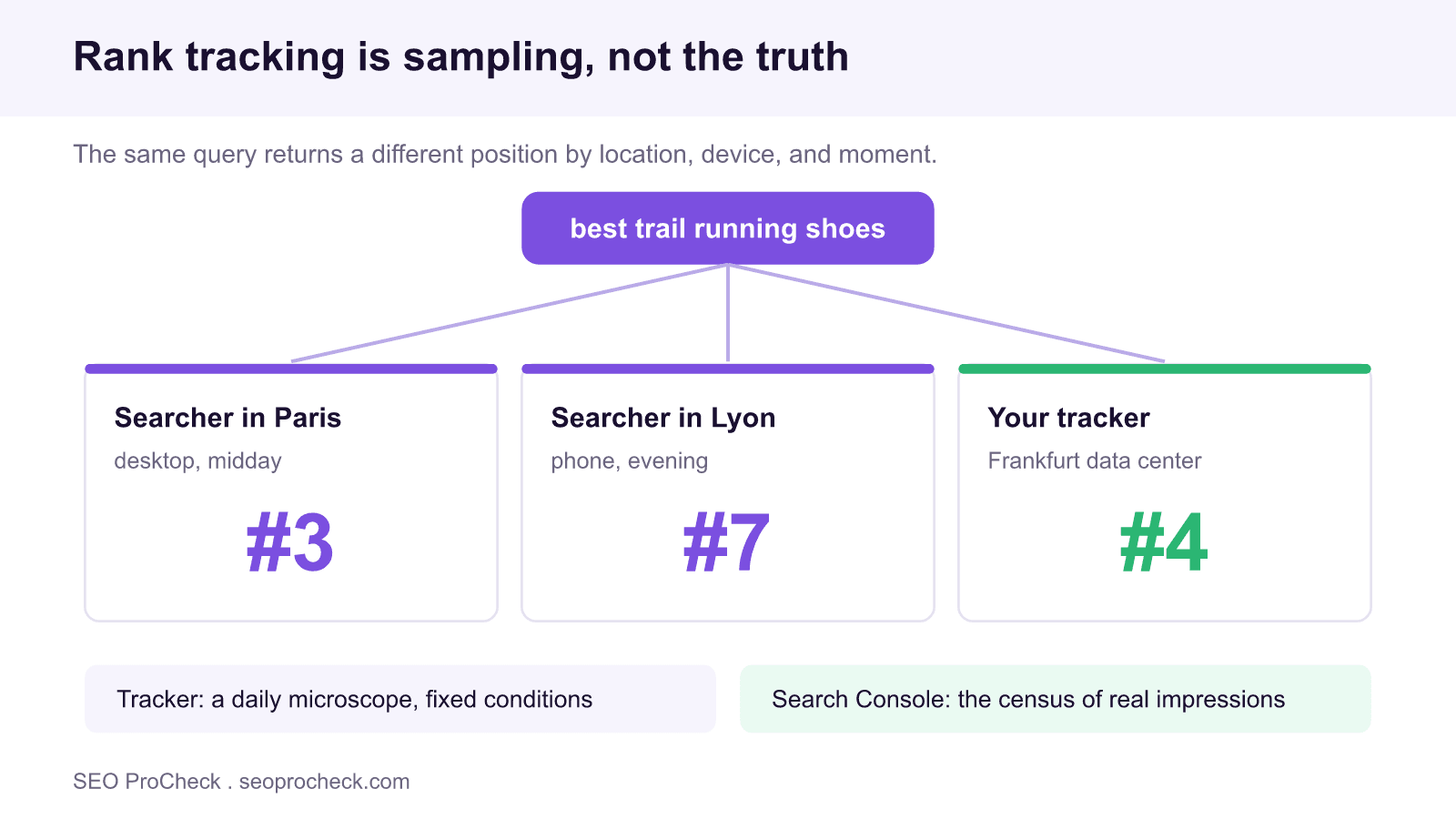
Here's the part most tool dashboards gloss over: the position your tracker reports is not the ranking. It's one observation from one location, one device, one language setting, at one moment, usually from a logged-out data-center IP. Change any of those variables and the number changes. A user in Lyon on a phone at 8pm sees a different result than a user in Paris on a desktop at noon, and both see something different from your tracker's proxy in a Frankfurt data center.
Personalization, localization, device type, SERP feature rotation, and Google's constant live testing all mean that "we rank #3 for X" is shorthand for "our tracker's sample said #3 under its specific conditions." That's still useful, a consistent sample measured the same way every day is a legitimate trend line. It just stops being useful the moment someone treats the absolute number as ground truth, or panics because the boss's phone shows #7 when the report says #4. Both are real observations. Neither is the whole picture.
This is why rank tracking and Google Search Console belong together. Your tracker gives you clean, daily, same-conditions readings for the keywords you chose to watch. Search Console gives you the messy truth: average position across every real impression, including hundreds of queries you never thought to track. The tracker is a microscope; Console is the census.
Tracking approaches and what each one misses
| Approach | What it tells you | What it misses |
|---|---|---|
| Manual incognito checks | A rough spot-check, right now, from your IP | Incognito does not remove localization, your city still shapes results. One-off checks have no trend, and you'll unconsciously check only when you expect good news. |
| Scheduled tool tracking (Semrush, Ahrefs, etc.) | Consistent daily/weekly positions from fixed location + device settings | Everything outside its sample: other cities, personalized results, and any query you didn't add to the list. Costs scale with keyword count, so lists get pruned to "important" terms and long-tail movement goes unseen. |
| GSC average position | Real average across all impressions that actually happened | Averages hide splits: position 2 in one country and 40 in another reports as ~20. No data at all on queries with zero impressions, which is exactly where new pages live. |
| SERP feature tracking | Whether a snippet, AI Overview, local pack, or video block sits above you | Position #1 below an AI Overview is not the #1 of 2019. Many trackers still count only classic blue links unless you turn feature tracking on. |
| Local grid tracking (map-pin sampling) | How rankings shift block-by-block across a metro area for local queries | Only relevant for local intent; overkill and misleading for informational queries. Grid points are still samples, just denser ones. |
How to set up rank tracking that's worth reading
- Pick keywords that map to money or mission, not vanity. Twenty terms you'd genuinely act on beat five hundred you scroll past. Include a handful of long-tail queries per key page, not just head terms.
- Fix the conditions. Set location (as granular as your business needs, country, city, or zip), device (track mobile if your traffic is mobile), and language. Write these settings down; the numbers are meaningless without them.
- Turn on SERP feature tracking so you know when a feature, not a competitor, ate your clicks.
- Tag keywords by page and by intent so you can read movement at the group level. One keyword wobbling is noise; a tagged cluster sliding is a signal.
- Annotate changes. Log deploy dates, content updates, and known algorithm updates against the timeline. Without annotations you're just watching a heartbeat monitor with no patient chart.
- Review weekly, judge monthly. Daily positions wiggle. Trends over 4 to 8 weeks are what you act on.
Common mistakes (and fixes)
- Treating daily wobble as news. A two-position move within a day is usually SERP churn. Fix: act on multi-week trends and cluster-level movement, not single-keyword blips.
- Tracking from the wrong location. A US-national setting for a business that sells in three cities produces numbers nobody experiences. Fix: match tracking location to where your customers actually search.
- Ignoring SERP features. "We held #2 but traffic fell 30%" is almost always a feature or AI Overview stealing clicks above you. Fix: track pixel depth or feature presence, and check CTR in Search Console alongside position.
- Reporting average position as a KPI. Averages across keyword sets reward adding easy keywords and punish targeting hard ones. Fix: report share of keywords in top 3 / top 10 per cluster, plus actual clicks.
- Letting the keyword list rot. The queries that mattered in 2023 may be irrelevant now. Fix: audit the list quarterly against Search Console's real query data and swap out dead weight.
FAQ
Why does my tool show a different position than what I see in my browser?
Because you and the tool are different searchers. Your browser session carries your location, device, and history; the tool queries from its own infrastructure with its own settings. Both are valid samples of a results page that is assembled per-request. If they're consistently far apart, check that the tool's location and device settings match your market.
How often should ranks be checked?
Daily for core commercial terms, weekly for the long tail. More frequent than daily buys you noise, not insight, positions fluctuate intraday and you'll chase ghosts.
Is rank tracking still worth it now that AI Overviews rewrite the SERP?
Yes, but position alone is worth less. A #1 that sits under an AI Overview, three ads, and a snippet gets a fraction of its old clicks. Track position and what sits above it, and weigh both against real CTR from Search Console.
Can I just use Search Console instead of a rank tracker?
For a small site, mostly yes, and it's free and based on real impressions. You give up daily granularity, fixed-location sampling, competitor tracking, and data on queries you don't yet rank for. Larger sites and agencies usually want both. See how to choose a rank tracker for the trade-offs.
Do rank trackers violate Google's terms?
Automated scraping of Google results is against Google's ToS, which is why trackers use proxy networks and why the data costs money. It's an industry-wide open secret; the practical risk sits with the tool vendors, not with you as a subscriber.
For a deeper treatment of localization traps and vanity metrics, read Rank Tracking Done Right. If you're picking a platform, Semrush's Position Tracking is one of the more configurable implementations of everything described above.
Take this with you
The assistant links open with a question about this page already written. Nothing is sent until you press enter.
Claude Vincent is a technical SEO consultant focused on crawlability, rendering, and AI-search visibility. He writes the field guides and case studies at SEO ProCheck, with a bias toward the durable, unglamorous work that decides whether search engines and AI answer engines can actually read and cite a site.
About SEO ProCheck
Technical SEO consulting and GEO strategy with 20 years of enterprise experience. Case studies, resources, and tools for search and AI visibility.
Work With Me
Technical SEO audits, GEO strategy, site migrations, and international SEO. Hourly consulting for teams who need hands-on support, not just reports.
Subscribe to our newsletter!








Recent Posts
- Most Top Sites Never Say Who They Are in Structured Data October 14, 2026
- Homepage Titles Are Mostly Too Short, Not Too Long October 8, 2026
- Who Actually Serves an llms.txt? 184 Top Sites Measured September 29, 2026