

AI Summary
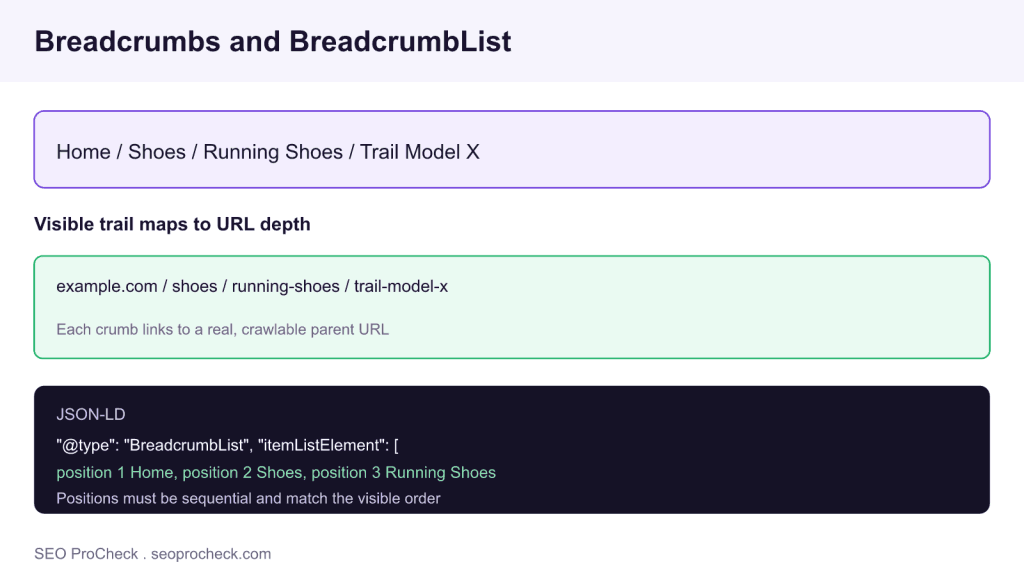
A breadcrumb is a secondary navigation trail that shows a page location inside the site hierarchy, for example Home then Shoes then Running Shoes. Marked up with BreadcrumbList structured data, it improves internal linking, orientation, and can replace the raw URL with a readable path in Google results.
- Breadcrumbs mirror your URL and category depth, so they reinforce site architecture and internal linking.
- Add BreadcrumbList JSON-LD with sequential
positionvalues that match the visible trail. - Each crumb should link to a real, crawlable parent URL, not a dead anchor.
- Breadcrumb rich results can display the path instead of the URL, which improves clarity and can lift click through.
What a breadcrumb is
A breadcrumb is a secondary navigation element, usually a horizontal trail near the top of the page, that shows where the current page sits within the site hierarchy. A typical trail reads Home then a category then a subcategory then the current page. The name comes from the trail of markers that lets a user retrace a path. For search engines the trail is equally useful: it exposes the parent child relationships between pages and reinforces how the site is organized.
There are three common breadcrumb types. A hierarchy breadcrumb reflects the site structure and is by far the most common and the most useful for SEO. An attribute breadcrumb reflects filters or facets a user has applied, common on faceted commerce listings. A history breadcrumb reflects the path the user personally took, which is rarely useful and should not be marked up as structured data. For nearly all sites the hierarchy breadcrumb is the one to implement.
Why breadcrumbs matter for SEO
Breadcrumbs deliver value on three fronts. First, orientation: they tell a visitor exactly where they are and give a one click route back up to broader category pages, which reduces bounce and helps discovery. Second, internal linking: every crumb is a contextual link to a parent page, and those links pass relevance and authority up the hierarchy while helping crawlers reach category pages. Third, search appearance: when you add BreadcrumbList structured data, Google can render the breadcrumb path in place of the plain URL in the result, which is easier to read and signals the page context before the click.
Implementing BreadcrumbList structured data
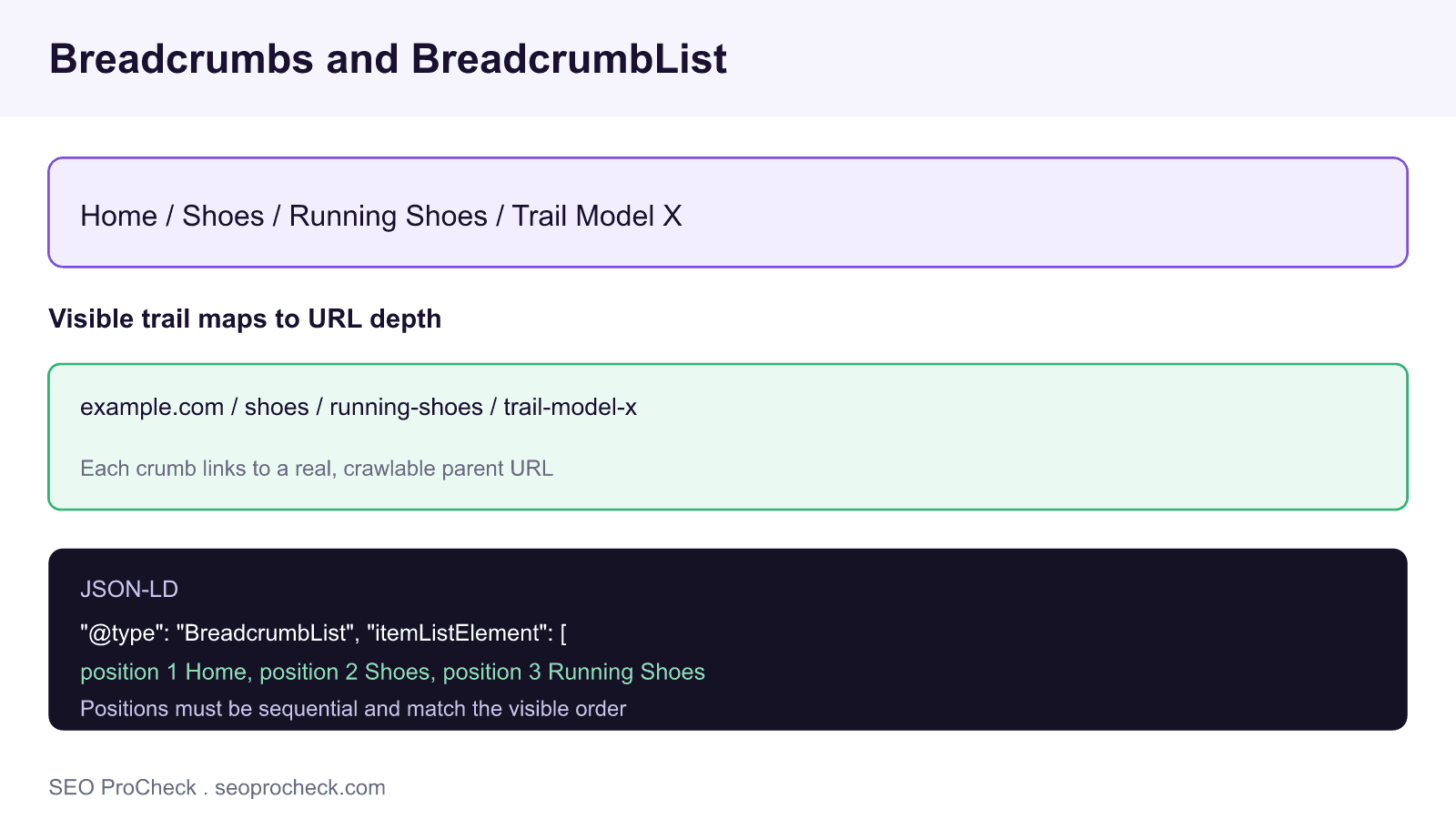
The markup that powers breadcrumb rich results is the BreadcrumbList type from schema.org, delivered as JSON-LD in the page head or body. Each level is an itemListElement of type ListItem with three parts: a position integer, a name, and an item that is the absolute URL of that level. The rules that trip people up are strict. Positions must start at 1 and increase by 1 with no gaps. The order and names in the markup must match the trail a user actually sees on the page. The final crumb, the current page, should still be represented, though many implementations omit its URL because it is the page itself.
Validate every implementation with the Rich Results Test and the Schema Markup validator. Google Search Console also reports a dedicated Breadcrumbs enhancement section that flags missing fields and parse errors across the site, which is the fastest way to catch a template level mistake affecting thousands of URLs.
Match the trail to real URL structure
Breadcrumbs create trust only when they are honest. The trail should map to the genuine URL and category structure. If your URL is example.com then shoes then running-shoes then a product, the trail should read Home, Shoes, Running Shoes, Product, and each crumb should link to a URL that returns 200. A common failure is a breadcrumb that references a virtual category with no real landing page, which produces a dead crumb and a poor experience. Another is a mismatch where the visible trail and the marked up trail disagree, which invalidates the structured data.
When breadcrumbs help most
Breadcrumbs pay off most on deep sites: large ecommerce catalogs, documentation, knowledge bases, and news archives where pages sit several levels below the home page. On a small brochure site with a flat structure the benefit is marginal. The practical rule is that if a page is more than two levels deep, a breadcrumb both helps the user climb back up and gives crawlers an extra structured path to the intermediate category pages that often struggle for internal links.
Related terms
Site Architecture, Navigation, Schema Markup, Internal Linking, Structured Data.
Breadcrumb types and SEO use
| Type | Reflects | Mark up with schema? | Best for |
|---|---|---|---|
| Hierarchy | Site structure | Yes, BreadcrumbList | Most sites, commerce, docs |
| Attribute | Applied filters | Sometimes, if stable URLs | Faceted catalogs |
| History | User click path | No | Rarely recommended |
Frequently Asked Questions
What is a breadcrumb in SEO?
It is a navigation trail that shows a page location within the site hierarchy, such as Home, Category, Subcategory, Page. It improves user orientation, adds internal links to parent pages, and can appear as a rich result in Google search.
How do I add breadcrumb schema?
Add a BreadcrumbList JSON-LD block where each level is a ListItem with a position, a name, and an item URL. Positions must start at 1 and increase without gaps, and the order must match the visible trail. Validate with the Rich Results Test.
Do breadcrumbs help rankings?
They help indirectly. They strengthen internal linking to category pages, clarify site structure for crawlers, and can improve click through when the path replaces the URL in results. They are not a direct ranking factor on their own.
Should the breadcrumb match my URL structure?
Yes. The trail should mirror the real category and URL hierarchy, and every crumb should link to a page that returns 200. A trail that references categories with no real landing page creates dead crumbs and weak signals.
Where should breadcrumbs appear on the page?
Near the top, above the main heading, so users see their location before reading. Keep them on category, subcategory, product, and article pages. The home page itself does not need a breadcrumb.
Do small websites need breadcrumbs?
The benefit grows with depth. On a flat site of a few pages breadcrumbs add little. On a site where pages sit three or more levels deep they meaningfully help both navigation and crawl paths to intermediate pages.
Learn More
Technical Definition
Breadcrumbs show page location within site hierarchy. Example: Home > Category > Subcategory > Page. Benefits: improved navigation, internal linking, enhanced SERP display (breadcrumb rich results). Implement with BreadcrumbList schema. Should match actual URL structure. Useful for complex sites with deep hierarchies.
Simple Explanation (ELI13)
Breadcrumbs are the navigation trail showing where you are on a site, like 'Home > Shoes > Running Shoes.' They help users navigate and can appear in search results instead of the URL. Implement them with schema markup. They're especially useful for e-commerce and large sites.
Related Terms
Site Architecture, Navigation, Schema Markup, Internal Linking
Learn More
Take this with you
The assistant links open with a question about this page already written. Nothing is sent until you press enter.
Claude Vincent is a technical SEO consultant focused on crawlability, rendering, and AI-search visibility. He writes the field guides and case studies at SEO ProCheck, with a bias toward the durable, unglamorous work that decides whether search engines and AI answer engines can actually read and cite a site.
About SEO ProCheck
Technical SEO consulting and GEO strategy with 20 years of enterprise experience. Case studies, resources, and tools for search and AI visibility.
Work With Me
Technical SEO audits, GEO strategy, site migrations, and international SEO. Hourly consulting for teams who need hands-on support, not just reports.
Subscribe to our newsletter!








Recent Posts
- Most Top Sites Never Say Who They Are in Structured Data October 14, 2026
- Homepage Titles Are Mostly Too Short, Not Too Long October 8, 2026
- Who Actually Serves an llms.txt? 184 Top Sites Measured September 29, 2026