

AI Summary
Rich results are search listings enhanced beyond the standard title and snippet, drawn straight from a page's structured data. Valid markup makes a page eligible, never entitled; Google decides per query and per day whether to show the enhancement, so maximize eligibility and then measure.
- Rich results change click through rate at your position, not the ranking itself.
- Miss one required property and the page loses eligibility entirely.
- FAQ was restricted and HowTo retired in 2023 despite valid markup, and FAQ was retired for every site on May 7, 2026.
- Measure real uplift in Search Console Search Appearance, not vendor case studies.

Rich results are Google search listings enhanced beyond the standard title-and-snippet: star ratings, prices, event dates, recipe photos, job details pulled straight from a page's structured data. They matter because they change click-through rate at the same ranking position, and because Google giveth and Google taketh away, sometimes retiring an entire rich result type overnight while your markup stays perfectly valid.
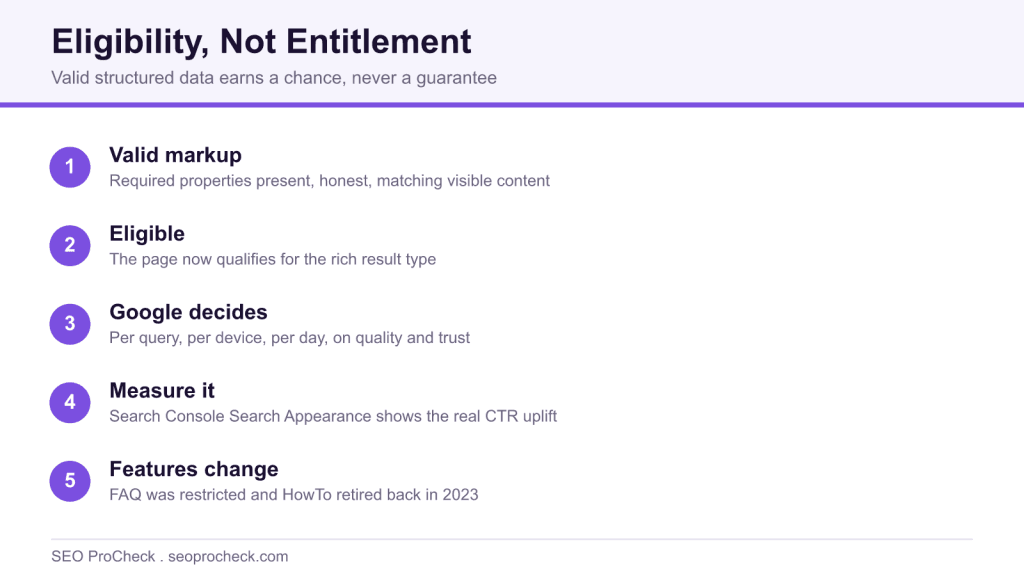
Eligibility, not entitlement
This is the part that trips people up in every audit conversation: valid structured data makes a page eligible for a rich result. It never guarantees one. Google decides per query, per device, per day whether to show the enhancement, based on result quality, site trust, and whatever the SERP layout team is testing that week. Two pages with byte-identical markup can get different treatment. So the job is to maximize eligibility, complete required properties, honest data, visible content, and then measure, rather than promise anyone stars.
The recent history proves the point. In August 2023 Google restricted FAQ rich results to a handful of well-known government and health sites and retired HowTo rich results entirely. Millions of pages carried valid FAQPage markup the day after; none of them got the accordion back. If your traffic case rests on a specific rich result existing forever, you don't have a strategy, you have a tenancy.
What each result type actually demands
Every rich result type has required properties (miss one, no eligibility), recommended properties (miss them, weaker eligibility), and a set of disqualifiers that Google's documentation states but people skip. The ones that matter most in practice:
| Rich result | Required properties (minimum) | Common disqualifiers seen in audits |
|---|---|---|
| Product snippet | name plus at least one of offers, review, aggregateRating | Markup on category/list pages; price mismatch with visible page; adult-category exclusions |
| Review snippet (stars) | reviewRating or aggregateRating with ratingValue, attached to a supported type | Self-serving reviews (LocalBusiness/Organization rating itself on its own site); ratings with no visible reviews |
| Recipe | name, image | Missing image; image ratios wrong; marking up non-recipe content as Recipe |
| Event | name, startDate, location | Marking up sales or promotions as events; expired events left live |
| JobPosting | title, description, datePosted, hiringOrganization, jobLocation | Expired listings not removed (a stated policy violation); markup on list pages instead of detail pages |
| Video | name, thumbnailUrl, uploadDate | Thumbnail not fetchable; video not actually the main content of the page |
| Breadcrumb | itemListElement with positioned items | Breadcrumb trail in markup doesn't match visible navigation |
| FAQ | mainEntity Question/Answer pairs | Retired for every site on May 7, 2026, government and health included; eligibility is gone regardless of markup quality |
Measuring what a rich result is worth
Rich results don't change your rank; they change what happens at your rank. The clean way to quantify it: Search Console → Performance → Search Appearance filter. Compare CTR for impressions with a given appearance ("Product snippets", "Review snippet", "Videos") against your plain results at similar average positions. That's your real uplift number, not a vendor's case study. It also gives you the before/after when an enhancement disappears, which is how you distinguish "Google turned off a feature" from "we broke our markup."
How to check it on your own site
- Run key templates through the Rich Results Test (search.google.com/test/rich-results). It reports only Google-supported types and tells you which enhancements the page is eligible for, with errors and warnings separated.
- Open Search Console → Enhancements. Each detected type gets its own report with valid/error counts across the site. Errors block eligibility; warnings mean missing recommended fields.
- In Performance → Search Appearance, confirm the rich results are actually showing in the wild and check their CTR against baseline.
- Search Google for
site:yourdomain.complus a money query and eyeball the live SERP on mobile, the appearance reports lag, the SERP doesn't. - When something's eligible in testing but absent in the SERP, walk a structured debugging checklist before touching the markup, the cause is often visibility, policy, or trust rather than syntax.
Common mistakes
- Chasing stars with self-serving reviews. An agency site marking up its own testimonials as aggregateRating on its homepage. Google explicitly excludes self-serving reviews for LocalBusiness and Organization, at best ignored, at worst a manual action. Fix: review markup belongs on things you sell or review, not on yourself.
- Treating "valid with warnings" as done. Warnings are the gap between technically eligible and competitively eligible. A Product with no
availabilityshows a weaker snippet than the competitor with full fields. Fix: close recommended properties on templates that earn money. - Panic when a rich result vanishes. Half the time nothing broke, Google reduced that feature's footprint (ask anyone who had FAQ accordions in 2023). Fix: check the Search Appearance trend across the whole site and industry chatter before rewriting working markup.
- Markup describing what users can't see. Ratings with hidden reviews, FAQ answers that exist only in the JSON. This is the violation Google's documentation names most explicitly. Fix: on-page visibility first, markup second.
- Stale time-sensitive data. Expired job postings and past events left marked up keep pages "eligible" for results that mislead users, a policy problem that compounds. Fix: expire the markup with the content, automatically.
FAQ
My markup is valid, why isn't Google showing the rich result?
Because valid means eligible, not shown. Common non-syntax causes: the content isn't visible on the page, the site hasn't earned enough trust, the result type is retired (FAQ since May 7, 2026, HowTo since 2023), or Google simply isn't showing that feature for those queries. Check the Search Appearance report to see if it's showing anywhere before assuming the page is the problem.
Do rich results improve rankings?
No. They improve presentation at whatever position you already earn, which typically improves CTR. The structured data feeding them helps comprehension, but position is decided by the usual ranking systems.
Which rich results are still worth pursuing in 2026?
Product, review snippets (on genuine review content), Recipe, JobPosting, Event, Video, and Breadcrumb all remain live and valuable. FAQ and HowTo are gone for all sites, keep the underlying schema markup only for entity and AI-parsing value, not for SERP features.
What format do I write the structured data in?
Rich results are powered by structured data, and the format Google recommends for it is JSON-LD, a detached script block that's easy to template and validate. The format entry covers the mechanics.
Can a rich result be taken away as a penalty?
Yes, structured data manual actions exist, and they remove rich result eligibility site-wide until you fix the violation and file reconsideration. They're rare, and they almost always trace back to marking up content users can't see or inflating ratings.
Take this with you
The assistant links open with a question about this page already written. Nothing is sent until you press enter.
Claude Vincent is a technical SEO consultant focused on crawlability, rendering, and AI-search visibility. He writes the field guides and case studies at SEO ProCheck, with a bias toward the durable, unglamorous work that decides whether search engines and AI answer engines can actually read and cite a site.
About SEO ProCheck
Technical SEO consulting and GEO strategy with 20 years of enterprise experience. Case studies, resources, and tools for search and AI visibility.
Work With Me
Technical SEO audits, GEO strategy, site migrations, and international SEO. Hourly consulting for teams who need hands-on support, not just reports.
Subscribe to our newsletter!








Recent Posts
- Most Top Sites Never Say Who They Are in Structured Data October 14, 2026
- Homepage Titles Are Mostly Too Short, Not Too Long October 8, 2026
- Who Actually Serves an llms.txt? 184 Top Sites Measured September 29, 2026