

Anchor Text Distribution Study: Natural vs Optimized Profiles
- March 10, 2022
- Cross-Industry
AI Summary
A natural anchor text profile is led by branded and naked URL anchors, with exact-match keyword anchors kept to a small share, while an over optimized profile inflates exact-match anchors and invites algorithmic scrutiny. Diversify anchors, let earned links keep their own wording, and audit the mix on a schedule.
- Branded anchors usually form the largest slice of a healthy profile, often around 30 to 50 percent.
- Exact-match keyword anchors are naturally rare, so a high share is a classic over optimization signal.
- Relevance of the linking page tends to matter more than the exact anchor wording.
- Run periodic anchor audits to catch spikes before they become a liability.

Why anchor text distribution is a risk signal
Anchor text is one of the few link signals a publisher can partly control, which is exactly why search engines treat an unnatural distribution as a footprint. When a site earns links organically, editors and readers describe it in many ways: the brand name, the bare URL, a partial phrase, or a generic call to action such as read more. A profile built to rank, by contrast, tends to repeat the same money keyword because someone chose that wording on purpose. The shape of the distribution, not any single link, is what stands out.
For practical guardrails on wording, our anchor text best practices guide covers what to aim for and what to avoid, and the internal linking study on anchor placement shows how the same principles apply inside your own site.
What a natural profile looks like in practice
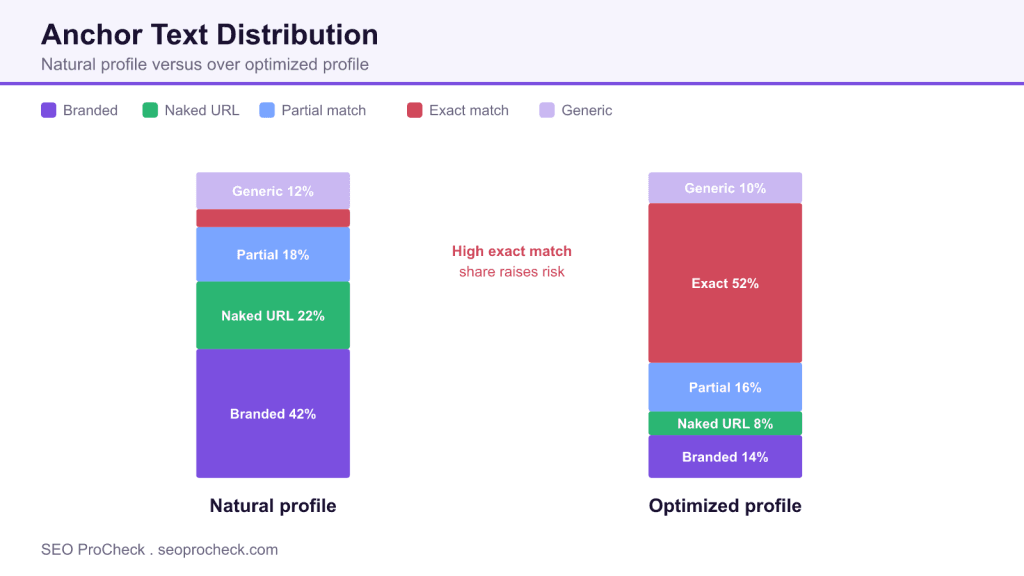
Across healthy profiles, branded anchors dominate because people link to a company by its name. Naked URLs (the raw address pasted into a sentence or a citation) form another large block. Partial matches and topically relevant variations appear when writers paraphrase, and true exact-match anchors stay comparatively rare. Generic anchors such as here or this article round out the mix. The takeaway for a link builder is counterintuitive: a profile that is too clean, meaning wall to wall keyword anchors, looks less natural than a messy one.
Over optimization signals to watch
Three patterns repeatedly correlate with trouble. First, a high absolute share of exact-match anchors pointing at commercial pages. Second, sudden spikes, where a page picks up dozens of keyword-rich anchors in a narrow window rather than accumulating them slowly. Third, low diversity, where the same two or three phrases repeat across unrelated referring domains. Any one of these can be innocent, but together they form the footprint that manual reviewers and link algorithms are tuned to notice. If the referring domains are also low quality, review our notes on toxic backlinks and the disavow tool before the profile compounds.
How to build and maintain a durable profile
Favor strategies that produce variety by default. Digital PR, resource pages, and genuinely useful assets earn branded and descriptive anchors without you dictating the text. When you can influence anchors, for example in guest contributions or partner listings, choose brand or partial phrases over the exact keyword. Resist the urge to standardize; the value of an editorial link is that a real person chose the words. On your own pages, keep internal anchors descriptive and specific, and fix the opposite problem too, since a page flagged for non descriptive anchor text loses the relevance signal a good anchor provides.
Set a review cadence. Quarterly, export your backlinks, bucket every anchor into branded, naked URL, partial, exact, or generic, and chart the percentages. If exact-match creeps upward, dilute it deliberately with branded outreach rather than trying to remove links. The goal is a distribution that trends toward the natural shape over time.
Anchor type reference
| Anchor type | Example | Typical natural share | Risk if overused |
|---|---|---|---|
| Branded | SEO ProCheck | High | Low |
| Naked URL | seoprocheck.com | Medium | Low |
| Partial match | this anchor text guide | Medium | Moderate |
| Exact match | anchor text distribution | Low | High |
| Generic | click here, read more | Low to medium | Low, but weak signal |
What has changed since
Since this research was compiled, Google has folded its link systems into the core algorithm and its link spam detection (SpamBrain) now often neutralizes the value of manipulative links rather than always issuing a penalty. The practical guidance is unchanged: a diverse, branded-led anchor profile earned over time remains the safe default.
Case summary and source
The original third-party summary and attribution for this page are preserved below.
Research into anchor text distribution examined what constitutes natural versus manipulated anchor text profiles. The study analyzed linking patterns across sites with varying ranking outcomes.
Natural Distribution Patterns
Natural backlink profiles showed branded anchors as the largest percentage, typically 30-50% of links. Naked URLs represented significant portions. Exact-match keyword anchors were relatively rare in natural profiles. Topic-relevant variations and partial matches appeared naturally.
Over-Optimization Signals
Profiles with excessive exact-match keyword anchors showed higher algorithmic penalty rates. Sudden spikes in keyword-rich anchors triggered scrutiny. Anchor text diversity correlated with ranking stability through algorithm updates.
Strategic Anchor Building
Diversified anchor strategies focusing on branded and natural variations outperformed keyword-focused approaches. Allowing earned links to accumulate natural anchors rather than controlling all anchor text proved safer. Periodic anchor text audits helped identify potential over-optimization before problems emerged.
Context and Relevance
Anchors from contextually relevant content provided stronger signals regardless of specific text. A topically relevant link with generic anchor often outperformed irrelevant links with optimized anchors. Quality and relevance of linking pages mattered more than anchor text optimization.
Source: Anchor text distribution research compiled
Frequently asked questions
What percentage of anchors should be exact match?
There is no official threshold, but exact-match anchors are naturally uncommon, so keeping them a small minority of the total is the safe default. Many practitioners aim for well under 15 percent and let branded and naked URL anchors carry the profile.
Can I control the anchor text of links other sites give me?
Only partly. Editorial links reflect how the author chose to describe you, which is the whole point of their value. You can influence anchors in guest posts or partnerships, but forcing the same keyword everywhere is what creates an unnatural footprint.
Are exact-match anchors always bad?
No. A few relevant exact-match anchors from quality, topically related pages are normal. The risk comes from a high share, sudden spikes, or low diversity across many referring domains.
How do I fix an over optimized anchor profile?
Dilute rather than delete. Earn more branded and naked URL links so the keyword-heavy anchors shrink as a percentage. Only consider disavow for genuinely toxic or spammy links, not for anchors you simply overbuilt.
Does anchor text still matter as a ranking factor?
Yes, but relevance and quality of the linking page carry more weight than the exact wording. A topically relevant link with a generic anchor often outperforms an irrelevant link with a perfectly optimized anchor.
How often should I audit anchor text?
A quarterly review is a reasonable cadence for most sites. Export the backlink profile, bucket anchors by type, and watch the exact-match share for upward drift or unusual spikes.
Take this with you
The assistant links open with a question about this page already written. Nothing is sent until you press enter.
Claude Vincent is a technical SEO consultant focused on crawlability, rendering, and AI-search visibility. He writes the field guides and case studies at SEO ProCheck, with a bias toward the durable, unglamorous work that decides whether search engines and AI answer engines can actually read and cite a site.
About SEO ProCheck
Technical SEO consulting and GEO strategy with 20 years of enterprise experience. Case studies, resources, and tools for search and AI visibility.
Work With Me
Technical SEO audits, GEO strategy, site migrations, and international SEO. Hourly consulting for teams who need hands-on support, not just reports.
Subscribe to our newsletter!







Recent Posts
- Finding a Competitor's Sitemap, and Turning It Into a Change Log September 15, 2026
- AI Crawler User Agents: The Current Names, and Which Ones Sites Actually Block September 9, 2026
- Can AI Crawlers Actually Read Your Site? I Measured 400 of the Biggest September 5, 2026