

Featured Snippet Optimization: What Content Wins Position Zero
- March 25, 2023
- Cross-Industry
AI Summary
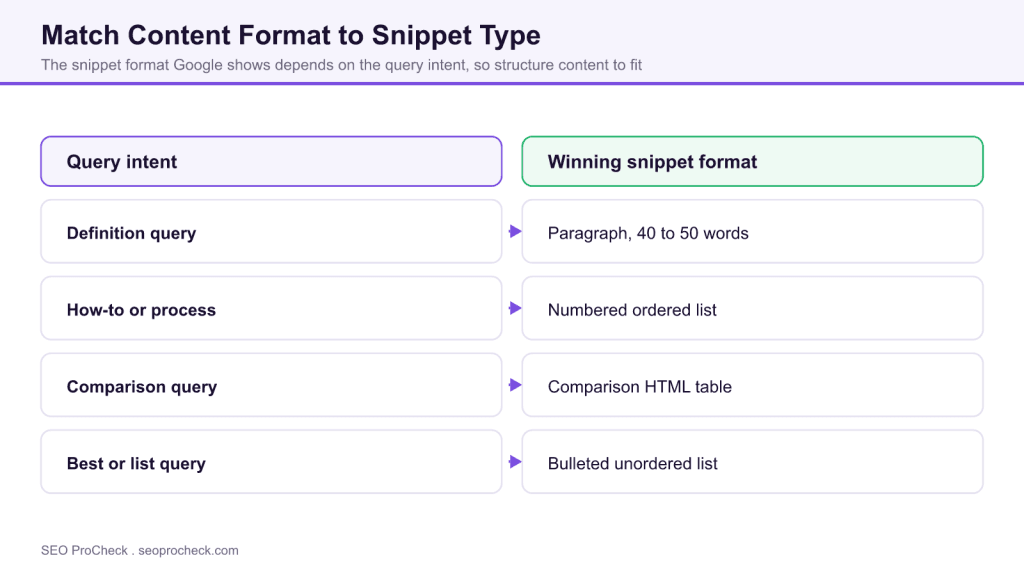
Featured snippets go to pages that answer the query directly, in the exact format Google wants to display, from a page that already ranks on the first result page. Match your content structure to the query intent: a 40 to 50 word paragraph for definitions, an ordered list for processes, and a table for comparisons.
- Format follows intent, so check what snippet Google already shows for the query before you write.
- Put the exact question in a heading and answer it immediately in the first sentence below.
- Keep paragraph answers self contained and inside roughly 40 to 50 words.
- You usually need to rank in the top 10 first, so snippet work follows ranking work.
Research into featured snippet acquisition examined what content characteristics correlate with winning the coveted position zero placement. The data provides actionable guidance for structuring content to capture featured snippets.
Format Matters
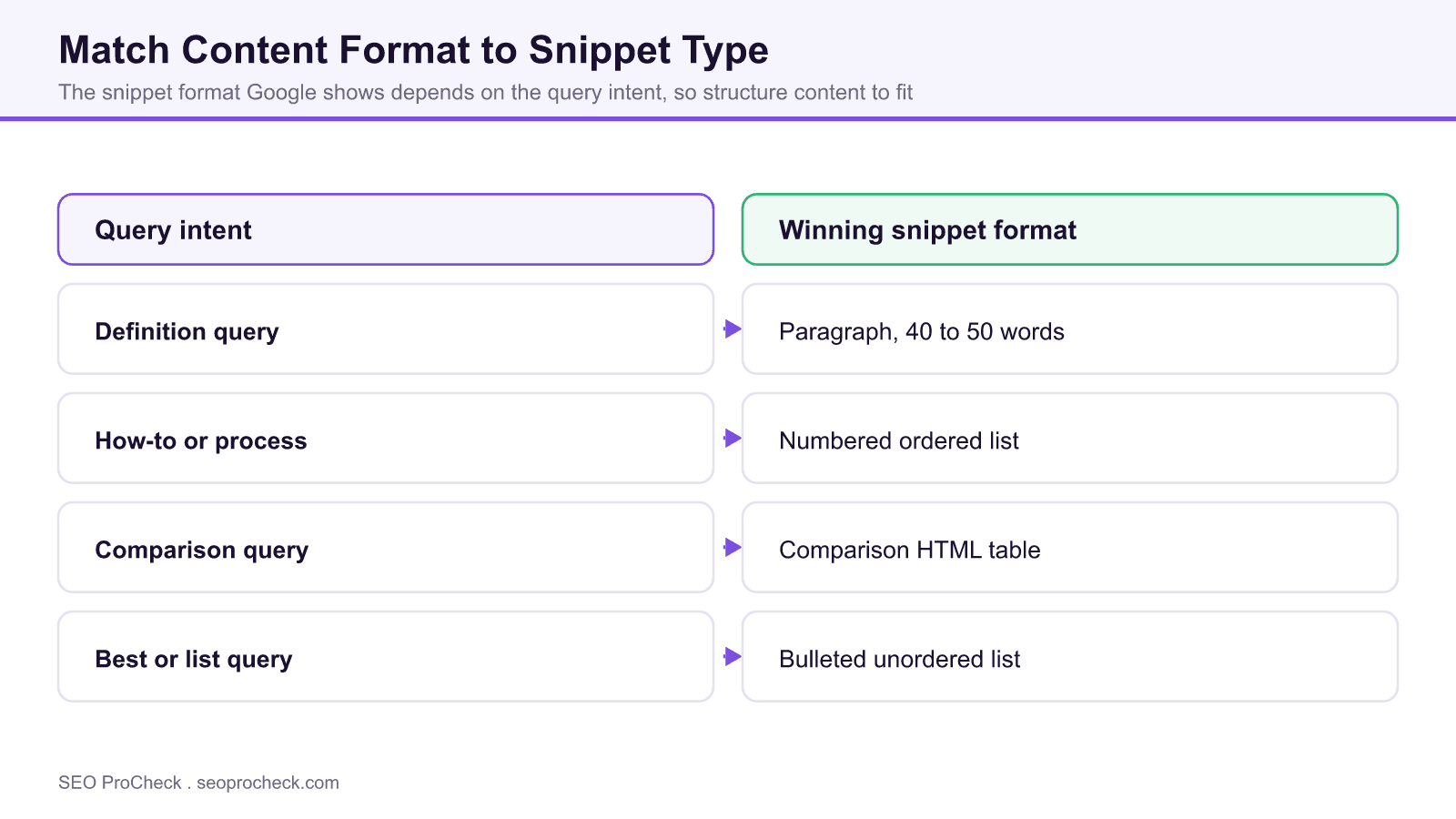
Different query types trigger different snippet formats. Definition queries favor paragraph snippets. Comparison and process queries favor tables and lists. Matching your content format to the expected snippet type dramatically improves capture rates. Tools that analyze existing snippet formats for target queries help inform content structure decisions.
Word Count Sweet Spots
Paragraph snippets averaged 40-50 words. Content that provided concise, direct answers in that range captured snippets more frequently than verbose explanations. The answer needs to be self-contained while remaining brief enough for snippet display limits.
Question-Answer Structure
Pages that explicitly posed questions in headers and immediately provided direct answers showed higher snippet capture rates. This structure makes extraction straightforward for Google's systems. Using the actual query as a header followed by a direct answer paragraph is a proven pattern.
Page Authority Still Matters
Featured snippets typically came from pages already ranking on page one. While snippet selection isn't purely rank-based, sites need baseline rankings to be considered. Building page authority through links and comprehensive content remains foundational before snippet optimization tactics matter.
Source: Multiple featured snippet studies compiled
Read the SERP before you write
Open the target query in a clean browser and study the current snippet. Google has already decided which format fits the intent, and it rarely switches format for one competitor. If it shows a paragraph, write a tight paragraph. If it shows a numbered list, structure your answer as ordered steps. If it shows a table, build a table. Matching the displayed format is the single highest leverage move in snippet optimization.
The heading plus answer pattern
The most reliable structure is a heading that repeats the query, followed immediately by a direct answer. For example:
<h2>What is keyword cannibalization?</h2>
<p>Keyword cannibalization is when two or more pages on the same site
compete for one query, splitting ranking signals so neither ranks well.</p>
The first sentence stands on its own and defines the term without forcing Google to stitch context from elsewhere on the page. That makes extraction trivial.
Formatting for each snippet type
- Paragraph: one self contained answer of 40 to 50 words directly under a question heading.
- Ordered list: use real
<ol>markup with short, parallel steps for how-to and process queries. - Unordered list: use
<ul>for "best of" and non sequential list queries. - Table: use a genuine
<table>with clear header cells for comparison and specification queries.
Clean, scannable formatting also helps human readers, which supports the engagement signals covered in our note on fixing difficult readability.
Authority still gates selection
Snippets are almost always pulled from pages already ranking on page one. If you are not there yet, snippet formatting alone will not lift you into the box. Build the ranking first through relevance, links, and depth, then layer the structural answer on top. It also helps to avoid splitting that ranking across duplicate pages, which is why resolving keyword cannibalization often unlocks snippets you were previously too weak to win.
What has changed since these studies
Since 2024, AI Overviews frequently sit above or in place of the classic featured snippet for many informational queries. The good news is that the same structure that wins snippets, a clear question and a direct, well formatted answer, is exactly what gets a page quoted and cited inside AI Overviews. Optimizing for position zero and optimizing for AI answers have largely converged.
Snippet format by query type
| Query type | Snippet format Google favors | How to structure your content |
|---|---|---|
| Definition ("what is") | Paragraph | Question heading plus a 40 to 50 word answer |
| Process ("how to") | Numbered list | Ordered list with short, parallel steps |
| List ("best", "types of") | Bulleted list | Unordered list of concise items |
| Comparison ("vs", "versus") | Table | HTML table with labeled header cells |
Frequently Asked Questions
What is a featured snippet?
A featured snippet is the answer box at the top of some Google results that quotes content directly from a ranking page. It can appear as a paragraph, a list, or a table, and it is drawn from a page that already ranks on the first page.
How do I win a featured snippet?
Rank on page one for the query, then answer it directly in the format Google already displays. Put the question in a heading, give a self contained answer immediately below it, and use the right markup: a paragraph, an ordered list, or a table.
How long should a paragraph snippet answer be?
Paragraph snippets tend to run about 40 to 50 words. Write a complete, self contained answer in that range so it fits the display limit without being cut off, then add depth in the paragraphs that follow.
Do I need to rank first to get a snippet?
Almost always yes. Google pulls snippets from pages already ranking in the top results, so build the ranking through relevance, links, and depth first, then add the structured direct answer to capture the box.
Have AI Overviews replaced featured snippets?
For many informational queries AI Overviews now appear above or instead of the classic snippet. The same structure still helps, because a clear question and a direct, well formatted answer is what gets a page cited inside AI Overviews too.
Why did I lose a featured snippet I used to hold?
Snippets are volatile: a competitor may have added a better formatted answer, or Google may have swapped the format or replaced the box with an AI Overview. Re check the live SERP, match the current format, and tighten your direct answer.
Take this with you
The assistant links open with a question about this page already written. Nothing is sent until you press enter.
Claude Vincent is a technical SEO consultant focused on crawlability, rendering, and AI-search visibility. He writes the field guides and case studies at SEO ProCheck, with a bias toward the durable, unglamorous work that decides whether search engines and AI answer engines can actually read and cite a site.
About SEO ProCheck
Technical SEO consulting and GEO strategy with 20 years of enterprise experience. Case studies, resources, and tools for search and AI visibility.
Work With Me
Technical SEO audits, GEO strategy, site migrations, and international SEO. Hourly consulting for teams who need hands-on support, not just reports.
Subscribe to our newsletter!








Recent Posts
- Most Top Sites Never Say Who They Are in Structured Data October 14, 2026
- Homepage Titles Are Mostly Too Short, Not Too Long October 8, 2026
- Who Actually Serves an llms.txt? 184 Top Sites Measured September 29, 2026