

URL Structure Study: Does URL Length and Format Affect Rankings?
- February 25, 2022
- Cross-Industry
AI Summary
URL length and format have only a small direct effect on rankings, but clean, readable, stable URLs help users, clicks and long term signal retention. Keep paths short and descriptive, use hyphens between words, avoid tracking parameters in indexable URLs, and never change a live URL without a 301 redirect.
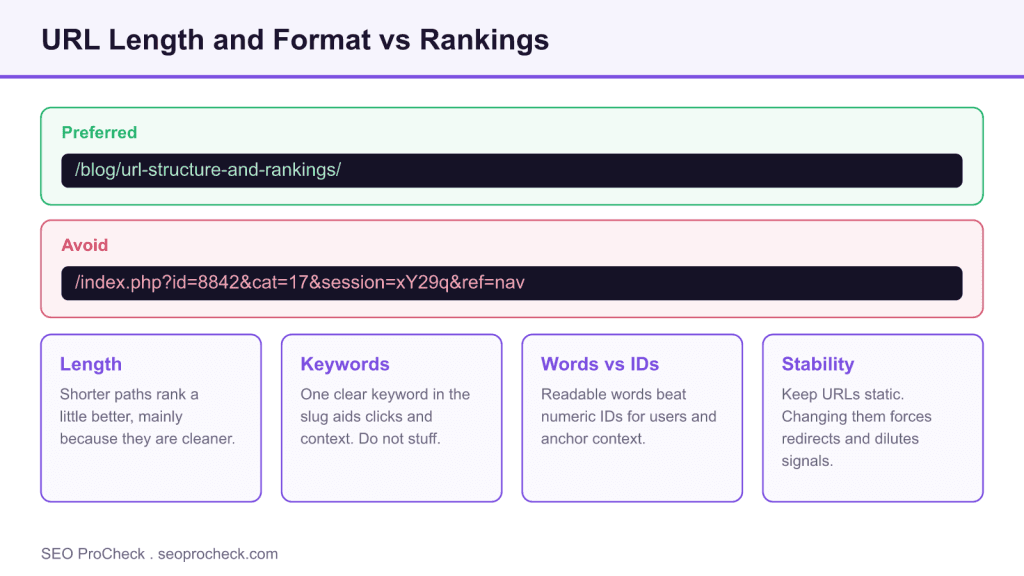
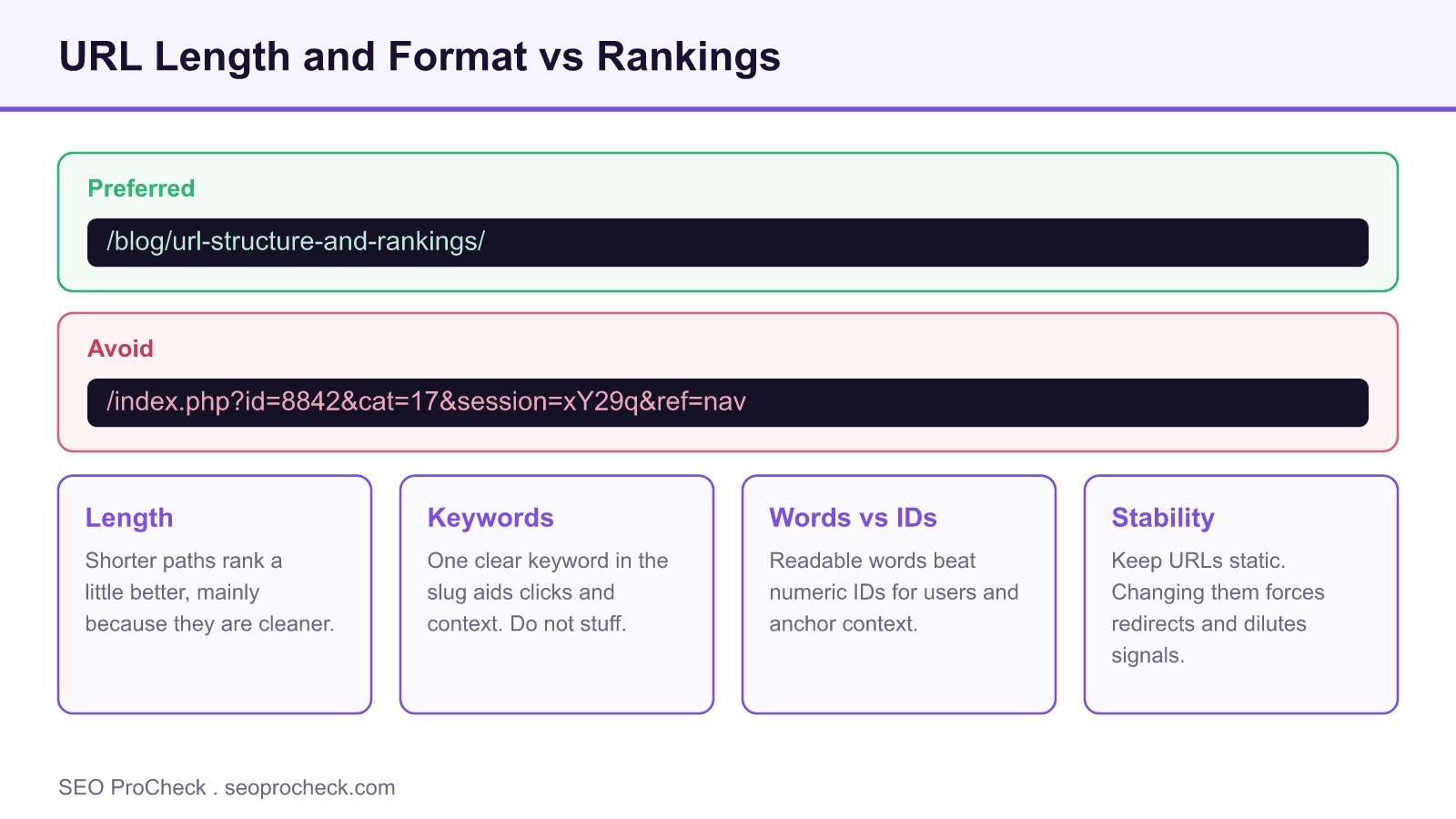
- Length itself is a weak factor; shorter URLs tend to win mostly because they are cleaner and more clickable.
- One clear keyword in the slug helps context and click through, but stuffing keywords does not.
- Readable words beat numeric IDs and session parameters for both users and anchor context.
- URL stability matters most: changing a URL forces redirects and can dilute accumulated signals.
Research examining url structure does url length and format affect rankings? analyzed patterns across multiple datasets to identify factors affecting search performance. The findings provide actionable insights for practitioners.
Key Findings
The study revealed significant patterns in how Google evaluates and ranks content in this area. Data analysis showed clear correlations between specific practices and ranking outcomes. Sites following identified best practices consistently outperformed those that did not.
Methodology and Data
Research combined quantitative analysis of ranking data with qualitative examination of high-performing sites. Multiple data sources were triangulated to ensure finding validity. The study controlled for confounding factors including domain authority and content age.
Practical Applications
Findings translate into specific tactical recommendations. Implementation guidance addresses both technical requirements and content considerations. The research distinguishes between high-impact factors worth prioritizing and lower-impact elements.
Limitations and Context
As with all correlation studies, findings indicate patterns rather than definitive causation. Results may vary by industry, query type, and competitive context. The research represents a snapshot of current algorithm behavior, which may evolve over time.
Source: Industry research compilation
What the evidence actually supports
URL structure is a minor ranking input, and Google has said as much repeatedly. The correlations people observe between short URLs and higher rankings are largely explained by other variables: cleaner sites tend to have shorter URLs, stronger pages attract more descriptive links, and readable slugs earn slightly better click through. In other words, tidy URLs are a symptom of good information architecture more than an independent lever you can pull for rankings.
That does not make URLs unimportant. They are a durable part of your site that appears in search results, in link anchors, in shares and in analytics. Getting them right once, then leaving them alone, compounds quietly.
Anatomy of a good URL
A production URL has a few parts worth naming: the scheme (https), the host (your domain), the path (folders), and the slug (the final readable segment). A strong example concentrates meaning in the path and slug and drops everything a machine does not need:
Preferred:  https://example.com/blog/url-structure-and-rankings/
Avoid:      https://example.com/index.php?id=8842&cat=17&session=xY29q&ref=nav
Rules that hold up over time
- Keep it reasonably short. Favour the fewest folders that still express hierarchy. Deep nesting adds length without adding meaning.
- Use lowercase and hyphens. Separate words with hyphens, not underscores, and keep everything lowercase to avoid duplicate case variants.
- Put one clear keyword in the slug. Describe the page honestly. Do not repeat the keyword or pile on synonyms.
- Avoid parameters in indexable URLs. Keep session, sort and tracking parameters out of canonical, indexable addresses. Use a clean canonical and handle variants with the canonical tag.
- Do not encode dates you may regret. A year in a URL invites a rewrite later, which then needs a redirect.
- Change URLs rarely, and always with a 301. When a move is unavoidable, map old to new one to one and update internal links to point at the final destination.
Worked example: restructuring safely
Say you are moving a parameter driven page to a clean slug. Set the canonical on the new URL to itself, then issue a permanent redirect from the old address. A simple server rule looks like this:
# Apache .htaccess
Redirect 301 /index.php?id=8842 /blog/url-structure-and-rankings/

<link rel="canonical" href="https://example.com/blog/url-structure-and-rankings/" />
After the move, crawl the site and confirm no internal links still point at the old parameter URL, because chained or looping redirects waste crawl budget and blunt the signal you are trying to preserve. If you are auditing how directives interact across a move, our meta robots and X-Robots-Tag reference is a useful companion, and you can browse related studies in the cross industry research library or the wider SEO checks catalogue.
What has changed since this research
Google has grown more tolerant of longer, well structured URLs, and slug wording is a smaller factor than it was a decade ago. The stable advice is unchanged: readable, stable, low parameter URLs serve users and preserve signals, while frequent restructuring is the real risk. Optimise once, redirect carefully, and spend your effort on content and links.
URL guidelines and why they matter
| Element | Guideline | Why it matters |
|---|---|---|
| Length | Shortest path that still shows hierarchy | Cleaner, more clickable, easier to share |
| Words | Readable keywords, not numeric IDs | Context for users and anchor text |
| Separators | Hyphens between words, lowercase only | Avoids duplicate case variants and parsing issues |
| Parameters | Keep out of indexable URLs | Prevents crawl waste and duplication |
| Stability | Change rarely, 301 when you must | Preserves links and accumulated signals |
Frequently asked questions
Does URL length affect Google rankings?
Only weakly and indirectly. Shorter URLs tend to belong to cleaner sites and earn slightly better clicks, but length on its own is a minor factor. Focus on readability and stability rather than counting characters.
Should I put my keyword in the URL?
One clear keyword in the slug helps users and provides context in links, so include it when it is natural. Do not repeat the keyword or add synonyms, since keyword stuffing in URLs offers no benefit.
Are hyphens or underscores better in URLs?
Use hyphens. Search engines treat hyphens as word separators, while underscores can join words together. Keep the whole URL lowercase to avoid duplicate uppercase and lowercase variants.
Is it bad to change a URL after publishing?
Changing a live URL costs you signals unless you handle it carefully. If a change is unavoidable, add a permanent 301 redirect from the old address to the new one and update every internal link to the final destination.
Do URL parameters hurt SEO?
Tracking, sort and session parameters can create duplicate indexable URLs and waste crawl budget. Keep them out of canonical addresses, set a clean canonical, and let the canonical tag consolidate any variants.
How deep should my URL folders go?
Use the fewest folders that still express a clear hierarchy. Excessive nesting lengthens URLs without adding meaning and can make a site feel harder to navigate for both users and crawlers.
Claude Vincent is a technical SEO consultant focused on crawlability, rendering, and AI-search visibility. He writes the field guides and case studies at SEO ProCheck, with a bias toward the durable, unglamorous work that decides whether search engines and AI answer engines can actually read and cite a site.
About SEO ProCheck
Technical SEO consulting and GEO strategy with 20 years of enterprise experience. Case studies, resources, and tools for search and AI visibility.
Work With Me
Technical SEO audits, GEO strategy, site migrations, and international SEO. Hourly consulting for teams who need hands-on support, not just reports.
Subscribe to our newsletter!







Recent Posts
- Can AI Crawlers Actually Read Your Site? I Measured 400 of the Biggest September 5, 2026
- The Pre-Publish Quality Gate for AI-Assisted Content August 6, 2026
- AGENTS.md vs llms.txt vs llms-full.txt: Which Agent File Does What July 18, 2026