

AI Summary
The most common international SEO mistakes come from broken hreflang, forced IP redirects, thin machine translation, and no clear URL plan for each market. Avoid them by mapping one clear URL structure per market, returning correct hreflang pairs, and writing for local intent rather than translating word for word.
- Broken or one way hreflang tags are the single most frequent international SEO error.
- IP based auto redirects trap both users and crawlers in the wrong locale.
- Machine translated pages that ignore local intent read as thin content.
- Pick one URL model per market: ccTLD, subfolder, or subdomain, and stay consistent.
Expanding into new countries multiplies the ways an SEO setup can break. The mistakes below are the ones that repeatedly cost visibility when a site goes global, drawn from patterns any technical audit surfaces. Each one has a clean fix.
The mistakes that cost the most
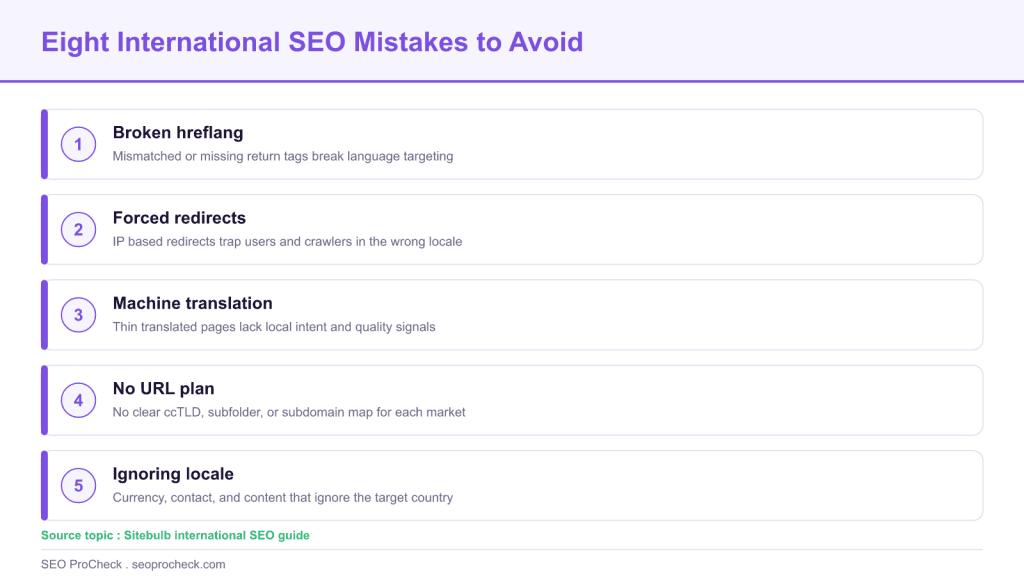
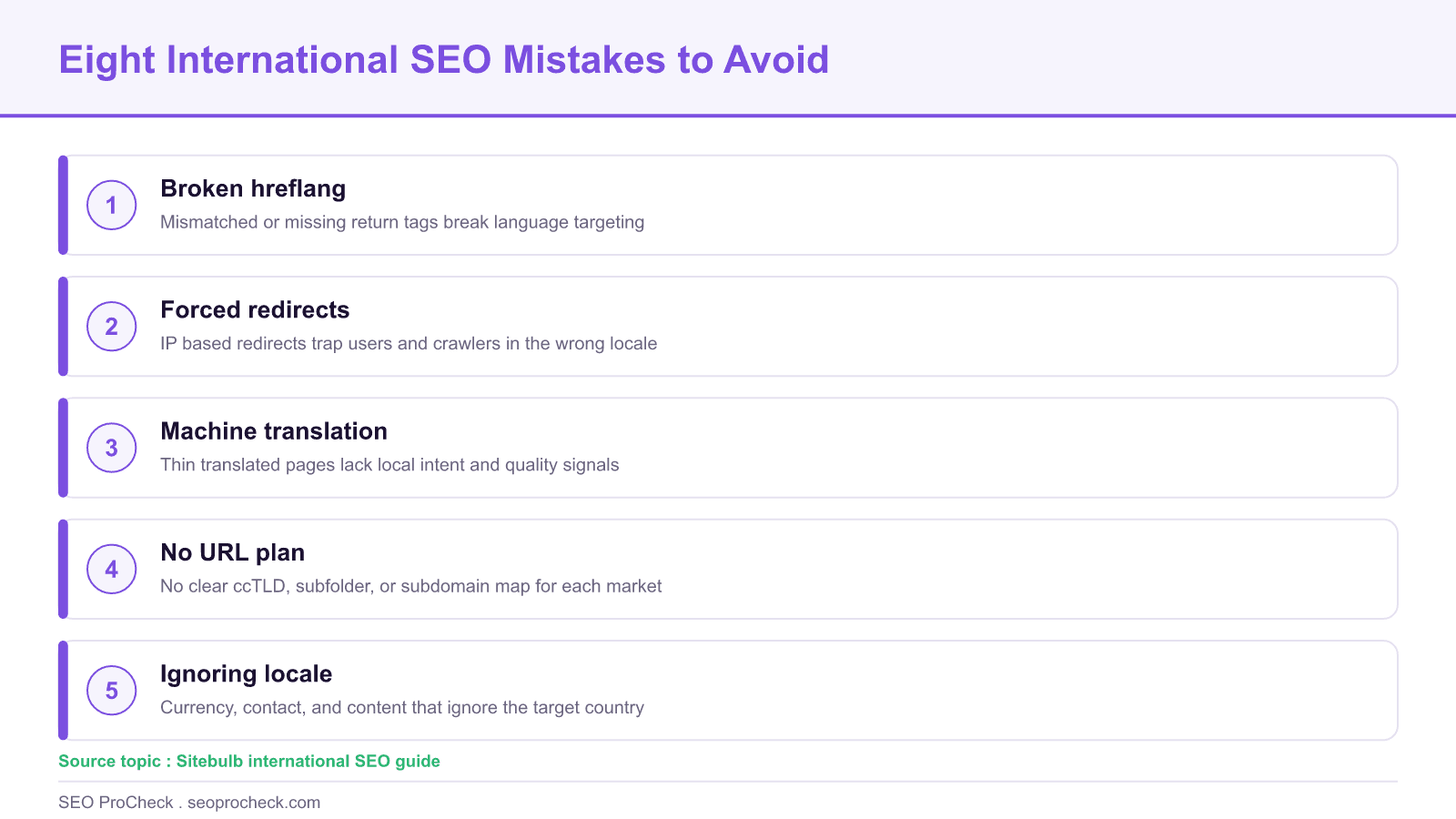
1. Broken hreflang. Hreflang tells Google which language and region version to serve. It must be reciprocal: if the English page points at the French page, the French page must point back. Missing return tags, wrong region codes, and pointing at redirected or noindex URLs are the usual failures. The hreflang FAQ walks through the exact tag syntax and validation.
2. Forced IP redirects. Automatically redirecting visitors by IP address feels helpful but traps Googlebot, which mostly crawls from the United States, inside one locale so it never sees your other market pages. Offer a banner or a country selector instead of a hard redirect.
3. Thin machine translation. Running pages through automated translation with no local review produces text that misses local phrasing, intent, and search demand. Search engines read this as low quality. Localize, do not just translate: adapt examples, currency, and terminology to the market.
4. No URL structure plan. Each market needs a clear home. The three options are a country code domain, a subfolder, or a subdomain, and mixing them at random confuses both users and crawlers.
5. Ignoring local relevance. Wrong currency, a foreign phone number, and content that names the wrong country tell users and engines the page is not really for them.
Choosing a URL structure for each market
| URL model | Example | Best when | Trade off |
|---|---|---|---|
| Country code domain | example.fr | You want the strongest local signal per country | Costs and authority split across many domains |
| Subfolder | example.com/fr/ | You want one strong domain and simple management | Weaker geo signal than a ccTLD |
| Subdomain | fr.example.com | Infrastructure or teams are separated by region | Authority can be treated as partly separate |
For most teams a subfolder on one authoritative domain is the pragmatic default. Whichever you pick, keep it consistent and back it with correct hreflang. See the gTLD and ccTLD reference and the broader international SEO overview for definitions.
A quick pre launch checklist
Before shipping a new market, confirm every point below with a crawl. A technical SEO audit makes this repeatable.
- Every localized page has reciprocal hreflang, including a self reference and an x default.
- No IP based hard redirects between locales.
- Each market page is genuinely localized, not machine translated.
- One consistent URL model across all markets.
- Currency, contact details, and legal pages match the target country.
What has changed since this guide
Google retired the country targeting setting in Search Console, so geographic relevance now rests more heavily on your URL structure, hreflang, and genuinely local content and links. Machine translation quality has improved, but the bar for helpful, localized content has risen with it, so a raw translated page still underperforms a properly localized one. The fundamentals in the source below hold up well.
Related content strategy principles
Content strategy determines what you create, why, and how it serves both users and business objectives. This resource examines approaches for developing content that performs well in search while delivering genuine value.
Understanding User Intent
Effective content addresses what users actually need when they search. Analyzing search intent, understanding user questions, and mapping content to the user journey ensures content serves real needs. Intent alignment has become as important as keyword targeting.
Quality and Comprehensiveness
Search engines increasingly reward comprehensive, authoritative content over thin pages targeting specific keywords. Building topical depth through thorough coverage of subjects establishes expertise. Quality signals including E-E-A-T factors influence how content is evaluated.
Content Lifecycle Management
Content requires ongoing maintenance to remain competitive. Regular audits identify content needing updates, consolidation, or removal. Fresh, accurate content maintains rankings while outdated content decays. Building content refresh into ongoing processes sustains performance.
This resource provides strategic guidance for content programs that drive sustainable organic growth.
Frequently Asked Questions
What is the most common international SEO mistake
Broken hreflang is the most frequent error. Tags are often missing the reciprocal return reference, use the wrong language or region code, or point at redirected pages. Because hreflang controls which localized version Google serves, getting it wrong scatters your international rankings.
Should I redirect users by their IP address
No, avoid hard IP redirects. Googlebot mostly crawls from the United States, so IP redirects can lock it into one locale and hide your other market pages. Use a dismissible banner or a country selector so users choose while crawlers still reach every version.
Is a ccTLD, subfolder, or subdomain best for international SEO
There is no single winner. A country code domain sends the strongest local signal but splits authority and costs more, while a subfolder keeps one strong domain and is easier to manage. The key is picking one model and applying it consistently with correct hreflang.
Is machine translation enough for international pages
Not on its own. Automated translation misses local intent, phrasing, and search demand, and search engines often treat the result as thin. Localize instead: adapt terminology, examples, currency, and keywords to how people actually search in that market.
Do I still need Search Console country targeting
Google removed the international targeting setting, so you can no longer set a country there. Geographic signals now come from your URL structure, hreflang, server and content localization, and local links. That makes getting those fundamentals right more important than before.
How do I check my hreflang is correct
Crawl the site with a tool such as Screaming Frog or Sitebulb and review its hreflang report for missing return tags, invalid codes, and links to non indexable URLs. Confirm each page references itself and includes an x default. Fix any tag that points at a redirected or noindex page.
Take this with you
The assistant links open with a question about this page already written. Nothing is sent until you press enter.
Claude Vincent is a technical SEO consultant focused on crawlability, rendering, and AI-search visibility. He writes the field guides and case studies at SEO ProCheck, with a bias toward the durable, unglamorous work that decides whether search engines and AI answer engines can actually read and cite a site.
About SEO ProCheck
Technical SEO consulting and GEO strategy with 20 years of enterprise experience. Case studies, resources, and tools for search and AI visibility.
Work With Me
Technical SEO audits, GEO strategy, site migrations, and international SEO. Hourly consulting for teams who need hands-on support, not just reports.
Subscribe to our newsletter!








Recent Posts
- Most Top Sites Never Say Who They Are in Structured Data October 14, 2026
- Homepage Titles Are Mostly Too Short, Not Too Long October 8, 2026
- Who Actually Serves an llms.txt? 184 Top Sites Measured September 29, 2026