

AI Summary
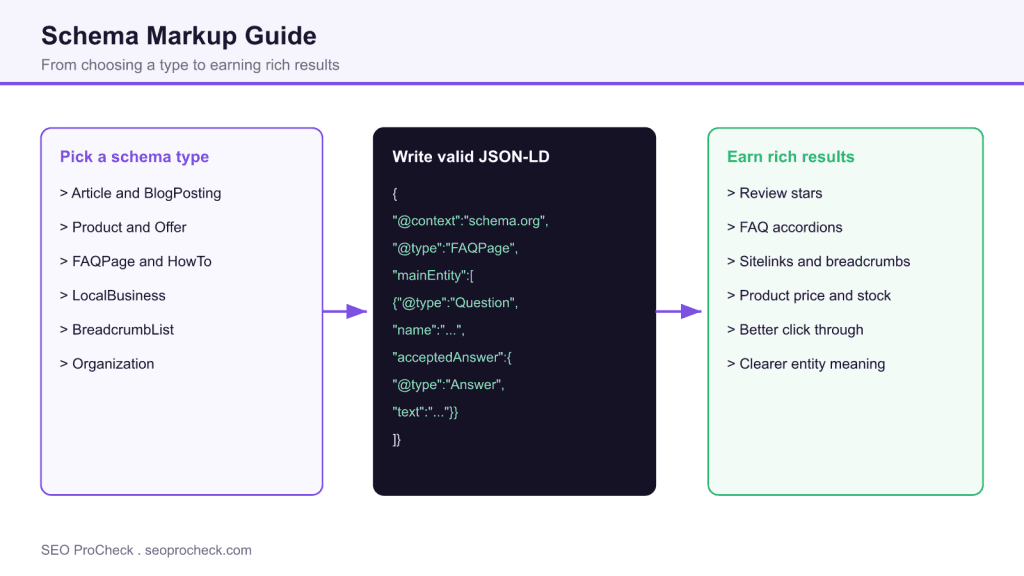
Schema markup is structured data you add to a page so search engines can understand its entities and, where eligible, show rich results such as review stars; Google stopped showing FAQ rich results for every site on May 7, 2026. Pick the type that matches your content, write it in valid JSON-LD that mirrors what users can actually see, and validate it before you ship.
- JSON-LD is the format Google recommends for structured data.
- Schema is not a direct ranking factor, but rich results can lift click through.
- Markup must describe content that is genuinely visible on the page.
- Validate with the Rich Results Test and monitor the Enhancements reports in Search Console.
Structured data helps search engines understand content context and enables rich results in search listings. This resource covers schema implementation strategies and best practices for maximizing structured data benefits.
Schema Types and Applications
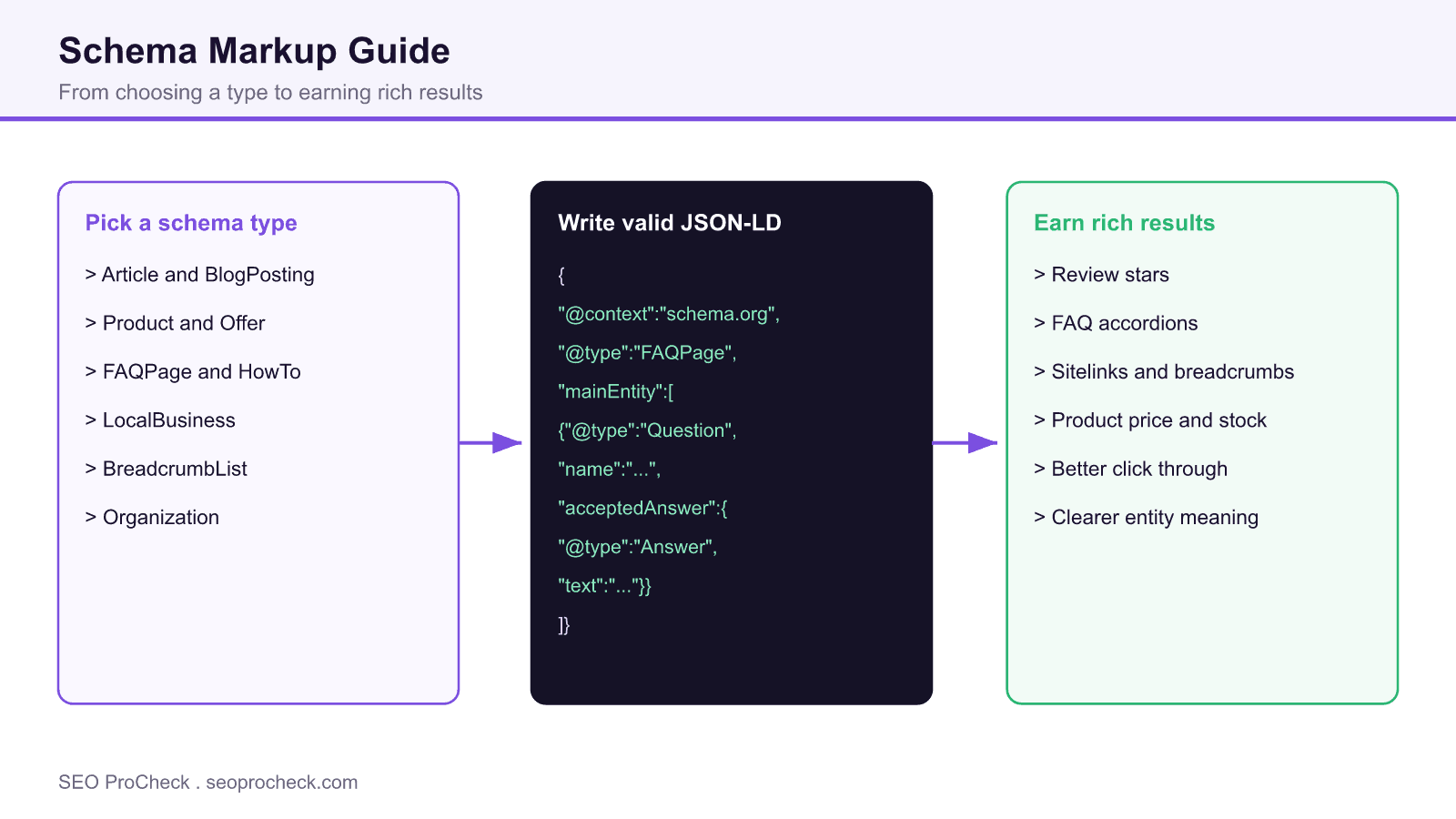
Different schema types serve different purposes. Article, Product, LocalBusiness, FAQ, HowTo, and other schemas each provide specific functionality, though Google no longer shows HowTo or FAQ rich results. Selecting appropriate schema types for your content enables relevant rich results and improves search engine understanding.
Implementation Best Practices
JSON-LD provides the recommended format for schema implementation. Proper nesting, complete required fields, and accurate data all contribute to schema effectiveness. Testing with Google's Rich Results Test ensures proper implementation before deployment.
Rich Results Impact
While schema isn't a direct ranking factor, rich results improve click-through rates. Review stars, recipe cards, and other rich results make listings more prominent and informative, while FAQ accordions stopped appearing in Google for every site on May 7, 2026. This visibility advantage can significantly impact traffic from search.
This resource provides practical guidance for implementing structured data that improves search presence.
Source: https://seotesting.com/blog/schema-markup
Practitioner notes on schema markup
Structured data is a vocabulary, defined at schema.org, that lets you label the things on a page so a machine can understand them: this is an article, this is its author, this is a product, this is its price. Google reads that labelling and, when a page qualifies, uses it to render richer, more prominent search listings. The important framing for practitioners is that schema does not make a page rank higher on its own. What it can do is make an eligible listing more attractive, which tends to improve click through, and give search engines and answer engines a cleaner read on the entities involved.
The recommended format is JSON-LD, a block of structured data placed in the page source. It is easier to maintain than inline microdata because it lives in one place and does not tangle with your visible HTML. The single most common mistake is markup that describes things a user cannot actually see on the page. Google is explicit that structured data must represent the visible content, so a FAQ block in your markup needs a matching FAQ visible to the reader, and a review rating needs a genuine, visible review behind it.
Choosing the right type
Match the schema type to the job the page does. The table below maps common types to their purpose and the rich result they can unlock.
| Schema type | Best fit | What it can unlock | Key properties |
|---|---|---|---|
| Article or BlogPosting | News and blog content | Article eligibility and clearer authorship | Author, datePublished, headline, image |
| Product and Offer | Ecommerce product pages | Price, availability, and review snippets | name, offers, price, availability |
| FAQPage | Pages with genuine questions and answers | None in Google since May 7, 2026 | mainEntity questions and answers |
| HowTo | Step by step instructions | None in Google since September 2023 | step, name, and optional images |
| LocalBusiness | Physical business locations | Knowledge panel and local details | name, address, openingHours |
| BreadcrumbList | Site hierarchy | Breadcrumb trail in listings | itemListElement positions |
Once the type is chosen, keep the implementation honest and complete. Fill the required properties, use real values, and make sure the marked up content matches what renders. Then validate. The Rich Results Test confirms eligibility for specific rich result types, and the Schema Markup Validator checks general syntax. After deployment, the Enhancements reports in Search Console tell you whether Google is parsing your markup at scale and flag errors to fix.
What is changed since this guide
Rich result support is not static, and Google has retired or narrowed several types over the years. HowTo rich results in particular were removed in September 2023 and FAQ rich results stopped appearing for every site on May 7, 2026, so you should treat any given rich result as a bonus rather than a guarantee and check the current Search Central documentation for what is still supported before investing heavily. The underlying value of clean structured data has if anything grown, because AI powered search features and answer engines lean on well labelled entities to understand and cite pages.
The durable advice is simple: mark up what is real, validate before shipping, and monitor after. For a hands on view of how teams apply this day to day, see our real world implementation questions and answers, a gentle primer in an introduction to structured data markup, ideas for commerce sites in underutilised ecommerce schema, and a quick way to inspect any page in getting structured data for any website.
Frequently asked questions
Is schema markup a ranking factor?
Schema markup is not a direct ranking factor. Its value is indirect: eligible pages can earn rich results that stand out in the listings and improve click through, and clean structured data helps search engines and answer engines understand the entities on a page.
What format should I use for structured data?
Use JSON-LD. It is the format Google recommends, it lives in a single block in the page source, and it is easier to maintain than inline microdata because it does not tangle with your visible HTML.
Do I need visible content to match my schema?
Yes. Google requires that structured data represents content that is actually visible to users. A FAQ in your markup needs a matching visible FAQ, and a review rating needs a real, visible review, or the markup can be ignored or flagged as a violation.
How do I test my schema markup?
Use the Rich Results Test to check eligibility for specific rich result types, and the Schema Markup Validator for general syntax. After you deploy, the Enhancements reports in Search Console show whether Google is parsing your markup and list any errors.
Which schema type should I use?
Match the type to the page. Use Article or BlogPosting for editorial content, Product and Offer for ecommerce, FAQPage for genuine question and answer content, HowTo for instructions, LocalBusiness for locations, and BreadcrumbList for site hierarchy.
Are FAQ and HowTo rich results still shown?
Google removed HowTo rich results in September 2023 and stopped showing FAQ rich results for every site on May 7, 2026, so treat any rich result as a bonus rather than a guarantee. Check the current Search Central documentation for what is supported, and value structured data for entity clarity even when a rich result is not shown.
Take this with you
The assistant links open with a question about this page already written. Nothing is sent until you press enter.
Claude Vincent is a technical SEO consultant focused on crawlability, rendering, and AI-search visibility. He writes the field guides and case studies at SEO ProCheck, with a bias toward the durable, unglamorous work that decides whether search engines and AI answer engines can actually read and cite a site.
About SEO ProCheck
Technical SEO consulting and GEO strategy with 20 years of enterprise experience. Case studies, resources, and tools for search and AI visibility.
Work With Me
Technical SEO audits, GEO strategy, site migrations, and international SEO. Hourly consulting for teams who need hands-on support, not just reports.
Subscribe to our newsletter!








Recent Posts
- Most Top Sites Never Say Who They Are in Structured Data October 14, 2026
- Homepage Titles Are Mostly Too Short, Not Too Long October 8, 2026
- Who Actually Serves an llms.txt? 184 Top Sites Measured September 29, 2026