

AI Summary
Hreflang tells search engines which language and regional versions of a page belong together, so users are served the right version in the right market. You need it only when you publish alternate versions of the same content, and if you use it, every version must reference every other version or the annotations are discarded.
- Hreflang is a serving instruction, not a ranking signal. It swaps which of your already-ranking URLs is displayed. It will not make a page rank.
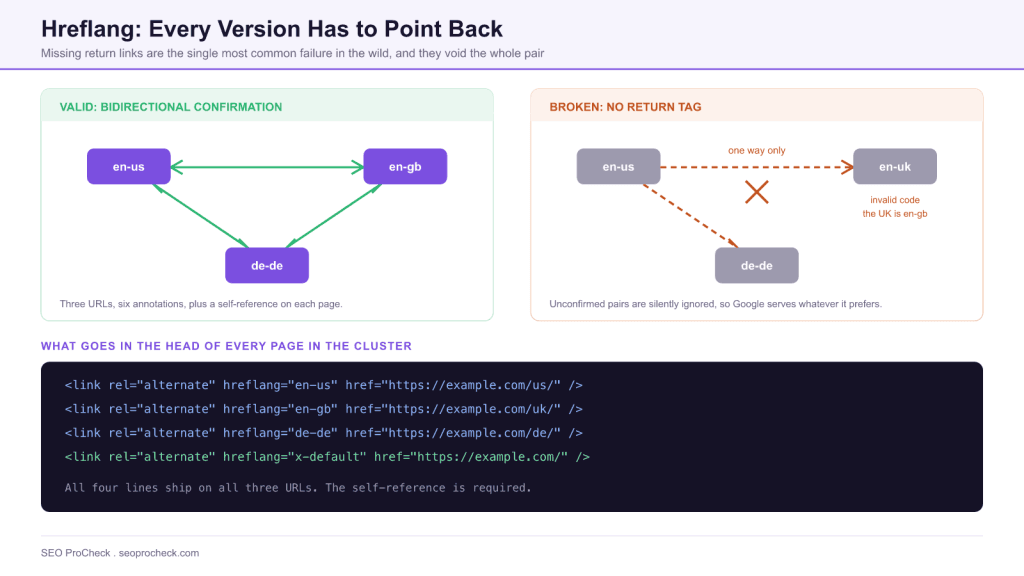
- Bidirectional confirmation is mandatory and missing return links are the most common failure in the wild. Each page must also reference itself.
- The United Kingdom is
en-gb, neveren-uk. Region-only values are invalid, so there is no way to target "Europe". - Pick one declaration method: HTML link tags, HTTP headers, or the XML sitemap. Mixing them invites silent contradictions.
What is hreflang and when do you need it? Hreflang is an annotation that tells search engines which language and regional versions of a page belong together, so users get served the right version in the right market. You need it only when you publish alternate versions of the same content for different languages or regions, and if you do use it, every version must link back to all the others, or the annotations are ignored.
Google's John Mueller Offers Hreflang SEO Advice provides valuable insights for SEO practitioners. This resource examines approaches and considerations that can improve organic search performance.
About the source
The Search Engine Roundtable post linked below is one of Barry Schwartz's write-ups relaying hreflang guidance from Google's John Mueller, who has spent years fielding the same recurring international SEO confusions in office hours, forums, and social threads. The themes Mueller has returned to repeatedly across those venues are consistent: hreflang is optional and only worth the complexity when you genuinely serve different markets; it does not merge or boost rankings, it swaps which known URL is shown; and the majority of hreflang problems are self-inflicted implementation errors rather than Google mishandling correct markup.
The current canonical hreflang rules
Whatever year you read hreflang advice from, implementation stands or falls on the same core rules from Google's documentation:
- Bidirectional confirmation is mandatory. If page A references page B, page B must reference page A. Missing return links invalidate the pair, and this is the single most common failure in the wild.
- Every page must reference itself. Each URL in the cluster includes its own hreflang annotation alongside its alternates.
- Use valid codes. Language in ISO 639-1, optional region in ISO 3166-1 Alpha 2, in that order (
en,en-gb,de-at). The classic trap: the United Kingdom isen-gb, noten-uk. Region-only values are invalid: you cannot target "Europe" or "es" as a region without a language. - Add an x-default. The
x-defaultvalue tells Google which version to show users who match none of your declared locales, typically your global or language-selector page. It is technically optional but you should treat it as required; our check on missing x-default hreflang explains what breaks without it, and the x-default lexicon entry covers the definition. - Point at canonical, indexable URLs. Hreflang must reference the canonical version of each alternate. Annotations pointing at redirected, noindexed, or non-canonical URLs are wasted.
- Pick exactly one declaration method. HTML
<link>tags in the head, HTTP headers, or the XML sitemap. Each is fully supported, but mixing methods invites contradictions. The trade-offs between them are covered in our guide on where to declare hreflang.
The three declaration methods, with the actual syntax
Each method carries the identical information. What differs is where it lives, who on your team owns it, and how it fails. Pick on the basis of which team can keep it accurate, because an out-of-date cluster is worse than no cluster at all.
1. HTML link elements. These go in the <head> of every URL in the cluster, and the full set ships on every page including a self-reference:
<link rel="alternate" hreflang="en-us" href="https://example.com/us/" />
<link rel="alternate" hreflang="en-gb" href="https://example.com/uk/" />
<link rel="alternate" hreflang="de-de" href="https://example.com/de/" />
<link rel="alternate" hreflang="x-default" href="https://example.com/" />
2. HTTP response headers. The only option for non-HTML files, because a PDF has no head to put tags in:
Link: <https://example.com/us/report.pdf>; rel="alternate"; hreflang="en-us",
      <https://example.com/uk/report.pdf>; rel="alternate"; hreflang="en-gb"
3. XML sitemap annotations. Best for large sites, because the whole cluster is maintained in one generated file instead of across thousands of templates:
<url>
  <loc>https://example.com/us/</loc>
  <xhtml:link rel="alternate" hreflang="en-us" href="https://example.com/us/" />
  <xhtml:link rel="alternate" hreflang="en-gb" href="https://example.com/uk/" />
  <xhtml:link rel="alternate" hreflang="x-default" href="https://example.com/" />
</url>| Method | Best for | Who owns it in practice | How it typically fails |
|---|---|---|---|
HTML <link> elements | Smaller sites, and clusters that map cleanly onto a template | Front-end or CMS template owners | Page weight grows with locale count, and a template fork silently drops a locale |
HTTP Link headers | PDFs, images, and any non-HTML resource | Server or CDN configuration owners | Invisible in view-source, so it goes unaudited for years |
| XML sitemap annotations | Large sites where editing templates is expensive | The team that generates the sitemap | The generator drifts out of sync with the live URL set after a migration |
One rule holds across all three: whichever you choose, the annotation set has to be regenerated whenever URLs change, not on an annual audit cycle. Our reference on hreflang implementation errors catalogues what the drift looks like in practice.
What practitioners get wrong about Mueller's advice
The recurring misreads are worth naming, because each one burns real engineering time:
- Treating hreflang as a ranking lever. It is a serving instruction, not a signal. If your German page does not rank, hreflang will not make it rank; it only decides which of your already-ranking alternates is displayed. Fix the ranking problem first.
- Deploying it "just in case." A single-language site, or one where each market has genuinely different content rather than translations/localizations of the same content, gains nothing from hreflang and inherits a maintenance liability.
- Expecting it to fix duplicate-content worries. Same-language regional variants (en-us vs en-gb) are a legitimate hreflang use case, but Google may still fold near-identical pages together via canonicalization. Hreflang and canonical must agree, not fight, which is the failure mode we unpack in conflicting hreflang and canonical.
- Assuming country targeting needs country domains. Hreflang works across ccTLDs, subdomains, and subfolders alike, and even across different domains, as long as the return links are in place.
- Set-and-forget. Every new page, removed page, or URL change breaks pairs silently. Hreflang is a living system that needs monitoring, not a launch task.
A sensible workflow: generate the cluster with our hreflang tag generator, then validate return links and codes with the hreflang validator after every significant release. The specific error to watch for after a release is the one covered in our missing reciprocal hreflang check, because it is the failure that produces no visible symptom until traffic lands on the wrong locale.
Common hreflang mistakes and fixes
| Mistake | Symptom | Fix |
|---|---|---|
| Missing return links | "No return tags" errors; wrong versions served | Ensure every URL in the cluster references every other, including itself |
Invalid codes (en-uk, eu, region-only) | Annotations silently ignored | ISO 639-1 language + ISO 3166-1 Alpha 2 region: en-gb, fr-be |
| No x-default | Unmatched users get an arbitrary version | Add x-default pointing to your global or selector page |
| Hreflang to non-canonical or redirected URLs | Cluster partially ignored; unstable serving | Reference final, indexable, canonical URLs only |
| Canonical tag contradicting hreflang | Alternates deindexed or folded into one version | Each alternate self-canonicalizes; never canonicalize all versions to one language |
| Mixed declaration methods with drift | Conflicting annotations across head, headers, sitemap | Standardize on one method and audit after releases |
What's changed since the original post
The rules above have been stable for years, because hreflang is one of the least-changed corners of Google's documentation, and Mueller's core advice has not been contradicted since. What has shifted around it: Google retired International Targeting reporting in Search Console, so third-party validators and log-based auditing carry more of the monitoring load than before; and Google's systems have grown more willing to fold thin, near-duplicate regional variants together regardless of markup, which raises the bar for same-language variants: if your en-us and en-au pages differ only by a currency symbol, expect canonicalization to override your intent. The practical posture in 2026: fewer, more genuinely localized variants beat exhaustive market matrices, and validation belongs in your release checklist rather than an annual audit.
Frequently asked questions
No. It changes which of your alternate versions is shown to a given user, not how well the cluster ranks. Ranking strength comes from the usual content and authority signals.
Technically optional, practically essential. Without it, users outside your declared locales get whichever version Google picks. Point x-default at your global homepage or language selector.
en-gb. The "uk" country code does not exist in ISO 3166-1; using en-uk silently invalidates the annotation.
Any one of the three. Use HTML link tags for smaller sites, XML sitemaps for large sites where editing templates is costly, and HTTP headers for non-HTML files like PDFs. Choose one method and stay consistent.
Only if the versions genuinely differ (pricing, spelling, availability, legal text). If they are near-identical, Google may canonicalize them together anyway, and you should consider whether separate URLs earn their keep.
Almost always an implementation gap: missing return links, annotations pointing at non-canonical URLs, conflicting canonicals, or invalid codes. Validate the full cluster before assuming Google is ignoring correct markup.
This resource contributes to the knowledge base SEO practitioners need for effective optimization in an evolving search landscape.
Source: https://www.seroundtable.com/john-mueller-offers-hreflang-google-seo-advice-35052.html
Claude Vincent is a technical SEO consultant focused on crawlability, rendering, and AI-search visibility. He writes the field guides and case studies at SEO ProCheck, with a bias toward the durable, unglamorous work that decides whether search engines and AI answer engines can actually read and cite a site.
About SEO ProCheck
Technical SEO consulting and GEO strategy with 20 years of enterprise experience. Case studies, resources, and tools for search and AI visibility.
Work With Me
Technical SEO audits, GEO strategy, site migrations, and international SEO. Hourly consulting for teams who need hands-on support, not just reports.
Subscribe to our newsletter!





Recent Posts
- Can AI Crawlers Actually Read Your Site? I Measured 400 of the Biggest September 5, 2026
- The Pre-Publish Quality Gate for AI-Assisted Content August 6, 2026
- AGENTS.md vs llms.txt vs llms-full.txt: Which Agent File Does What July 18, 2026