

e-Commerce SEO Case Study: The short and long-term ranking impact of removing long and fluff e-commerce category descriptions.
- August 30, 2021
- Content
AI Summary
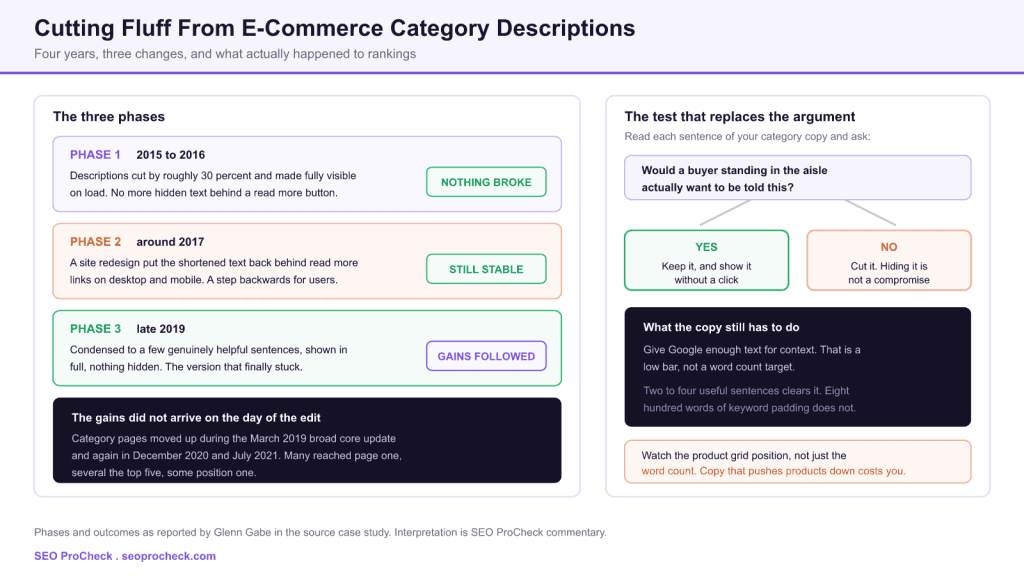
Glenn Gabe documented an e-commerce site that cut its long, hidden category descriptions in three stages between 2015 and late 2019, and the rankings never dropped. The pages then gained substantially during the March 2019 broad core update and again in December 2020 and July 2021, which suggests the fluffy descriptions were at best doing nothing and quite possibly holding the pages back.
- Phase one cut descriptions by roughly 30 percent and made them visible on load, with no immediate ranking change.
- Phase two hid the shortened text behind read more links again during a redesign, and rankings still held.
- Phase three, in late 2019, condensed the copy to a few helpful sentences shown in full. That version stuck.
- The gains showed up at broad core updates, not on the day of the edit, so short term monitoring would have missed them entirely.
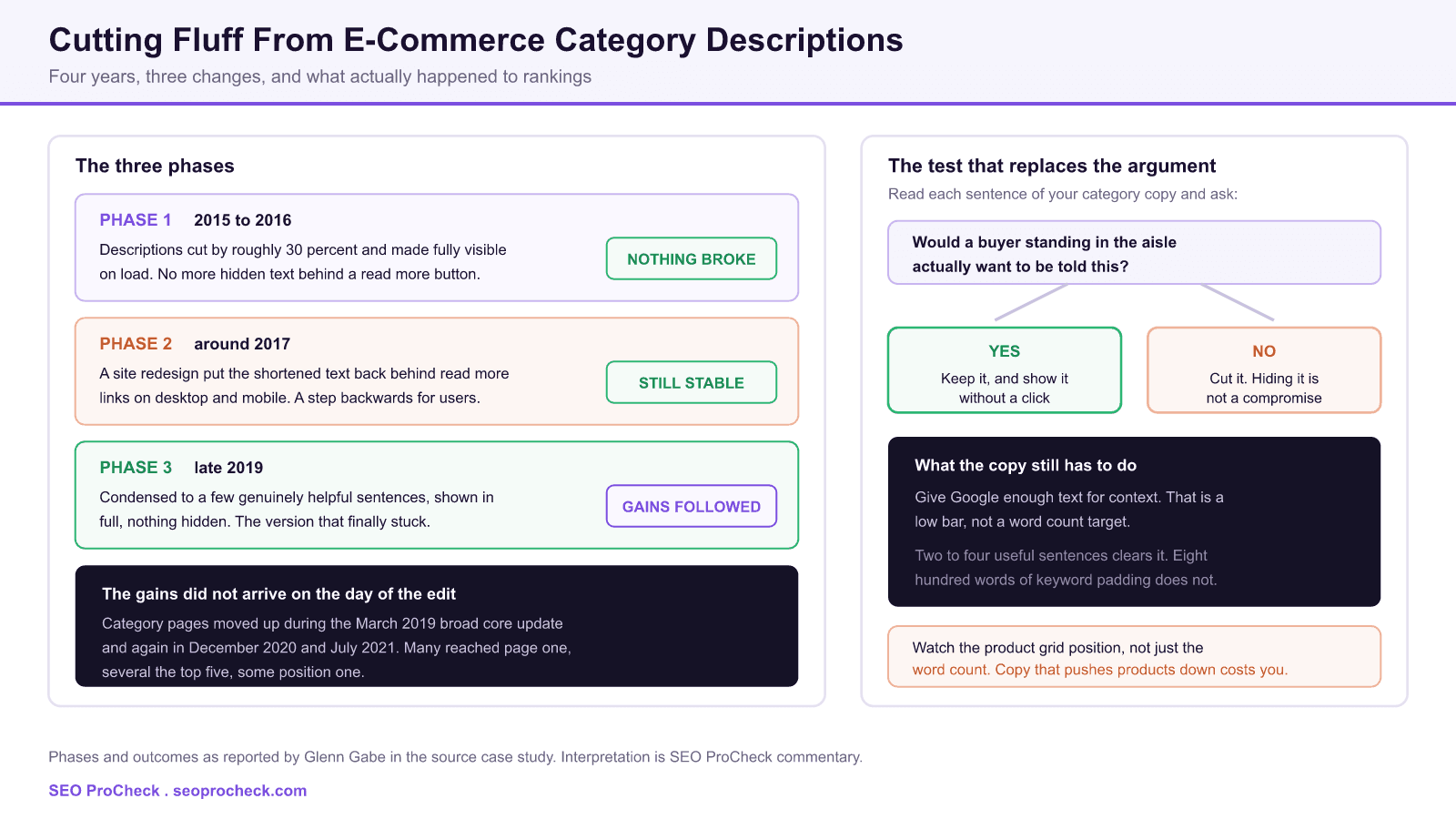
The nine hundred word block of prose sitting under your product grid is almost certainly not what is ranking the page. This case study is the closest thing the e-commerce world has to a long running natural experiment on that question, and across four years and three separate reductions the answer was consistently: nothing bad happened, and eventually something good did. The practical takeaway is not "delete all category copy" but "stop measuring category copy by its length and start measuring it by whether a buyer would want to read it."
Almost every e-commerce SEO inherits the same argument. Someone, at some point, was told that category pages need text, and the site now carries hundreds of category descriptions running to several hundred words each, usually hidden behind a read more toggle because nobody could bear to look at them. Nobody wants to remove them, because nobody can prove they are not load bearing. That is exactly the standoff this case study breaks.
What was actually tested
This is not a controlled split test, and it is important to be honest about that up front. It is a longitudinal account of one site making the same directional change three times over four years, with ranking observations after each. The evidential value comes from the repetition and the duration rather than from statistical isolation, and there is no control group, so seasonality and algorithm movement are not formally separated out.
The starting condition will be familiar. The site's category pages carried lengthy descriptions hidden behind read more buttons, which frustrated users and provided questionable SEO value. The three phases then ran as follows.
| Phase | When | What changed | Reported ranking outcome |
|---|---|---|---|
| 1 | 2015 to 2016 | Descriptions reduced by approximately 30 percent and made fully visible on load, with no click required to expand | Nothing changed immediately, described in the source as a good outcome |
| 2 | Around 2017 | During a site redesign the shorter descriptions were hidden behind read more links again, on both desktop and mobile | Rankings remained stable through this phase as well |
| 3 | Late 2019 | Descriptions condensed to a few helpful sentences and displayed in full, with nothing hidden | Significant gains followed at the March 2019 and subsequent broad core updates |
Phases and outcomes as reported in the source case study by Glenn Gabe, published 30 August 2021. The site is not named.
Phase two is the one worth pausing on, because it is the accidental control. A redesign undid the visibility improvement and put the text back behind a toggle, and rankings still did not move. That tells you something useful: on these pages, the visibility of the copy was not the ranking lever either. The copy simply was not doing much in either direction.
The short term versus long term distinction
The title of the original case study puts the emphasis in the right place, and it is the part most readers skim past. In the short term, nothing happened. Not a dip, not a spike. If your success criterion had been "did rankings improve within six weeks of the edit", every one of these changes would have been logged as a failure and quietly reverted.
The improvements are reported as arriving with broad core updates: March 2019, then December 2020, then July 2021. Many category pages reached page one, several the top five, some position one. That pattern is consistent with how quality-oriented content work generally behaves. Broad core updates reassess how well pages satisfy the queries they surface for, and the reassessment happens on Google's schedule, not on your release schedule.
There is an obvious caveat and the source does not hide from it. Gains that coincide with a broad core update cannot be cleanly attributed to a description edit made months or years earlier. Plenty else changed on that site and across those SERPs in the interval. What you can take from it with confidence is the negative finding, which is the one that unblocks the work: removing the fluff did not cost anything, repeatedly, over four years.
How to decide what to cut
Word count is the wrong unit. The useful question is what job each sentence is doing, and once you sort the sentences that way the cutting decisions make themselves. Here is the audit we run on category copy before touching anything.
| Sentence type | Example | Verdict | Where it belongs |
|---|---|---|---|
| Choice guidance | Sizing runs small on this range, order one size up | Keep | Visible, near the top of the copy block |
| Compatibility or fitment | These filters fit models manufactured after 2018 only | Keep | Visible, and ideally repeated as a filter facet |
| Genuine category definition | What separates a chef's knife from a santoku, in one sentence | Keep, condensed | One short paragraph beneath the grid |
| Restated category name | We stock a wide range of blue running shoes for women | Cut | Nowhere. The H1 already said this |
| Brand self description | We have been committed to quality since 1994 | Cut | The about page, if anywhere |
| Synonym padding | Trainers, sneakers, running shoes, athletic footwear and jogging shoes | Cut | Nowhere. This is the pattern that reads as manipulation |
Classification framework is SEO ProCheck commentary, applied to the pattern of copy the source case study describes.
A practical rule that survives most internal debates: if a sentence would embarrass you when read aloud to a customer, it is not earning its place on the page. Hiding it behind a toggle is not a compromise, it is a way of avoiding the decision.
The implementation, step by step
Do not run this as a single global deployment. The value of a staged rollout is that it gives you a comparison group, which is the thing this case study most conspicuously lacked.
- Export the current state. Crawl the category templates and record URL, word count of the description block, whether it is hidden behind a toggle, and its DOM position relative to the product grid. Screaming Frog custom extraction with an XPath such as
//div[@class='category-description']gets you all four columns in one pass. - Pull the query data per URL. In Search Console, filter Performance by page and export the query list for each category you intend to change. You are looking for long tail queries that only the description could plausibly be answering. Those are the sentences you protect.
- Split the categories. Take fifty to a hundred comparable categories, matched on traffic band and product count, and change half. The unchanged half is your baseline.
- Rewrite rather than truncate. Cutting a nine hundred word block to its first two hundred words leaves you with the introduction, which is the least useful part. Write the replacement from the buyer's questions instead.
- Place it below the grid and leave it visible. Products first. Then a short block of copy that a shopper who scrolled that far might actually read.
- Annotate the deploy date and then wait. This case study is a four year story. Give it at least two broad core updates before you draw a conclusion, and monitor impressions and average position rather than clicks alone, since clicks move with seasonality.
What Google has actually said
The source grounds its argument in guidance from John Mueller, whose position has been consistent: sites need some textual content so Google can have context, but there is no requirement for lengthy descriptions. That phrasing repays close reading. "Some textual content" is a floor, not a target, and a category page that has an H1, breadcrumbs, filter labels and forty product titles already carries considerable textual context before you write a word of prose.
Where teams go wrong is treating the floor as a scoring system, on the assumption that if some text provides context then more text provides more context. That inference has never been supported by anything Google has published, and the pattern it produces, long blocks of keyword-dense prose written for a crawler rather than a customer, is precisely what quality assessments are designed to catch.
If you want the broader version of this argument with a controlled test behind it rather than a longitudinal account, our write up of the split test on whether unique content earns its cost reaches a compatible conclusion from a different direction.
What has changed since this case study
The case study was published in August 2021 and its final phase ran in late 2019. Three things have shifted since, and all three strengthen rather than weaken the conclusion.
First, Google has run several rounds of updates explicitly targeting content produced for search engines rather than people, beginning with the helpful content system in 2022 and later folded into the core ranking systems. Long padded category descriptions are close to the archetype of what those systems were built to identify. The risk profile of leaving the fluff in place is higher now than it was in 2019.
Second, Interaction to Next Paint replaced First Input Delay as a Core Web Vitals metric in March 2024, and expandable read more components are a common source of interaction latency on category templates. The toggle you added to hide the copy now carries a measurable cost that it did not carry when the pattern became popular. Our Core Web Vitals overview covers where that shows up in field data.
Third, AI generated answer surfaces now sit above the organic results for a growing share of commercial queries, and they extract from content that is present and clearly structured. Text collapsed behind an interaction is at a structural disadvantage there compared with visible, well-headed prose. That argument did not exist in 2019 and it points in the same direction as everything above.
The measurement mistake that kills this project
Teams abandon description cleanups because they measure them wrong, not because the cleanups fail. Three specific errors account for most of it.
The first is watching rankings for a fortnight. This case study's entire point is that the short term signal is flat, and a flat signal read impatiently gets interpreted as failure. The second is measuring clicks instead of impressions and average position, which means seasonality drowns the effect you are looking for. The third, and the most damaging, is changing the copy at the same time as the template, so that when something does move you cannot say which change moved it. Phase two of this case study is the cautionary example: a redesign silently reversed a deliberate improvement, and nobody noticed for two years.
If your category pages also suffer from near identical copy repeated across dozens of similar categories, deal with that first, because it is a larger problem than length. Our duplicate content guide covers the consolidation behaviour that follows, and the broader e-commerce category page SEO guide sets out the template level fixes that matter more than the prose.
FAQ
No. This case study reports that descriptions were cut by roughly 30 percent and later condensed to a few sentences with no ranking loss, and that the pages went on to gain during subsequent broad core updates. What a category page needs is enough text to establish context, not a word count. Two to four sentences that genuinely help a shopper choose will usually clear that bar.
Google has said for years that it indexes content hidden behind expandable elements, and in this case study rankings stayed stable across a phase where the text was pushed back behind read more links. The stronger argument against hiding it is different: if the copy is worth hiding, it is usually worth deleting, and if it is genuinely useful, it deserves to be visible.
Below, in almost every case. The product grid is what the shopper came for, and copy placed above it delays the thing they are trying to reach. A short introductory line above the grid plus the substantive detail underneath gives you both context for search engines and a fast path to products for buyers.
They did not track the edit dates. The case study describes stable rankings immediately after each change, with the notable improvements arriving at the March 2019 broad core update and again at the December 2020 and July 2021 updates. That lag is the norm for quality-related content work and is the main reason these projects get abandoned prematurely.
Read each sentence and ask whether a buyer standing in front of the shelf would want to be told it. Sentences that restate the category name, list synonyms, or describe the brand's commitment to quality fail that test. Sentences that explain sizing, materials, compatibility, or how to choose between two ranges pass it.
It can if the copy was the only thing giving the page topical context, or if you remove it from a page that currently ranks for long tail queries the copy uniquely answered. Check Search Console query data for the URL before you cut, keep the queries that matter, and roll the change out to a subset of categories first so you have a comparison group.
Not sure whether your category copy is helping or holding you back?
An audit classifies category page content by the job it does and identifies which templates are candidates for reduction, with a measurement plan attached.
Source: https://www.gsqi.com/marketing-blog/ecommerce-category-description-case-study/
Claude Vincent is a technical SEO consultant focused on crawlability, rendering, and AI-search visibility. He writes the field guides and case studies at SEO ProCheck, with a bias toward the durable, unglamorous work that decides whether search engines and AI answer engines can actually read and cite a site.
About SEO ProCheck
Technical SEO consulting and GEO strategy with 20 years of enterprise experience. Case studies, resources, and tools for search and AI visibility.
Work With Me
Technical SEO audits, GEO strategy, site migrations, and international SEO. Hourly consulting for teams who need hands-on support, not just reports.
Subscribe to our newsletter!







Recent Posts
- Can AI Crawlers Actually Read Your Site? I Measured 400 of the Biggest September 5, 2026
- The Pre-Publish Quality Gate for AI-Assisted Content August 6, 2026
- AGENTS.md vs llms.txt vs llms-full.txt: Which Agent File Does What July 18, 2026