

Proof That 301 Redirects To Less-Relevant Pages Are Seen As Soft 404s To Google
- July 29, 2016
- Crawling and Indexing
AI Summary
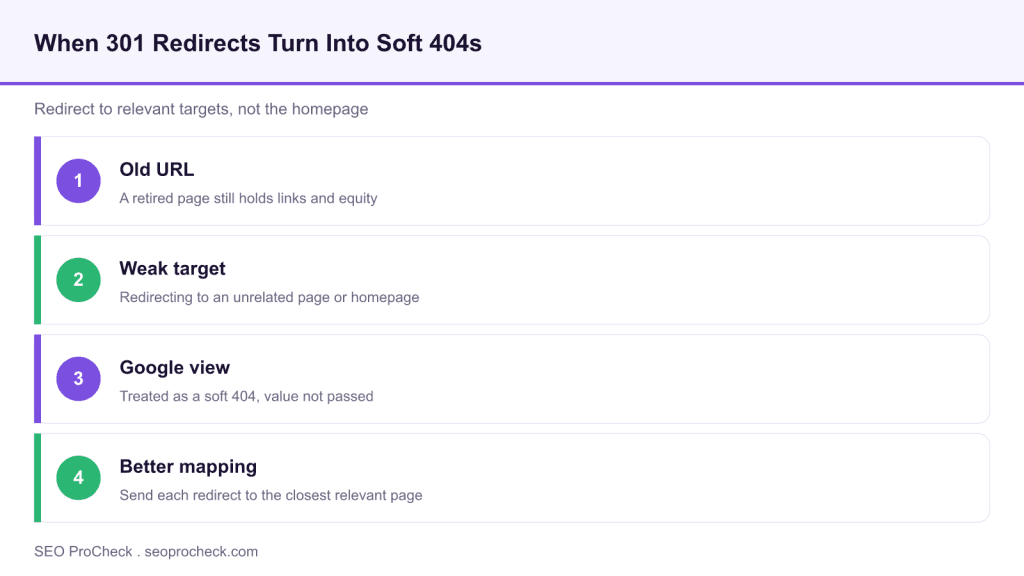
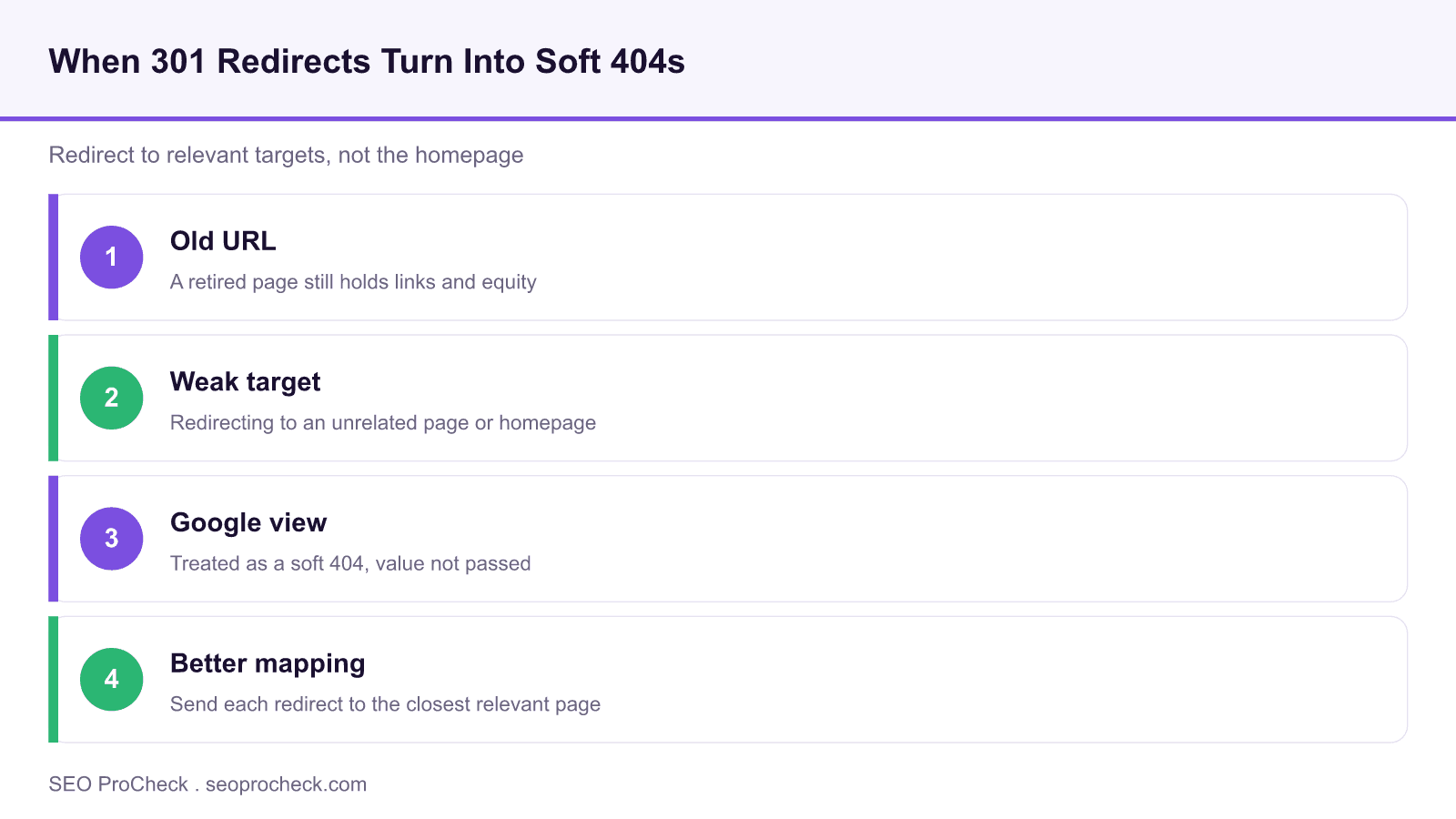
This case study, based on analysis by Glenn Gabe at GSQI, documents proof that 301 redirects pointing to less relevant pages are frequently treated by Google as soft 404s. When that happens the redirect passes little or no value, so the safe practice is to map each retired URL to the closest genuinely relevant page rather than dumping it on the homepage.
- A 301 to an unrelated page or the homepage is often treated as a soft 404.
- Soft 404 handling means the redirect passes little ranking value.
- Google's own guidance is that irrelevant redirects behave like a not found response.
- Map every redirect to the closest equivalent page to preserve signals.
This SEO case study documents a successful optimization initiative, providing actionable insights for practitioners. The documented approach demonstrates how strategic SEO implementation drives measurable results.
Initial Situation
Understanding the starting point is essential context for evaluating any case study. This documentation covers the initial challenges, competitive position, and business objectives that shaped the SEO strategy.
Strategy and Approach
The strategic approach combined multiple SEO disciplines to address identified opportunities. Key decisions around prioritization and resource allocation provide a template for similar initiatives.
Implementation
Moving from strategy to execution required specific technical implementations, content development, and process changes. This case study documents the practical steps that translated strategy into action.
Results and Learnings
The outcomes demonstrate effectiveness through measurable improvements in rankings, traffic, and business metrics. Analysis of successes and challenges provides learning value for practitioners.
Case studies like this contribute to the SEO knowledge base, helping practitioners learn from documented real-world experiences.
Source: https://www.gsqi.com/marketing-blog/redirects-less-relevant-pages-soft-404s/
Why an irrelevant redirect becomes a soft 404
A 301 tells Google that a URL has permanently moved to a new location, and the expectation is that the destination is a reasonable replacement for the original. When the destination is unrelated, for example an old product URL pointed at the homepage, Google can decide the original content is simply gone and classify the redirect as a soft 404. From the search engine's point of view nothing equivalent exists at the new address, so there is nothing to carry the old page's signals forward.
This is the trap the GSQI analysis makes concrete: teams assume any 301 preserves equity, then wonder why rankings for the retired URLs vanish. The redirect fired correctly at the server level, but the search engine treated it as a not found because the target did not match. Canonical confusion can produce a similar outcome, which is why this pairs well with the case of canonicalization.
How to map redirects so they actually pass value
Work from the retired URL's intent, not its position in the site tree. For a discontinued product, redirect to the closest replacement product or its parent category, not the homepage. For a merged article, redirect to the article that absorbed its topic. Only fall back to a category or the homepage when no closer match exists, and accept that those fallbacks may be treated as soft 404s and pass little value.
If a page truly has no replacement and no equity worth keeping, letting it return 404 or 410 is a legitimate choice, and the deindexing timeline is covered in this study on how long deindexing takes. For the broader pattern of redirects that quietly drain rankings, the companion case study on the negative impact of 301 redirects is worth reading next.
| Redirect scenario | How Google often treats it | Better approach |
|---|---|---|
| Old product to homepage | Soft 404, little value passed | Redirect to closest product or category |
| Merged article to unrelated post | Soft 404 risk | Redirect to the post that absorbed the topic |
| Category to homepage | Often a soft 404 | Redirect to the nearest surviving category |
| No true equivalent exists | Value cannot transfer anyway | Return 404 or 410 and remove links |
What's changed since
The finding has aged well. Google representatives have repeatedly confirmed that redirecting to an irrelevant page is treated like a soft 404, so this is now settled guidance rather than a surprising discovery. Search Console continues to report soft 404s, which makes the problem easy to detect after a migration.
What has sharpened is the tooling and the consensus. Crawlers flag redirect to homepage patterns automatically, and the recommended fix, redirect to the closest relevant page, is now standard migration hygiene. The underlying mechanism, no equivalent content means no transferred value, has not changed at all.
Frequently asked questions
What is a soft 404?
A soft 404 is a page that returns a success status but that Google judges to have no real content, so it is treated as not found. Redirects to irrelevant destinations are one common way to trigger this classification.
Do 301 redirects always pass link equity?
No. A 301 passes value only when the destination is a reasonable equivalent of the original page. When the target is unrelated, Google may treat the redirect as a soft 404 and pass little or nothing.
Should I redirect retired pages to the homepage?
Usually not. The homepage rarely matches the intent of a specific retired URL, so those redirects are frequently treated as soft 404s. Redirect to the closest relevant page instead, and reserve the homepage as a last resort.
Is it ever fine to let a page return 404?
Yes. If a page has no equivalent replacement and no meaningful equity, returning 404 or 410 is cleaner than forcing an irrelevant redirect. Remove internal links to the dead URL so users and crawlers stop reaching it.
How do I find soft 404s caused by redirects?
Check the Search Console index coverage report for soft 404s, and crawl your redirect map to spot many to one redirects that dump unrelated URLs onto a single page. Prioritize any high value URLs that landed on the homepage.
Does this apply to redirects during a site migration?
Very much so. Migrations are where many to one and redirect to homepage mistakes happen at scale, so build a URL level mapping to the closest equivalent and validate it before launch to avoid a wave of soft 404s.
Claude Vincent is a technical SEO consultant focused on crawlability, rendering, and AI-search visibility. He writes the field guides and case studies at SEO ProCheck, with a bias toward the durable, unglamorous work that decides whether search engines and AI answer engines can actually read and cite a site.
About SEO ProCheck
Technical SEO consulting and GEO strategy with 20 years of enterprise experience. Case studies, resources, and tools for search and AI visibility.
Work With Me
Technical SEO audits, GEO strategy, site migrations, and international SEO. Hourly consulting for teams who need hands-on support, not just reports.
Subscribe to our newsletter!







Recent Posts
- Can AI Crawlers Actually Read Your Site? I Measured 400 of the Biggest September 5, 2026
- The Pre-Publish Quality Gate for AI-Assisted Content August 6, 2026
- AGENTS.md vs llms.txt vs llms-full.txt: Which Agent File Does What July 18, 2026