

How long does it take to deindex low-quality or thin content published by accident?
- September 21, 2017
- Crawling and Indexing
AI Summary
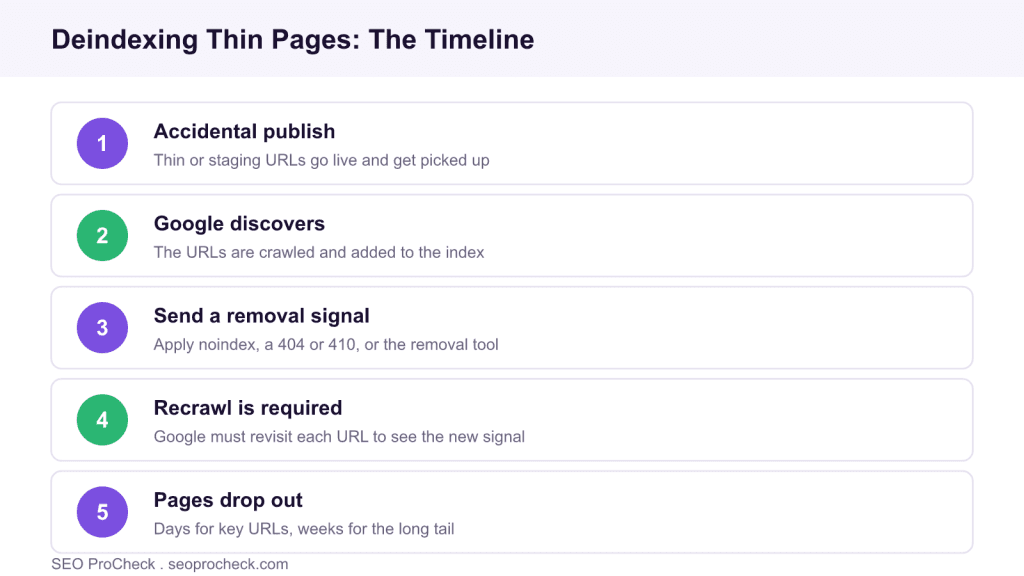
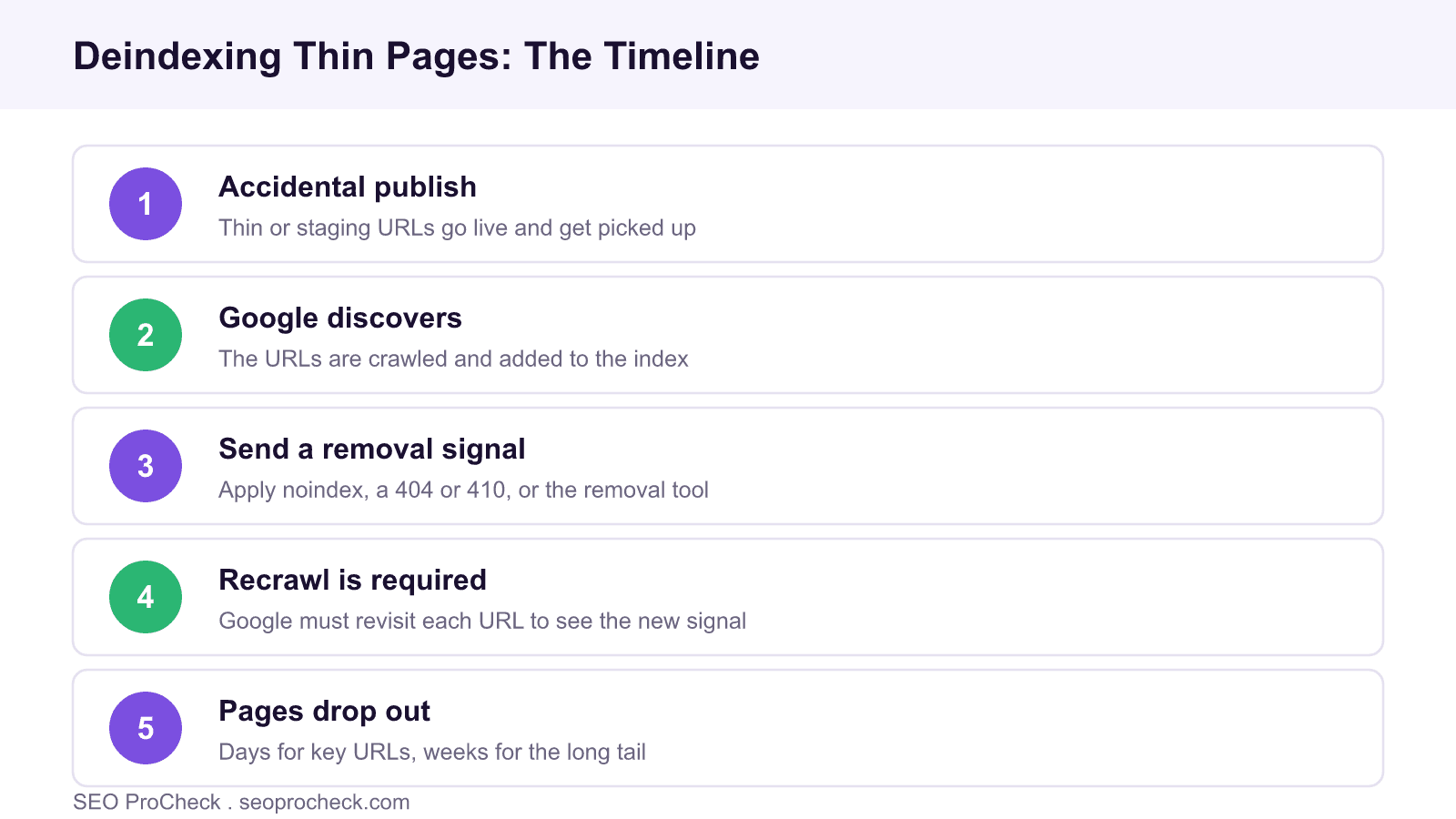
Removing accidentally published thin content from Google is not instant, because Google has to recrawl each URL before it can act on your removal signal. High value pages that are crawled often can drop within days, while the long tail can take several weeks, so the right method plus a push to recrawl is what shortens the wait.
- Deindexing speed depends on how often Google recrawls the URL, not on when you applied the fix.
- noindex, a 410 or 404, and the Removals tool all work, but with different speed and durability.
- Do not block the URL in robots.txt if you need Google to see a noindex, since blocking prevents recrawl.
- Submit the affected URLs so Google recrawls them sooner and the removal takes effect faster.
This case study, originally published on Search Engine Land, examines how long it takes to deindex low quality or thin content that went live by accident. We keep the original summary and source below, then add a decision guide for choosing the fastest safe removal path.
This SEO case study documents a successful optimization initiative, providing actionable insights for practitioners. The documented approach demonstrates how strategic SEO implementation drives measurable results.
Initial Situation
Understanding the starting point is essential context for evaluating any case study. This documentation covers the initial challenges, competitive position, and business objectives that shaped the SEO strategy.
Strategy and Approach
The strategic approach combined multiple SEO disciplines to address identified opportunities. Key decisions around prioritization and resource allocation provide a template for similar initiatives.
Implementation
Moving from strategy to execution required specific technical implementations, content development, and process changes. This case study documents the practical steps that translated strategy into action.
Results and Learnings
The outcomes demonstrate effectiveness through measurable improvements in rankings, traffic, and business metrics. Analysis of successes and challenges provides learning value for practitioners.
Case studies like this contribute to the SEO knowledge base, helping practitioners learn from documented real-world experiences.
Why removal is never instant
Every removal method shares one dependency: Google has to recrawl the URL to notice the change. Apply a noindex tag and the page stays indexed until Googlebot fetches it again and reads the directive. Return a 410 and the same rule applies. This is why a URL that Google visits daily disappears quickly, while a deep, rarely crawled page can linger. It is the same crawl demand dynamic that governs what crawl budget means for the rest of your site.
Choose the right removal method
Match the method to the urgency and to whether the URL should ever return. For content that will come back later, a noindex keeps the URL alive while hiding it. For content that should be gone for good, a 410 is a clear signal that the page is permanently removed. When you need something out of results now, the Search Console Removals tool hides a URL fast, though that hiding is temporary and must be paired with a durable signal such as noindex or a 410.
| Method | Typical speed | Best for | Caveat |
|---|---|---|---|
| Removals tool | Hours to a day | Urgent, visible URLs | Temporary, roughly six months, pair with noindex or 410 |
| Meta robots noindex | Days after recrawl | Pages that may return | Must stay crawlable so Google reads it |
| 410 Gone | Days to weeks after recrawl | Permanent removal | Confirm the URL should never return |
| 404 Not Found | Days to weeks after recrawl | Deleted pages | Slower to be trusted than a 410 |
| robots.txt disallow alone | Does not deindex | Nothing on its own | Blocks the recrawl that reads your noindex |
The mistake that stalls deindexing
The classic error is blocking the URL in robots.txt at the same time as adding a noindex. Google cannot fetch a disallowed URL, so it never sees the noindex, and the page can stay indexed as a URL only entry. If you have applied a noindex, keep the URL crawlable until it drops, then tidy up. To speed the whole process, submit the affected URLs, for example in a temporary sitemap, so Google recrawls them sooner. If the leak involved many templated URLs, the wider lesson about protecting your index quality is covered in revisiting the importance of quality indexation for large sites, and a clean canonical strategy from a curious case of canonicalization helps prevent duplicate leaks in the first place.
What has changed since this case study
The mechanics are the same, and Google has since retired the separate noindex directive in robots.txt, which it never officially supported, so the meta robots tag and the HTTP header are the sanctioned ways to noindex. The Removals tool remains the fastest way to hide a URL temporarily while a durable signal takes hold. Realistic expectations still apply: budget days for high value URLs and weeks for the long tail, and speed things up by making the affected pages easy to recrawl rather than hard.
Frequently asked questions
How long does deindexing usually take?
It depends on crawl frequency. Frequently crawled URLs can drop within days of Google seeing your removal signal, while rarely crawled long tail pages can take several weeks. The signal only counts once the page is recrawled.
Should I use noindex or a 410?
Use noindex if the page might return later, since it keeps the URL alive while hiding it. Use a 410 when the page is gone for good, because it clearly tells Google the URL was permanently removed.
Why is my noindexed page still indexed?
The most common reason is that the URL is also blocked in robots.txt, so Google cannot fetch it to read the noindex. Unblock it, keep it crawlable, and the page will drop after the next crawl.
Does the Removals tool delete pages from the index?
No, it hides them from results temporarily, for roughly six months. You must pair it with a durable signal such as a meta robots noindex or a 410 so the page stays out once the temporary hiding expires.
Can I speed up deindexing?
Yes, make the affected URLs easy to recrawl and submit them, for example in a temporary sitemap, so Google revisits them sooner. The faster the recrawl, the faster your removal signal is acted on.
Will thin content that leaked hurt my whole site?
A small, quickly corrected leak is usually minor. The risk grows if large numbers of thin URLs get indexed and persist, which is why fixing the source of the leak and protecting index quality matters as much as removal.
Take this with you
The assistant links open with a question about this page already written. Nothing is sent until you press enter.
Claude Vincent is a technical SEO consultant focused on crawlability, rendering, and AI-search visibility. He writes the field guides and case studies at SEO ProCheck, with a bias toward the durable, unglamorous work that decides whether search engines and AI answer engines can actually read and cite a site.
About SEO ProCheck
Technical SEO consulting and GEO strategy with 20 years of enterprise experience. Case studies, resources, and tools for search and AI visibility.
Work With Me
Technical SEO audits, GEO strategy, site migrations, and international SEO. Hourly consulting for teams who need hands-on support, not just reports.
Subscribe to our newsletter!








Recent Posts
- Most Top Sites Never Say Who They Are in Structured Data October 14, 2026
- Homepage Titles Are Mostly Too Short, Not Too Long October 8, 2026
- Who Actually Serves an llms.txt? 184 Top Sites Measured September 29, 2026