


AI Summary
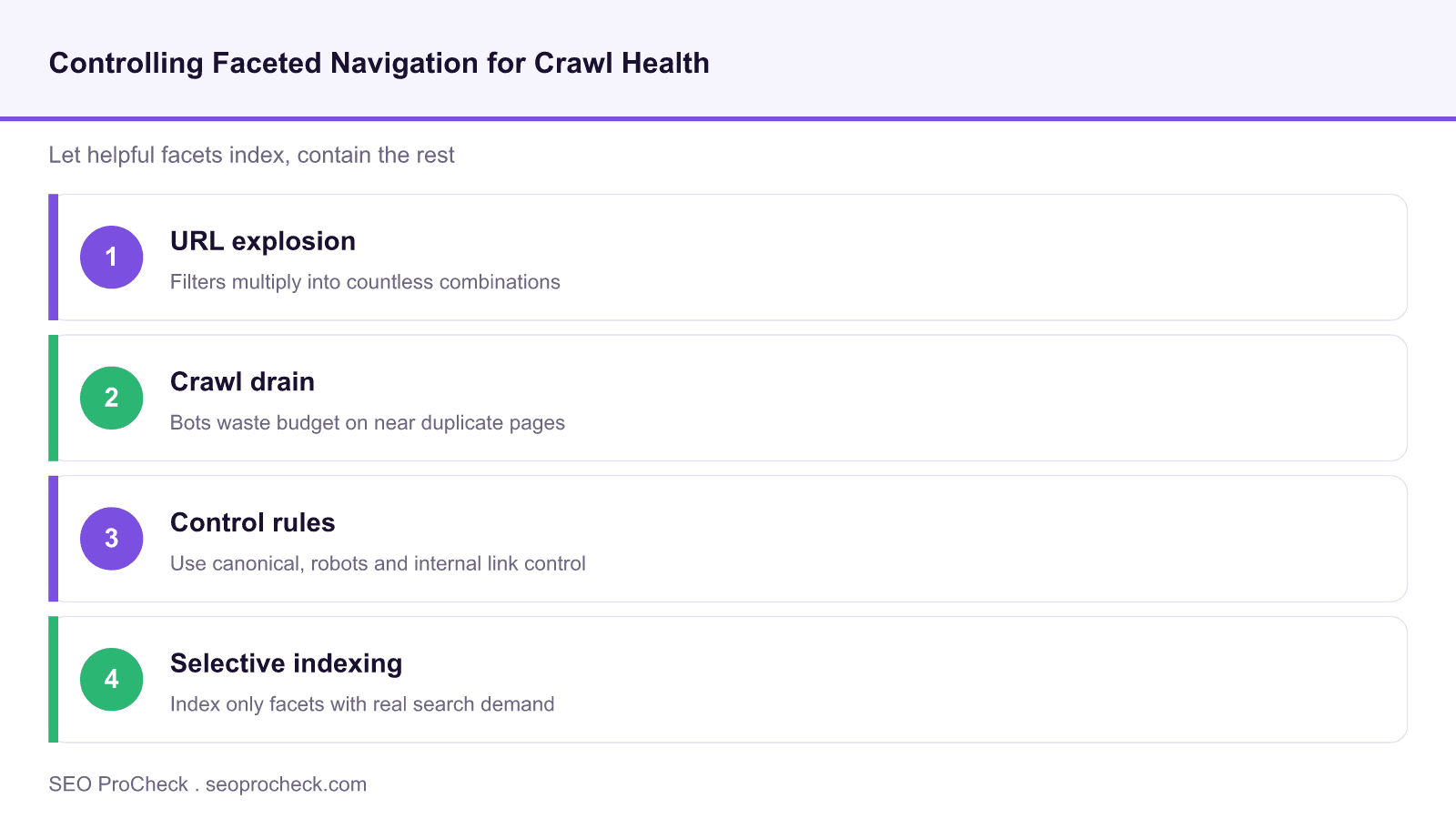
This case study, based on guidance from Andy Chadwick, explains how to control faceted navigation so it helps rather than harms SEO. Filters and facets can multiply into an enormous number of near duplicate URLs that drain crawl budget, so the goal is to let facets with real search demand be indexed while containing the rest with canonical, robots and internal link controls.
- Faceted filters multiply into countless near duplicate URL combinations.
- Uncontrolled facets drain crawl budget and can create index bloat.
- Canonical tags, robots rules and internal link control keep the URL space in check.
- Index only the facet combinations that have genuine search demand.
This SEO case study documents a successful optimization initiative, providing actionable insights for practitioners. The documented approach demonstrates how strategic SEO implementation drives measurable results.
Initial Situation
Understanding the starting point is essential context for evaluating any case study. This documentation covers the initial challenges, competitive position, and business objectives that shaped the SEO strategy.
Strategy and Approach
The strategic approach combined multiple SEO disciplines to address identified opportunities. Key decisions around prioritization and resource allocation provide a template for similar initiatives.
Implementation
Moving from strategy to execution required specific technical implementations, content development, and process changes. This case study documents the practical steps that translated strategy into action.
Results and Learnings
The outcomes demonstrate effectiveness through measurable improvements in rankings, traffic, and business metrics. Analysis of successes and challenges provides learning value for practitioners.
Case studies like this contribute to the SEO knowledge base, helping practitioners learn from documented real-world experiences.
Source: https://www.andy-chadwick.com/technical/unleash-your-faceted-navigation/
Why faceted navigation is a crawl problem
Faceted navigation is brilliant for shoppers and dangerous for crawlers. Every filter you add multiplies the possible URL combinations: color times size times brand times price range, in every order, quickly reaches numbers no crawler will ever fully explore. Most of those combinations are near duplicates of each other and of the parent category, so if they are all crawlable and indexable you get two problems at once, wasted crawl budget and index bloat that dilutes the pages you actually want ranked.
The strategic move is to decide, deliberately, which facet combinations deserve to be indexable and which should merely be usable. A handful of combinations map to real queries that people search, for example a popular brand within a category. The long tail of arbitrary combinations has no search demand and should be contained so crawlers spend their time where it counts.
The controls that keep facets in check
Use a layered approach. Point canonical tags from near duplicate facet URLs to the primary category or the canonical facet so signals consolidate. Use robots rules or noindex to keep low value parameter combinations out of the crawl and the index, and be deliberate about which parameters generate crawlable links at all. Control internal linking so that only the valuable facets receive followed links, since links are how crawl demand is created in the first place. The same measure, prune and verify loop from this study on optimizing crawl budget applies directly here.
Watch depth as well as breadth. Facets can bury useful pages many clicks from the home page, and click depth affects how often pages are crawled, a relationship explored in this experiment on pagination and click depth. Keep the facet combinations you want indexed reachable through short, clean internal paths.
Before you roll any of this out, map the current facet URL space with a crawler and pull server logs to see which combinations Googlebot already fetches. Deciding what to index in the abstract is guesswork, whereas deciding it against real crawl data and real query demand is a plan you can defend.
| Facet type | Search demand | Recommended handling |
|---|---|---|
| Core category facet | High | Index and link internally |
| Popular single filter | Medium to high | Index selectively, canonical near duplicates |
| Multi filter combination | Low | Canonical to parent or noindex |
| Sort and view parameters | None | Block from crawling or canonicalize |
What's changed since
The fundamentals are unchanged, but the toolset has matured. Google retired its old URL parameters tool, so parameter handling now lives in your own canonical, robots and linking decisions rather than in a Search Console setting. That makes deliberate on site control more important, not less.
Rendering has also moved on, so facets built with JavaScript are generally discovered, which means you cannot rely on script alone to hide them from crawlers. The durable principle stands: expose the facet combinations with real demand, contain the rest, and keep the valuable ones shallow and well linked.
Frequently asked questions
What is faceted navigation?
Faceted navigation is the set of filters on category pages that let users narrow results by attributes such as color, size, brand or price. Each combination of filters typically generates its own URL, which is what creates the SEO challenge.
Why is faceted navigation an SEO risk?
Filters multiply into a huge number of near duplicate URLs. If they are all crawlable and indexable they waste crawl budget and cause index bloat, which can dilute the ranking signals of your main category pages.
Should any facet pages be indexed?
Yes, the ones that match real search demand. A popular brand within a category, for instance, can be a valuable landing page, so index those deliberately while containing arbitrary multi filter combinations.
How do I stop Google crawling low value facets?
Combine controls: canonical near duplicate facets to the parent, apply robots rules or noindex to low value parameter combinations, and avoid generating followed internal links to them. No single control is enough on its own.
Is robots.txt or noindex better for facets?
They solve different problems. A robots.txt disallow saves crawl budget by preventing fetching, but does not remove already indexed URLs. A noindex tag removes pages from the index but requires the page to stay crawlable so the tag can be seen, so choose based on whether your goal is crawl control or index removal.
What happened to Google's URL parameters tool?
Google retired the URL parameters tool in Search Console, so you can no longer hint at parameter handling there. Parameter and facet control now depends entirely on your own canonical tags, robots rules and internal linking decisions.
Take this with you
The assistant links open with a question about this page already written. Nothing is sent until you press enter.
Claude Vincent is a technical SEO consultant focused on crawlability, rendering, and AI-search visibility. He writes the field guides and case studies at SEO ProCheck, with a bias toward the durable, unglamorous work that decides whether search engines and AI answer engines can actually read and cite a site.
About SEO ProCheck
Technical SEO consulting and GEO strategy with 20 years of enterprise experience. Case studies, resources, and tools for search and AI visibility.
Work With Me
Technical SEO audits, GEO strategy, site migrations, and international SEO. Hourly consulting for teams who need hands-on support, not just reports.
Subscribe to our newsletter!








Recent Posts
- Most Top Sites Never Say Who They Are in Structured Data October 14, 2026
- Homepage Titles Are Mostly Too Short, Not Too Long October 8, 2026
- Who Actually Serves an llms.txt? 184 Top Sites Measured September 29, 2026