• Articles
    & Evergreen
    • Articles
      • Algorithm Updates
      • Analytics & Measurement
      • CMS and Platforms
      • Content Strategy
      • E-commerce SEO
      • General
      • Industry Guides
      • Keyword Research
      • Link Building
      • Local SEO
      • Mobile SEO
      • On-Page SEO
      • SEO Tools
    • Evergreen
      • AI and Search
        • AEO (Answer Engine Optimization)
        • AI Overviews and SGE
        • GEO (Generative Engine Optimization)
        • LLM Citation Optimization
      • Content SEO
        • Content Architecture
        • E-E-A-T Optimization
        • Internal Linking Strategy
      • Python and Automation
      • Technical SEO
        • Core Web Vitals and Performance
        • Crawlability and Indexation
        • International SEO and Hreflang
        • Log File Analysis
        • Schema and Structured Data
        • Site Architecture
        • Site Migrations
  • Case Studies
    & Researches
    • Case Studies
      • Content
      • Crawling and Indexing
      • Growth
      • International SEO
      • JavaScript SEO
      • Metadata
      • Migrations
      • Website Architecture
      • Web Performance
    • Research
      • AI Search
      • Cross-Industry
      • E-commerce
      • Enterprise
      • Local and Listings
      • Publisher
  • Free
    Tools
    • Free SEO & AI Search Tools
    • Free SEO Tools
      • Content Analysis
      • Developer Utilities
      • GEO & AI Visibility
      • Local SEO
      • Schema & Structured Data
      • Social & Meta
      • Technical SEO
    • Browser Extensions
  • Resources
    & Guides
    • Executive Briefings
      • What SEO Actually Is
      • Why SEO Takes Time
      • Technical vs Content SEO
      • What AI Search Changes
      • Is Your SEO Working?
      • Case Studies
      • Is It Worth It?
      • Hiring an Agency
      • SEO vs Paid
      • Resourcing SEO
    • Best Practices
      • Accessibility
      • AMP
      • Content & GEO
      • Duplicates
      • HTML Structure
      • hrefLang
      • Images
      • Indexation
      • Links
      • Mobile
      • On-Page SEO
      • Organic & Analytics
      • Performance
      • Redirections
      • Robots.txt
      • Security
      • Structured Data
      • Technical GEO
      • URLs
      • XML Sitemaps
    • FAQ
      • AI & Search FAQ
      • Technical SEO FAQ
      • Content SEO FAQ
      • Off-Page SEO FAQ
      • Local SEO FAQ
      • E-commerce SEO FAQ
      • Tools and Analytics FAQ
    • Glossary
      • Glossary | Algorithms
      • Glossary | Analytics
      • Glossary | Business
      • Glossary | Content SEO
      • Glossary | E-commerce
      • Glossary | Emerging
      • Glossary | GEO & AI SEO
      • Glossary | International SEO
      • Glossary | Link Building
      • Glossary | Local SEO
      • Glossary | Search Behavior
      • Glossary | Technical SEO
      • Glossary | Tools
  • Articles
    & Evergreen
    • Articles
      • Algorithm Updates
      • Analytics & Measurement
      • CMS and Platforms
      • Content Strategy
      • E-commerce SEO
      • General
      • Industry Guides
      • Keyword Research
      • Link Building
      • Local SEO
      • Mobile SEO
      • On-Page SEO
      • SEO Tools
    • Evergreen
      • AI and Search
        • AEO (Answer Engine Optimization)
        • AI Overviews and SGE
        • GEO (Generative Engine Optimization)
        • LLM Citation Optimization
      • Content SEO
        • Content Architecture
        • E-E-A-T Optimization
        • Internal Linking Strategy
      • Python and Automation
      • Technical SEO
        • Core Web Vitals and Performance
        • Crawlability and Indexation
        • International SEO and Hreflang
        • Log File Analysis
        • Schema and Structured Data
        • Site Architecture
        • Site Migrations
  • Case Studies
    & Researches
    • Case Studies
      • Content
      • Crawling and Indexing
      • Growth
      • International SEO
      • JavaScript SEO
      • Metadata
      • Migrations
      • Website Architecture
      • Web Performance
    • Research
      • AI Search
      • Cross-Industry
      • E-commerce
      • Enterprise
      • Local and Listings
      • Publisher
  • Free
    Tools
    • Free SEO & AI Search Tools
    • Free SEO Tools
      • Content Analysis
      • Developer Utilities
      • GEO & AI Visibility
      • Local SEO
      • Schema & Structured Data
      • Social & Meta
      • Technical SEO
    • Browser Extensions
  • Resources
    & Guides
    • Executive Briefings
      • What SEO Actually Is
      • Why SEO Takes Time
      • Technical vs Content SEO
      • What AI Search Changes
      • Is Your SEO Working?
      • Case Studies
      • Is It Worth It?
      • Hiring an Agency
      • SEO vs Paid
      • Resourcing SEO
    • Best Practices
      • Accessibility
      • AMP
      • Content & GEO
      • Duplicates
      • HTML Structure
      • hrefLang
      • Images
      • Indexation
      • Links
      • Mobile
      • On-Page SEO
      • Organic & Analytics
      • Performance
      • Redirections
      • Robots.txt
      • Security
      • Structured Data
      • Technical GEO
      • URLs
      • XML Sitemaps
    • FAQ
      • AI & Search FAQ
      • Technical SEO FAQ
      • Content SEO FAQ
      • Off-Page SEO FAQ
      • Local SEO FAQ
      • E-commerce SEO FAQ
      • Tools and Analytics FAQ
    • Glossary
      • Glossary | Algorithms
      • Glossary | Analytics
      • Glossary | Business
      • Glossary | Content SEO
      • Glossary | E-commerce
      • Glossary | Emerging
      • Glossary | GEO & AI SEO
      • Glossary | International SEO
      • Glossary | Link Building
      • Glossary | Local SEO
      • Glossary | Search Behavior
      • Glossary | Technical SEO
      • Glossary | Tools
consulting
Home / Metadata / Placing the Brand Name First in Title Tags: SEO Split Testing Lessons from SearchPilot

Placing the Brand Name First in Title Tags: SEO Split Testing Lessons from SearchPilot

  • January 13, 2021
  • Metadata
No Comments
Placing the brand name first in title tags: seo split testing lessons from searchpilot

AI Summary

Whether the brand name should lead the title tag depends on brand strength and query type, and the effect shows up in organic click through rate rather than rankings. Strong brands often win by leading with the name, while lesser known brands usually win by leading with the primary keyword.

  • Brand first spends prominent pixels on the name, brand last favours the keyword
  • Keep the primary keyword within the first sixty characters to survive truncation
  • Google may reorder or add the site name since the 2021 title update
  • Test brand position on templated pages against a matched control
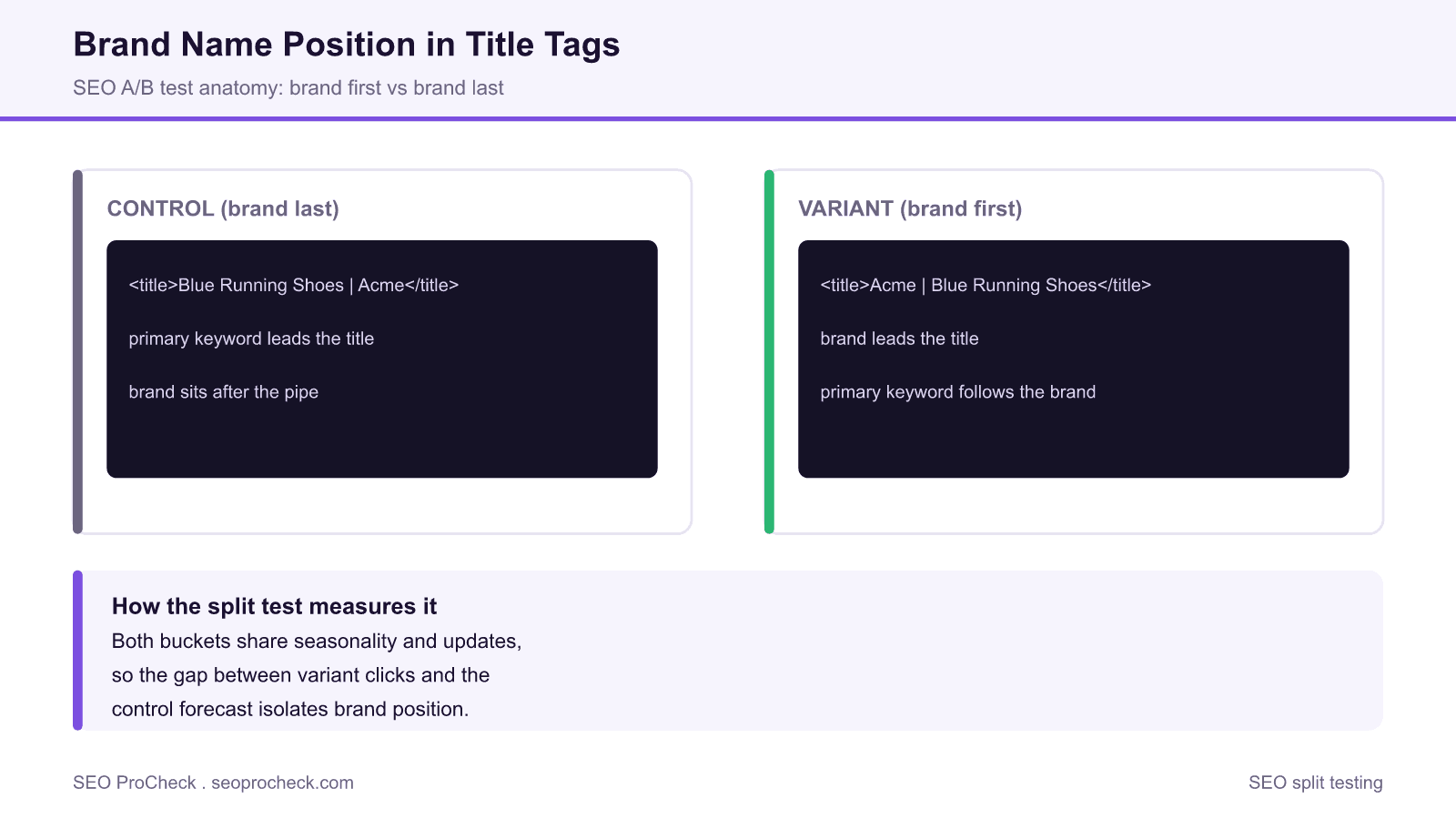
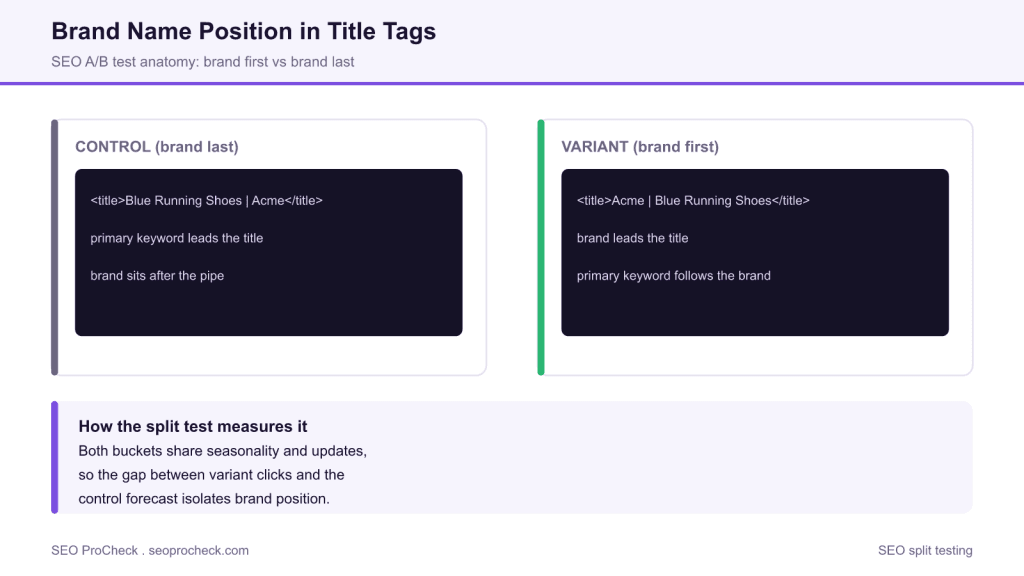
Diagram comparing a brand last control title tag with a brand first variant title tag inside a controlled seo split test.
Brand first versus brand last title structure tested across a page template.

This SEO case study documents a successful optimization initiative, providing actionable insights for practitioners. The documented approach demonstrates how strategic SEO implementation drives measurable results.

Initial Situation

Understanding the starting point is essential context for evaluating any case study. This documentation covers the initial challenges, competitive position, and business objectives that shaped the SEO strategy.

Strategy and Approach

The strategic approach combined multiple SEO disciplines to address identified opportunities. Key decisions around prioritization and resource allocation provide a template for similar initiatives.

Implementation

Moving from strategy to execution required specific technical implementations, content development, and process changes. This case study documents the practical steps that translated strategy into action.

Results and Learnings

The outcomes demonstrate effectiveness through measurable improvements in rankings, traffic, and business metrics. Analysis of successes and challenges provides learning value for practitioners.

Case studies like this contribute to the SEO knowledge base, helping practitioners learn from documented real-world experiences.

Source: https://www.searchpilot.com/resources/case-studies/seo-split-test-lessons-placing-the-brand-name-first-in-title-tags/

Practitioner commentary

This case study tests a question every in house SEO eventually argues about: should the brand name sit at the front of the title tag or at the end, and does the position actually move organic click through rate.

The real tradeoff behind brand position

Putting the brand first spends pixel width and keyword prominence on a word that most searchers who clicked already recognise. Putting the primary keyword first keeps the terms a searcher scanned for closest to the left edge, where the eye lands. For a strong, trusted brand the front position can lift click through rate because the name is itself a trust signal. For a weak or unknown brand the same position wastes prime space and can suppress clicks. This is why the answer is site specific and belongs in a test.

There is also a truncation angle. Google truncates title links at roughly 600 pixels on desktop, so anything you push to the front survives and anything at the end can be cut. If the brand leads, a long keyword may be clipped. If the keyword leads, the brand may vanish behind an ellipsis, which is usually the safer thing to lose.

How SearchPilot isolates the effect

The platform assigns comparable pages, for example all pages on one template, to control and variant buckets at random. The variant flips the brand to the front of the title while the control keeps it at the end. Because both buckets experience the same demand seasonality and the same algorithm updates, a forecast built from the control predicts what the variant would have done unchanged, and the residual is the effect of brand position. This is the only clean way to separate a copy change from the noise of everyday ranking movement.

To reproduce the logic without the tool, hold every other variable steady. Change brand position on one coherent set of templated pages, keep a matched set untouched, and compare click through rate for the identical date window in Search Console. Do not mix in pages where you also changed the keyword or the description, or you will not know which change moved the metric.

Applying the lesson on your own site

Treat brand position as a decision that depends on brand strength and query type. Strong brands often win by leading with the name on navigational and mid funnel queries. Everyone else usually wins by leading with the primary keyword and letting the brand trail after a separator. Standardise the pattern in your title template so the choice is applied consistently and is easy to reverse, and re check the live SERP because Google may rewrite the title and undo your ordering.

Whatever you choose, keep the primary keyword within the first sixty or so characters so it survives truncation, and keep the separator consistent so your brand presentation looks deliberate across the SERP.

Brand first versus brand last: when each tends to win

FactorBrand first tends to winBrand last tends to win
Brand strengthWell known, trusted nameNew or low awareness brand
Query typeNavigational or brandedNon branded, keyword driven
Truncation riskShort primary keywordLong primary keyword
Click through goalReassurance and trustKeyword match and scannability

What has changed since this test

Since the August 2021 title update Google frequently rewrites title links, and one of its habits is to append or move the site name. That means the brand can appear even when you removed it, and your carefully chosen order can be reshuffled, so the live result is the only source of truth.

Google now derives the site name for the brand portion of some results from structured data and consistent site wide signals, which reduces the payoff of manually forcing the brand into every title. Getting site name and Organization data right can matter more than the raw ordering you set in the tag.

Related reading

  • adding prices to title tags
  • seasonal messaging in titles
  • metadata case studies

Frequently asked questions

Should the brand name go first or last in a title tag?

It depends on brand strength and query type. Strong, trusted brands often gain click through rate by leading with the name, while lesser known brands usually do better leading with the primary keyword and placing the brand after a separator. Test it on your own templates rather than following a universal rule.

Does brand position affect rankings or only click through rate?

The primary, measurable effect is on click through rate, because position changes what a searcher sees and scans first. Any ranking effect is indirect and small, driven by keyword prominence, so treat this as a click through rate optimisation.

Will Google keep the brand order I set?

Not always. Since 2021 Google rewrites titles and may move, add, or remove the site name. Always verify on the live search result that your intended order is the one being shown.

Where should the primary keyword sit if the brand goes first?

Immediately after the brand and separator, and within the first sixty or so characters, so it survives the roughly 600 pixel desktop truncation limit and stays visible to searchers scanning the results.

Does putting the brand first waste space?

For an unknown brand, often yes, because it spends the most prominent pixels on a word searchers do not recognise. For a trusted brand the name itself is a trust signal that can earn the click, which is why the answer is site specific.

How do I test brand position without SearchPilot?

Change brand order on one set of templated pages, keep a matched set unchanged, and compare click through rate in Search Console for the same date range. Avoid changing anything else on those pages during the test.

Take this with you

Ask ChatGPTAsk ClaudeAsk PerplexityShare on LinkedIn

The assistant links open with a question about this page already written. Nothing is sent until you press enter.

  • Claude Vincent

Claude Vincent is a technical SEO consultant focused on crawlability, rendering, and AI-search visibility. He writes the field guides and case studies at SEO ProCheck, with a bias toward the durable, unglamorous work that decides whether search engines and AI answer engines can actually read and cite a site.

  • Brand Signals, Local SEO, Title Tags

About SEO ProCheck

Technical SEO consulting and GEO strategy with 20 years of enterprise experience. Case studies, resources, and tools for search and AI visibility.

Learn more about me

Work With Me

Technical SEO audits, GEO strategy, site migrations, and international SEO. Hourly consulting for teams who need hands-on support, not just reports.

Contact now

Subscribe to our newsletter!

More from our blog


Stacked bar of 184 of the web's most visited sites showing where an XML sitemap can be found. 78 sites by guessing the usual path, 38 more only by reading the Sitemap line in robots.txt, and 68 by neither route.

Finding a Competitor's Sitemap, and Turning It Into a Change Log

A competitor's XML sitemap is a change log they publish without meaning…
Continue reading
Bar chart of the twelve most blocked AI crawler names across 148 top websites. bytespider and ccbot lead with 21 sites each, then gptbot 18 and google-extended 15. Three names in the top ten, anthropic-ai, omgili and cohere-ai, are marked as names their vendor no longer publishes.

AI Crawler User Agents: The Current Names, and Which Ones Sites Actually Block

I read the robots.txt of 148 of the most visited sites on…
Continue reading
A two by two matrix of 126 top websites. Where robots.txt does not block GPTBot, 87 sites serve the page and 20 deny it at the edge. Where robots.txt does block GPTBot, 14 sites serve the page anyway and 5 deny it.

Can AI Crawlers Actually Read Your Site? I Measured 400 of the Biggest

I requested the homepage of 400 of the world's most visited sites…
Continue reading
Flowchart of the five check pre-publish quality gate for AI-assisted content: the anyone test, the no-AI test, says something new, the first screen, and the recommend test. All five passing leads to ship it; any failure leads back to editing.

The Pre-Publish Quality Gate for AI-Assisted Content

The five check gate we run on every AI-assisted page, built after…
Continue reading
Diagram of the agent-readable file stack showing AGENTS.md in the code repository read by coding agents, llms.txt and llms-full.txt at the website root read by answer engines, and robots.txt plus RSL as the access and licensing layer beneath both.

AGENTS.md vs llms.txt vs llms-full.txt: Which Agent File Does What

AGENTS.md, llms.txt and llms-full.txt look alike but serve different readers. What each…
Continue reading

Profound vs Semrush and Ahrefs: What an AI-Search Tool Actually Replaces (and What It Doesn't)

Profound vs Semrush and Ahrefs don't measure the same thing. A practitioner's…
Continue reading
SEO is the foundation everything is built on; AEO (be the answer) and GEO (get cited) are what it makes possible

SEO vs AEO vs GEO: What Each One Means and How They Actually Differ

SEO, AEO, and GEO are three different jobs: rank in search results,…
Continue reading
Google May 2026 Core Update: What We Learned After the Dust Settled

Google May 2026 Core Update: What We Learned After the Dust Settled

The May 2026 Core Update rolled out from May 21 to June…
Continue reading
Prev. Post
Next Post

Recent Posts

  • Finding a Competitor's Sitemap, and Turning It Into a Change Log September 15, 2026
  • AI Crawler User Agents: The Current Names, and Which Ones Sites Actually Block September 9, 2026
  • Can AI Crawlers Actually Read Your Site? I Measured 400 of the Biggest September 5, 2026

All Website Tags

AI SEO Analytics B2B Batch Check Content Analysis Content Quality Content Strategy Core Web Vitals Crawl Budget Crawling DOM Parsing E-commerce E-E-A-T Enterprise FAQ GEO Googlebot Google Search Console High Priority Hreflang HTTP Requests Indexing Internal Linking International SEO JavaScript SEO Keyword Research Link Building Live Check Local SEO Low Priority Medium Priority Multiple APIs On-Page SEO Page Speed PageSpeed API Rich Results SaaS Schema Validation SEO Tools SERP Features Site Architecture Site Migrations Structured Data Technical SEO Title Tags

Case studies, research, best practices and free tools for technical SEO, GEO and AI search.

Free tools: SEO & AI search tools · GitHub · browser extensions

SEO Geek since 2004. © All Rights Reserved.

About Me  |  Sitemap for Humans  |  Privacy  |  Terms