

International SEO: Growing From Zero To £2m/year (Case Study)
- April 6, 2023
- International SEO
AI Summary
International SEO growth comes from three levers done in the right order: choosing a URL structure, signaling language and region with correct hreflang, and localizing content properly for each market. When all three are in place, every new market adds its own stream of qualified organic traffic, so revenue compounds rather than plateaus.
- Pick a URL structure first: subdirectories usually beat separate domains for authority.
- Implement reciprocal hreflang with an x-default fallback, or Google ignores the cluster.
- Localize, do not just translate: adapt currency, intent, and tone per market.
- Growth compounds as each localized market contributes its own organic revenue.
International SEO presents unique challenges for reaching users across languages and regions. This case study documents successful international expansion strategies that established search visibility in target markets.
The case study behind this page follows a business that grew international organic revenue from a standing start to a substantial recurring figure. The exact numbers belong to the original author, and the value here is the repeatable method rather than the specific total. That method breaks down into a small number of decisions, each of which has a clear right and wrong answer for most sites.
Decision one: URL structure
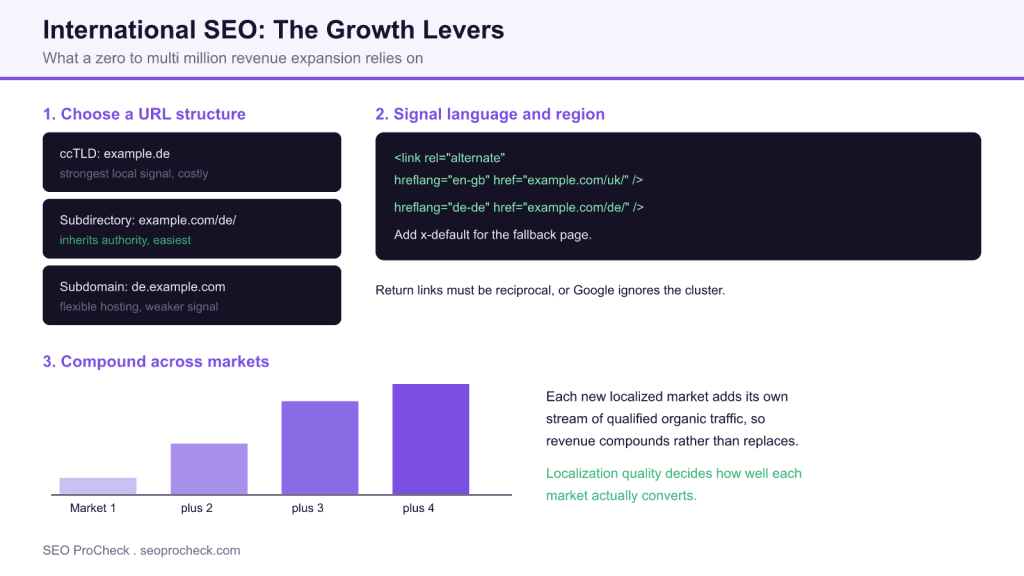
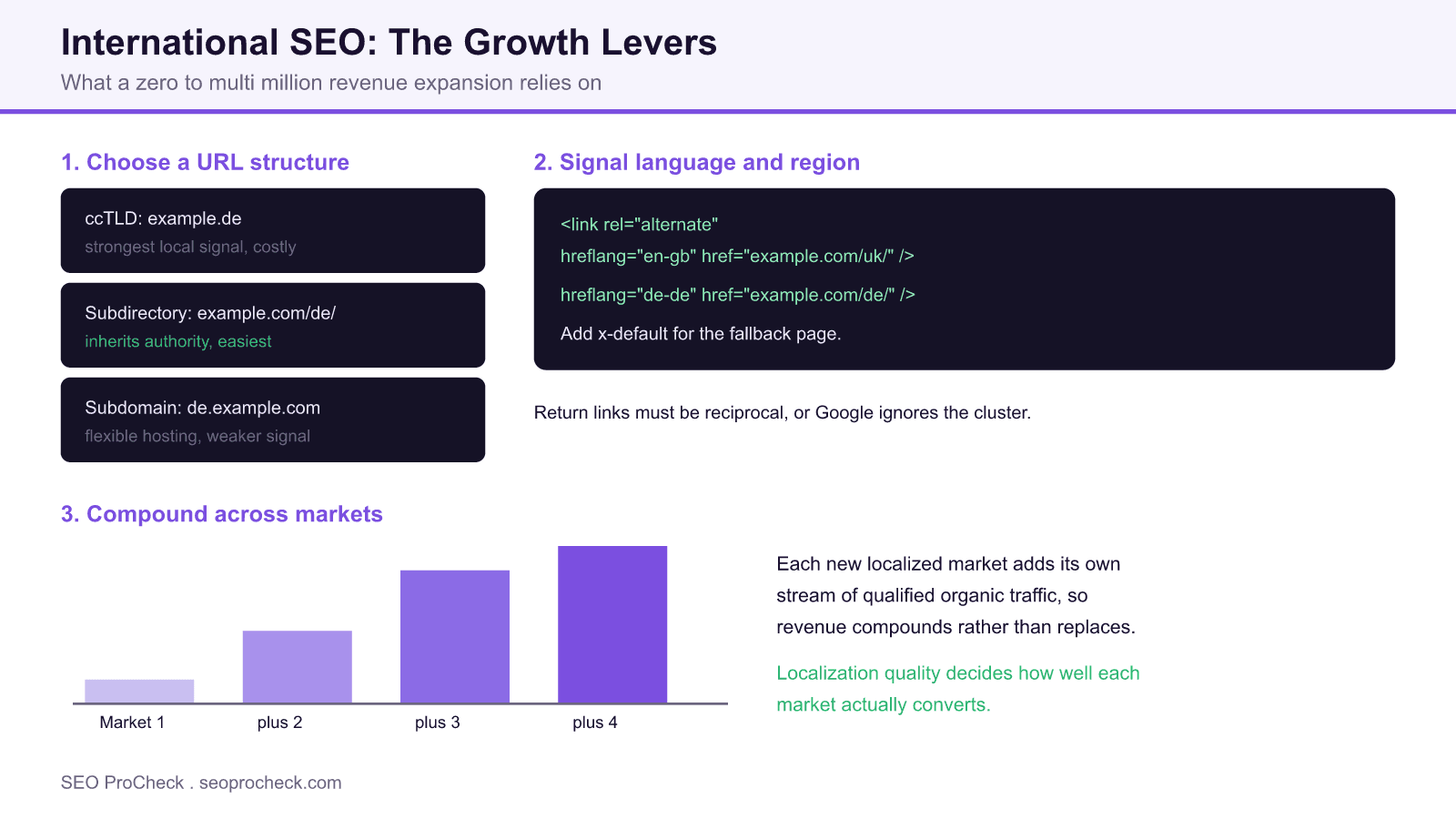
Before writing a single localized page, decide where those pages will live. Country code top level domains, such as example.de, send the clearest signal to Google that a site targets a specific country, and they can build strong local trust, but each new domain starts its authority from zero and multiplies your maintenance cost. Subdirectories, such as example.com/de/, keep everything under one domain, so new markets inherit the authority you have already earned and you manage one property. Subdomains, such as de.example.com, sit in between: flexible for hosting but a weaker and less predictable signal. For most companies expanding market by market, subdirectories are the pragmatic winner, which is why the growth path in the diagram above starts there. The international SEO best practices guide compares these structures in more depth.
Decision two: hreflang signals
Hreflang tells Google which language and region each page serves, so it can show the German version to a German searcher and the British version to a British one. A minimal cluster looks like this: on your UK page you declare hreflang="en-gb" pointing to the UK URL and hreflang="de-de" pointing to the German URL, and every other page in the set declares the same complete list. Two rules cause most failures. First, the annotations must be reciprocal: if page A points to page B, page B must point back to A, or Google discards the whole cluster. Second, add an x-default entry for the fallback page, so unmatched visitors get a sensible default rather than the wrong locale. Google's own guidance on this has shifted over time, as covered in John Mueller's hreflang advice.
Decision three: localization, not translation
Technical signals only route users to the right page. Whether that page converts depends on localization. Translation converts words; localization adapts the whole experience: currency and units, local examples and case studies, tone and formality, and above all the exact phrases people in that market actually search. A term that dominates in one country may be a minority phrasing in another, so keyword research has to be redone per market rather than translated from the source language. Machine translation can get a page indexed, but native review and local intent research are what turn visits into revenue. Skipping this step is the most expensive mistake, and it is covered directly in the guide on how to avoid international SEO mistakes.
Why the results compound
The reason international SEO can take a business from zero to a large recurring figure is that markets stack. Once the first localized market is crawled, indexed, and earning local links, it produces a steady stream of qualified organic traffic. Adding a second market does not replace the first: it adds a second stream on top. Because the technical framework and content templates are reused, each additional market is cheaper to launch than the last, while the revenue it adds is roughly independent of the others. That is the compounding shown in the bar chart in the diagram, and it is why disciplined international programs tend to accelerate rather than plateau. For a broader overview of the full workflow, the ultimate international SEO guide is a useful companion.
URL structure options compared
| Structure | Example | Local signal | Authority and cost | Best for |
|---|---|---|---|---|
| Country code domain | example.de | Strongest | Splits authority, highest cost | Big brands committed to a market |
| Subdirectory | example.com/de/ | Good with hreflang | Inherits authority, low cost | Most market by market expansion |
| Subdomain | de.example.com | Weaker, less predictable | Partial authority, medium cost | Separate hosting or tech stacks |
International Context
International SEO requirements vary based on target markets, content localization needs, and technical infrastructure. This case study establishes the international scope and specific challenges addressed.
Technical Implementation
International targeting requires proper technical setup: URL structure decisions, hreflang implementation, and Search Console configuration. This case study documents the technical approach that enabled successful international targeting.
Localization Strategy
Beyond technical implementation, international success requires appropriate content localization. This case study covers translation quality, local relevance adaptation, and market-specific content development.
Market Performance
International SEO success is measured by visibility and traffic in target markets. This case study quantifies performance across markets, demonstrating the effectiveness of the international approach.
What has changed since this case study
Google has signaled that it leans less heavily on hreflang than it once did, using automatic language detection to serve the right page in some cases, but hreflang remains the reliable way to control which version ranks and to avoid duplicate treatment across locales. Search Console also retired the old international targeting setting for country, so geographic intent now comes from URL structure, hreflang, and genuine local relevance rather than a manual toggle. The core method in this case study still holds: structure, signal, localize, then repeat per market.
Frequently Asked Questions
What URL structure is best for international SEO?
There are three main options: country code domains such as example.de, subdirectories such as example.com/de/, and subdomains such as de.example.com. Subdirectories are usually the pragmatic choice because they inherit the authority of the main domain and are cheaper to run, while country code domains send the strongest local signal but split your authority and cost more to maintain.
What is hreflang and why does it matter?
Hreflang is a tag that tells Google which language and region a page targets, so it can serve the right version to the right user. Without it, Google may show a German user your English page, or treat your localized pages as duplicates. Correct hreflang is the single most important technical signal in international SEO.
Do hreflang tags need to be reciprocal?
Yes. Every page in an hreflang cluster must reference every other version, including itself, and those return links must point back correctly. If the return links are missing or wrong, Google ignores the annotations, which is one of the most common reasons international setups quietly fail.
Is translation enough, or do I need localization?
Translation alone rarely wins. Localization adapts currency, examples, units, tone, and local search intent, because people in different markets search for the same thing in different words. A machine translated page can rank, but a properly localized page converts far better and earns local links and trust.
How long does international SEO take to pay off?
Expect months, not weeks, per market. New localized sections need to be crawled, indexed, and to earn local relevance and links before they rank. The upside is that growth compounds: each market you add contributes its own stream of organic traffic, so revenue stacks rather than replaces.
Should I use x-default in hreflang?
Yes, add an x-default entry pointing to your fallback page, usually a language selector or your primary market version. It tells Google what to serve when no other language or region matches the user, which prevents the wrong page appearing for unmatched visitors.
International SEO case studies help practitioners navigate the complexity of multi-market optimization.
Source: https://freddiechatt.com/international-seo/
Take this with you
The assistant links open with a question about this page already written. Nothing is sent until you press enter.
Claude Vincent is a technical SEO consultant focused on crawlability, rendering, and AI-search visibility. He writes the field guides and case studies at SEO ProCheck, with a bias toward the durable, unglamorous work that decides whether search engines and AI answer engines can actually read and cite a site.
About SEO ProCheck
Technical SEO consulting and GEO strategy with 20 years of enterprise experience. Case studies, resources, and tools for search and AI visibility.
Work With Me
Technical SEO audits, GEO strategy, site migrations, and international SEO. Hourly consulting for teams who need hands-on support, not just reports.
Subscribe to our newsletter!








Recent Posts
- Most Top Sites Never Say Who They Are in Structured Data October 14, 2026
- Homepage Titles Are Mostly Too Short, Not Too Long October 8, 2026
- Who Actually Serves an llms.txt? 184 Top Sites Measured September 29, 2026