

TL;DR
Domain Authority (DA) is a score from 1 to 100 made by Moz, an SEO software company. It is not a Google metric, Google has said so for years, and Moz says so too. You cannot improve it directly: you improve what it roughly reflects, which is how many real, relevant sites link to you.
- Google does keep site-level signals of its own. The 2024 documentation leak shows a field named
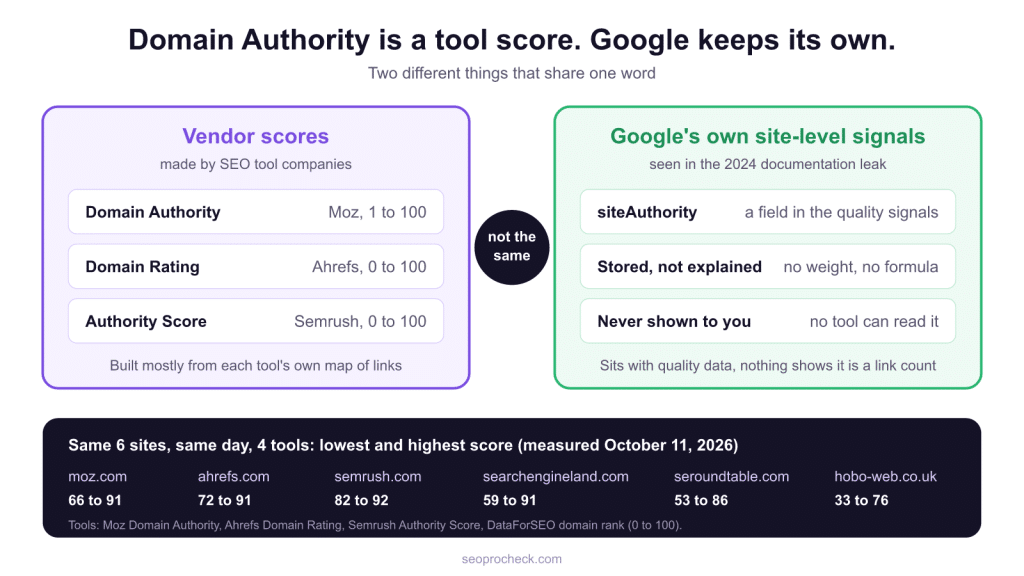
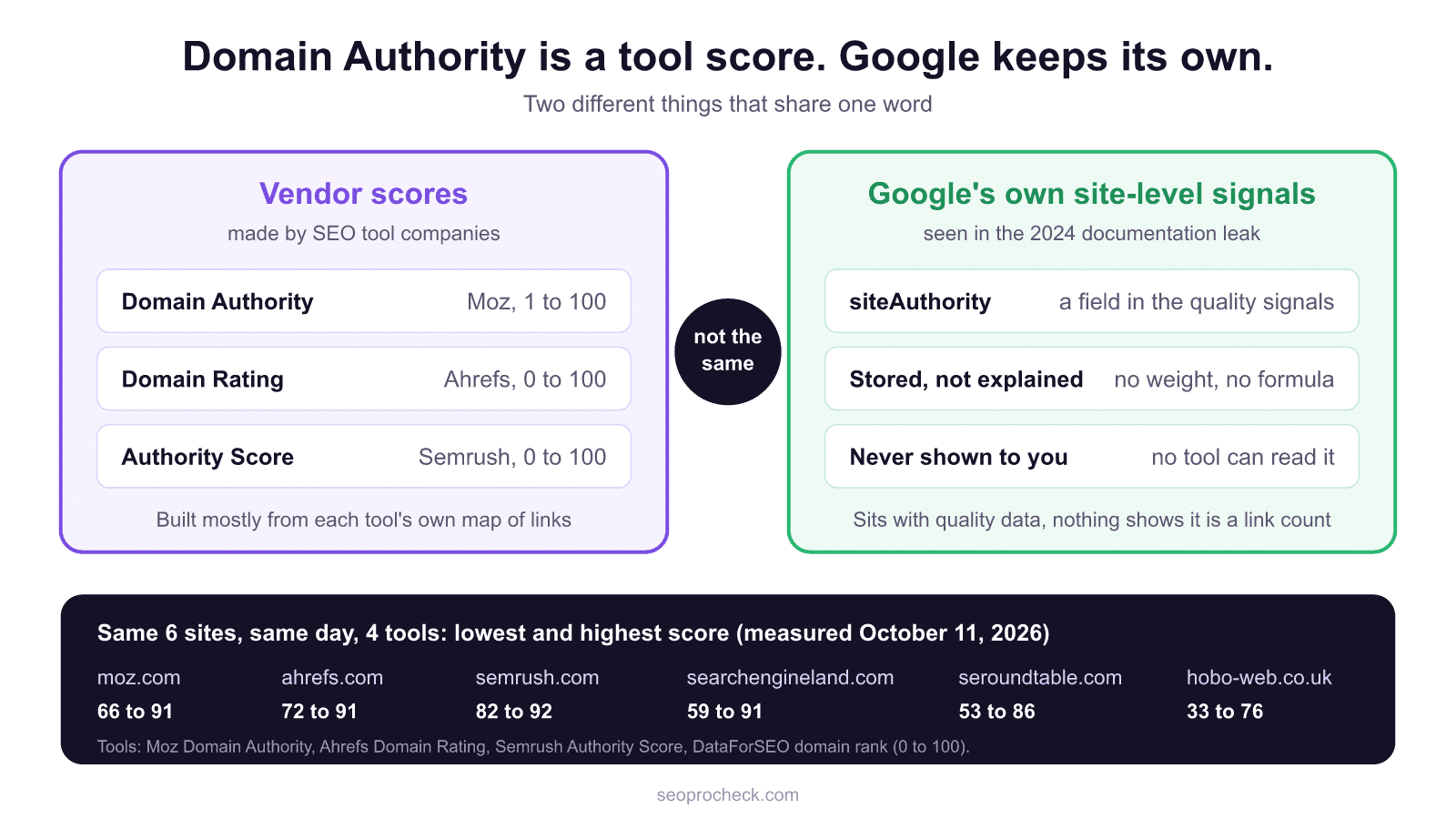
siteAuthority, stored with its quality signals. Nothing in the leak says it is a link score, and no tool can read it. - Different tools give the same site different scores. On October 11, 2026, 4 tools scored the same 6 sites, and the lowest and highest score for one site were 10 to 43 points apart.
- A DA number is fine for a quick comparison inside one tool. It is a poor report card and a bad reason to buy links.
- What moves the real thing: links from sites in your subject, content worth citing, and fixing the links you already earned.
What Domain Authority is, and whose it is
Domain Authority is a product. Moz, a company that sells SEO software, built it to answer one question: compared with other sites, how strong is this site's collection of links? The answer is a score from 1 to 100. Moz describes it as a prediction of how likely a site is to rank, and builds it mostly from its own map of which sites link to which.
Moz is not the only one. Ahrefs has Domain Rating and Semrush has Authority Score, both on a 0 to 100 scale. They measure a similar idea with different crawlers, different link maps and different math. People say "DA" for all three, the way they say a brand name for a whole kind of product. The glossary entry on Domain Authority (DA) has the short definition, and the entry on a referring domain explains the unit these scores are built from.
The score is relative, not absolute. It only means something next to another site's score, in the same tool. It is also built on a curve, so going from 20 to 30 is far easier than going from 70 to 80.
Does Google use Domain Authority? What its people said, year by year
No, and this is one of the few SEO questions with a paper trail. The table below lists what Google staff said in public, each line checked against its original source in October 2026. Read it top to bottom and one thing stands out: Google kept denying a single authority score, and at the same time said it has signals that work at the level of a whole site.
| When | Who and where | What was said, in plain words | Source |
|---|---|---|---|
| October 2013 | Matt Cutts, then head of web spam, Pubcon keynote | If you are an authority on a topic, keep writing about it and keep making that content deeper. The talk left open whether he meant a site or an author. | Bill Slawski's transcript |
| October 27, 2016 | Gary Illyes, on Twitter | There is no such thing at Google as one overall domain authority. | The tweet |
| December 30, 2016 | John Mueller, on Twitter | A 5-word reply: Google doesn't use "domain authority". The tweet has since been removed, an archived copy remains. | Archived tweet |
| May 2017 | Paul Haahr, Google search quality engineer, to Search Engine Land | Google has no single signal it would point to and call authority. It looks at a whole set of things. | Search Engine Land |
| 2018, published December 10 | John Mueller, on stage at SearchLove London | He would not call it authority, but Google does have some metrics that work at site level, and some of them may map to similar things. | Brainlabs write-up |
| June 11, 2019 | John Mueller, Google office hours | As a general matter Google does not rate a site's authority, and has no overall authority score to hand out for a website. | Search Engine Journal transcript |
| 2022, reported April 1 | John Mueller, on Reddit | DA is not needed for Google Search, and Google does not use it. | Search Engine Roundtable |
Moz agrees with Google on this. Its own guide to Domain Authority states that the score is not a Google ranking factor and has no effect on search results.
What the 2024 leak added: siteAuthority
In May 2024, a large set of internal Google documentation became public. One module, CompressedQualitySignals, lists a field named siteAuthority. Its one-line description says it is an integer, converted from quality_nsr.SiteAuthority, and applied in a system called Qstar. You can read the line in the published copy of the documentation, and Mike King's first analysis at iPullRank is dated May 27, 2024.
Many people read that field name and concluded that Google had lied for years. Shaun Anderson of Hobo argued in October 2026 that this is mostly a mix-up of words, and the record supports him: Google denied using Domain Authority, which is Moz's score, and it had already said in 2018 that it has site-level metrics. His article is What is Site Authority?.
Here is what the leak does and does not tell us. It tells us the field exists, that it sits with quality data, and that it comes from a quality system, not from a link counter. It does not give a weight, a formula, or proof that the field is used in ranking today. The documentation describes what Google stores, not how Google ranks. Anyone who says they can raise your siteAuthority is selling a number nobody outside Google can see. This site's notes on the leak itself are in Secrets from the Algorithm.
Measured: 4 tools, the same 6 sites, the same day
If these scores measured one real thing, the tools would land close to each other. So on October 11, 2026 this site asked 4 of them about the same 6 sites: the three best-known SEO tool companies and three SEO publishers. Every score is on a scale that tops out at 100.
| Site | Moz Domain Authority | Ahrefs Domain Rating | Semrush Authority Score | DataForSEO domain rank | Lowest to highest | Spread |
|---|---|---|---|---|---|---|
| moz.com | 91 | 91 | 66 | 75 | 66 to 91 | 25 |
| ahrefs.com | 84 | 91 | 72 | 82 | 72 to 91 | 19 |
| semrush.com | 86 | 92 | 88 | 82 | 82 to 92 | 10 |
| searchengineland.com | 91 | 91 | 59 | 73 | 59 to 91 | 32 |
| seroundtable.com | 79 | 86 | 53 | 67 | 53 to 86 | 33 |
| hobo-web.co.uk | 55 | 76 | 33 | 46 | 33 to 76 | 43 |
Four things show up. First, no site gets the same score twice: the gap between the lowest and the highest score runs from 10 points to 43 points, on the same site, on the same day. Second, the gap is narrowest for the tool companies' own sites (10 to 25 points) and widest for the three publishers (32 to 43 points). The smallest of them is rated 33 by one tool and 76 by another. Third, Moz and Ahrefs each give their own site 91, and Semrush gives its own site 88, while Semrush rates the other two at 66 and 72. Fourth, the score is not a simple count of linking sites: Moz counts 194,177 sites linking to semrush.com and 158,213 linking to searchengineland.com, and gives the second one the higher Domain Authority.
How this was measured: 6 sites, October 11, 2026. Moz Domain Authority and the linking-site counts came from the Moz API, Ahrefs Domain Rating from Ahrefs's free public Website Authority Checker, Semrush Authority Score from Semrush's Domain Overview report, and the DataForSEO rank from its Backlinks API on the 0 to 100 scale. Six sites is an illustration, not a study. The point holds at any size: a score is one company's estimate, so never compare a number from one tool with a number from another.
When a DA number helps, and when it misleads
| You want to | Is a DA number useful? | Why |
|---|---|---|
| Compare two sites quickly before asking for a link | Yes, as a rough filter | Inside one tool, a 70 and a 20 are different kinds of site. A 42 and a 47 are not. |
| Watch your own link profile over a year | Yes, as a trend | Same tool, same site, month after month. Read the direction, not the digit. |
| Predict whether a page will rank | Barely | The score describes a whole site in one tool's eyes. A page ranks on what it answers and who links to that page. |
| Report SEO progress to a boss or a client | No | It is not Google's number, and it can rise while traffic falls. Report linking sites gained and searches ranked. |
| Decide what a link or a guest post is worth | No | Sellers price by the score because buyers ask for it, and the score can be inflated. |
| Explain a traffic drop | No | Google does not read it, so a change in it cannot be the cause. |
How to improve it, the honest version
You do not improve Domain Authority. You improve your links, and the tools notice later. That order matters, because every shortcut that targets the number first is a way to pay for a change Google never sees.
- Earn links from sites in your own subject. One new site linking to you is worth more than ten more links from a site that already does. Count linking sites, not links.
- Publish something other people need to cite. Your own numbers, a clear reference page, a free tool. A page that only repeats what the top results say gives nobody a reason to link.
- Keep to your subject and go deeper. This is the 2013 advice from the table above, and it has aged well. A small site can show real expertise without a big name.
- Collect what you already earned. Find old pages that other sites link to and that now return an error, then restore them or redirect them to the closest live page. This is often the fastest gain on an older site.
- Pass it around inside your site. Link from your most linked pages to the pages that need help, with plain descriptive words.
- Do not buy it. Paid links, link networks and "DA boosting" services move the tool's number and put the site at risk. See how spam updates treat link schemes.
Then wait. A tool has to recrawl the linking page before its score moves, and Google works on its own clock: its own figures, shared at a Search Central event in 2026, put the typical return visit to a known page at about 30 days (reported by Search Engine Roundtable). More questions on earning links are answered in the link building FAQ.
What to report in its place
If a boss or a client asks for "the DA", give them numbers that describe the same progress and that Google can actually see.
- Linking sites gained and lost this quarter, from one tool, with the names of the best new ones.
- How many searches you rank for in the top 10, from Search Console, this quarter against last.
- Searches for your own name, which rise when people hear about you somewhere else.
- The score itself, last and small, labeled with the tool's name and the date, as a trend line and nothing more.
FAQ
No. It is a score made by Moz, and Moz's own guide says it is not a Google ranking factor and has no effect on search results. Google staff have said the same in 2016, 2019 and 2022.
There is no good score on its own. The scale is relative, so the only fair comparison is with the sites you compete against, in the same tool, on the same day. A local shop with 25 can be ahead of every rival in its town.
Each company crawls the web with its own crawler, keeps its own map of links, and uses its own formula. On October 11, 2026, 4 tools scored the same 6 sites, and the lowest and highest score for one site were 10 to 43 points apart, so a difference between tools tells you about the tools, not about your site.
It showed that Google stores a site-level field named siteAuthority, kept with its quality signals. It did not show a link-based score like Moz's, and it showed no weight or formula. Google had denied using Domain Authority, the Moz score, while saying in 2018 that it has some site-level metrics.
It changes when the tool recrawls the links pointing at you and recalculates, which each tool does on its own schedule. For the 6 homepages checked here, Moz's last crawl dates ranged from September 30 to October 6, 2026. A new link can take weeks to show.
No. A purchased link can lift a number in a tool without lifting anything in Google, and paid links that pass ranking credit are against Google's spam policies. Spend the money on something other sites want to cite.
Take this with you
The assistant links open with a question about this page already written. Nothing is sent until you press enter.
Claude Vincent is a technical SEO consultant focused on crawlability, rendering, and AI-search visibility. He writes the field guides and case studies at SEO ProCheck, with a bias toward the durable, unglamorous work that decides whether search engines and AI answer engines can actually read and cite a site.
About SEO ProCheck
Technical SEO consulting and GEO strategy with 20 years of enterprise experience. Case studies, resources, and tools for search and AI visibility.
Work With Me
Technical SEO audits, GEO strategy, site migrations, and international SEO. Hourly consulting for teams who need hands-on support, not just reports.
Subscribe to our newsletter!
Recent Posts
- Most Top Sites Never Say Who They Are in Structured Data October 14, 2026
- Homepage Titles Are Mostly Too Short, Not Too Long October 8, 2026
- Who Actually Serves an llms.txt? 184 Top Sites Measured September 29, 2026