AI Summary
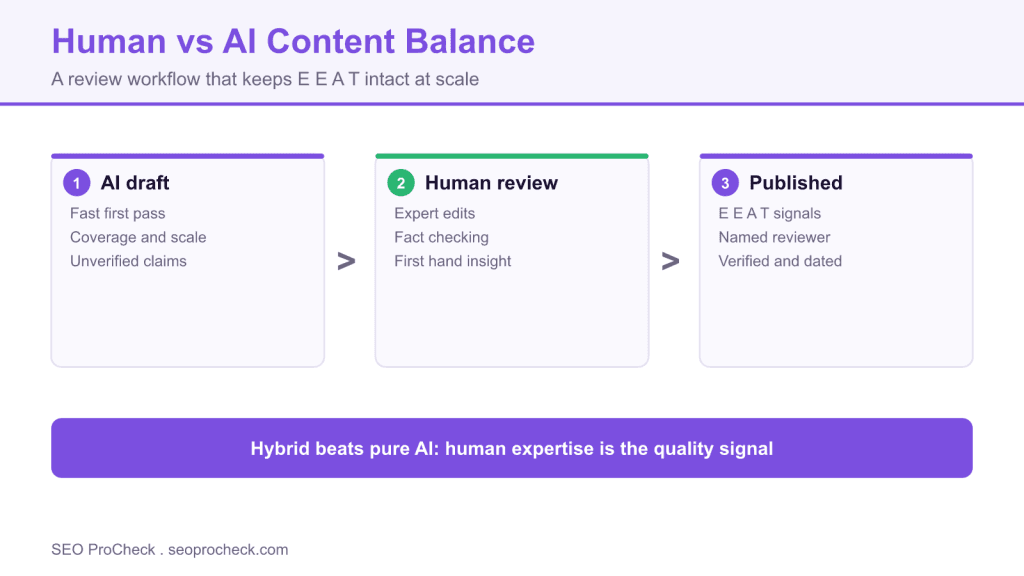
Human vs AI content balance is about keeping genuine human expertise and review in content that may be drafted with AI help. A hybrid workflow, where AI handles a fast first pass and a qualified human edits, fact checks, and adds first hand insight, protects quality and the E-E-A-T signals that search engines and AI systems reward.
- Element code CO-008, a content quality and GEO check.
- Pure unreviewed AI output risks being devalued for thin or inaccurate content.
- A hybrid workflow pairs AI speed with human expertise, fact checking, and review.
- Human first hand experience is the signal that is hardest for AI alone to fake.

Quick Reference
Element Code: CO-008
Issue: Content may be predominantly AI-generated without human review
Impact: May be identified as low-quality
Fix: Ensure human expertise and review in all content
Detection: Content audit
What Is This Issue?
Pure AI-generated content may be devalued. Human expertise and review ensure quality and uniqueness.
Why This Matters for Your Website
Human expertise adds value that pure AI content lacks.
How to Fix This Issue
- Human review: All AI content reviewed
- Add expertise: Human insights
- Fact check: Verify claims
Tools for Detection
- Content audit: Assess content origin
AI Search and GEO Considerations
AI systems may prefer human-reviewed content for its accuracy.
TL;DR (The Simple Version)
Ensure all content has human review. Pure AI content may be devalued. Add unique human insights.
The problem with unreviewed AI content
AI drafting is fast and covers a lot of ground, but on its own it tends to produce confident text that is generic, occasionally wrong, and stripped of any real experience. Search guidance rewards content that demonstrates experience, expertise, authoritativeness, and trust, the E-E-A-T signals, and unreviewed AI output is weak on exactly those. It is not that AI assistance is penalized, it is that content lacking genuine human value gets devalued regardless of how it was made.
A hybrid workflow that keeps quality high
The practical answer is not to ban AI or to publish it raw, but to build a workflow where each step does what it is best at:
- AI first pass. Use AI to draft structure and cover the obvious ground quickly. Treat this as raw material, never as a finished page.
- Human review. A qualified editor reworks the draft, corrects tone, and removes generic filler that says nothing.
- Fact checking. Every claim, statistic, and name is verified against a primary source. This is where unreviewed AI most often fails.
- Add first hand insight. The reviewer adds lived experience, original examples, opinions, and specifics that no model could have generated, which is what makes the page worth citing.
- Attribute and date. Publish under a named, credentialed author with a real update date so the trust signals are visible.
Demonstrating experience, not just claiming it
The hardest E-E-A-T signal to fake is experience. Show it with specifics: a screenshot from a tool you actually used, a number from a test you actually ran, a mistake you actually made and how you fixed it. These details are also what make content unique and citable, so the same edits that satisfy quality reviewers also raise AI citation worthiness.
Disclosure and governance
Decide a clear internal standard for how AI is used and hold to it. There is no requirement to remove AI from your process, but every published page should carry human accountability: a named reviewer who stands behind the facts. That accountability, not the drafting tool, is what protects the site over time.
What changed since: as AI drafting became easy and common, the web filled with generic AI text, and search and answer systems responded by leaning harder on experience and originality. The differentiator is no longer producing content, it is producing content a human genuinely stands behind.
Reference table
| Workflow stage | Human role | Signal it produces |
|---|---|---|
| AI first pass | Direct scope, treat output as raw material | Coverage and speed |
| Editorial review | Rework tone and cut generic filler | Readability and voice |
| Fact checking | Verify every claim against a source | Accuracy and trust |
| Insight and attribution | Add first hand experience and a named author | Experience and authority |
Frequently Asked Questions
What is human vs AI content balance?
It is keeping genuine human expertise and review in content that may be drafted with AI help. A hybrid workflow uses AI for a fast first pass and a qualified human for editing, fact checking, and adding first hand insight, which protects quality and E-E-A-T signals.
Is AI generated content penalized by search engines?
AI assistance itself is not penalized. What gets devalued is content that lacks genuine value, accuracy, or experience, whether a human or a model produced it. The fix is human review, fact checking, and original insight, not avoiding AI tools.
What does E-E-A-T mean here?
E-E-A-T stands for experience, expertise, authoritativeness, and trust. It is the set of quality signals search systems use to judge content, and unreviewed AI output tends to be weak on all four, especially demonstrated experience.
How much human involvement is enough?
Enough that a named, qualified person stands behind every published claim. In practice that means editing the draft, verifying every fact against a source, and adding first hand experience the model could not have produced, then attributing the page to a real author.
How do I show experience in AI assisted content?
Add specifics only a real practitioner would have: a screenshot from a tool you used, a number from a test you ran, or a mistake you made and fixed. These details demonstrate experience and also make the content unique and more citable.
Do I need to disclose that I used AI?
There is no universal rule, but you should set a clear internal standard and ensure every page carries human accountability through a named reviewer. That accountability, rather than the drafting tool, is what protects the site's trust over time.
Related SEO ProCheck checks
Claude Vincent is a technical SEO consultant focused on crawlability, rendering, and AI-search visibility. He writes the field guides and case studies at SEO ProCheck, with a bias toward the durable, unglamorous work that decides whether search engines and AI answer engines can actually read and cite a site.
About SEO ProCheck
Technical SEO consulting and GEO strategy with 20 years of enterprise experience. Case studies, resources, and tools for search and AI visibility.
Work With Me
Technical SEO audits, GEO strategy, site migrations, and international SEO. Hourly consulting for teams who need hands-on support, not just reports.
Subscribe to our newsletter!