

AI Summary
Search trends describe how demand for a query moves over time, rising, falling, seasonal, or spiking, rather than the flat monthly average a keyword tool reports. Reading the trend shape tells you when to publish and which way demand is heading, which is where most of the timing advantage in content SEO lives.
- The monthly search volume figure is a twelve month mean that hides both seasonality and momentum.
- Use Google Trends for direction and timing, then a volume tool such as Ahrefs or Semrush for the actual size.
- Publish seasonal content weeks before the peak so you already rank when demand arrives.
- A small but rising keyword can be worth claiming before the SERP fills with competitors.

What Search Trends Are
Search trends are the way demand for a query rises, falls, spikes, or repeats over time, rather than the flat monthly average most keyword tools show you. Reading a trend instead of a single number is the difference between publishing when interest is climbing and publishing three months after the wave has already broken.
A keyword with 10,000 monthly searches can be dying, exploding, or dead-flat, and the average hides all three. The trend is where the timing lives, and timing is most of what separates content that catches a wave from content that arrives late to an empty beach.
Why the Average Lies
Standard search volume is a twelve-month mean. That works fine for evergreen terms, but it flattens two things that matter enormously: seasonality and momentum. "Pumpkin spice recipe" might average a modest number across the year while actually being near-zero for nine months and a screaming spike every September. Plan against the average and you publish in March, index quietly, and get buried by fresher content the moment demand actually returns.
Momentum is the other half. A rising trend, even off a small base, is a keyword worth betting on before the competition wakes up. A falling trend is a warning that the topic's best days are behind it. The average can't tell you which direction you're standing in; only the trend line can. For recurring cycles specifically, the related idea of seasonality covers the predictable yearly patterns you can plan a calendar around.
A Real Example: Reading a Trend, Not a Number
Imagine you're deciding between two keywords for a fitness site. Both show roughly the same average monthly volume in your keyword tool. Pull them up in Google Trends side by side and the picture splits apart. Keyword A, "new year workout plan," is a January cliff, near-zero the rest of the year. Keyword B, "beginner strength training," is a gentle year-round line with a slow upward drift.
Same average, completely different strategies. Keyword A demands you publish and promote in late December so you're indexed and ranking when the January flood hits. Keyword B is an evergreen you can build once and grow over years. If you'd trusted the average alone, you'd have treated them identically and gotten the timing wrong on at least one. That is the entire case for reading trends: the number tells you how big, the trend tells you when and which way.
Trend Shapes and What They Mean
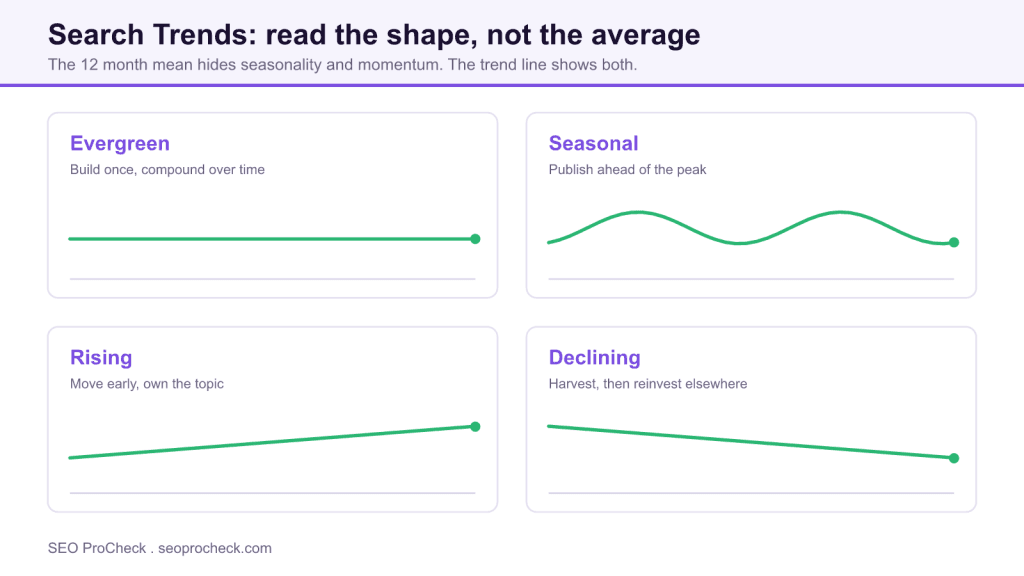
| Trend shape | What it looks like | Example query | What to do |
|---|---|---|---|
| Evergreen | Flat, steady line year-round | how to tie a tie | Build once, maintain, compound over time |
| Seasonal | Predictable yearly peaks and troughs | tax filing deadline | Publish weeks ahead of the peak, refresh yearly |
| Rising | Sustained upward slope | local AI models | Move early, own the topic before it's crowded |
| Declining | Steady downward slope | Adobe Flash tutorials | Deprioritize; harvest existing traffic, don't invest |
| Spike / breakout | Sudden vertical jump, then fade | a news event or product launch | Publish fast if relevant; expect the traffic to fade |
| Cyclical (non-annual) | Repeating peaks on a multi-year cycle | World Cup tickets | Prep against the known event calendar |
How to Read Search Trends
- Start in Google Trends. Enter your query, widen the range to five years, and note the shape. Five years is enough to separate a genuine seasonal cycle from random noise. Remember the axis is relative interest scaled 0 to 100, not raw search counts.
- Compare candidates head to head. Trends lets you plot up to five terms on one chart. This is the fastest way to see which of two equal-looking keywords is actually rising and which is fading.
- Cross-check magnitude in a volume tool. Trends shows direction and timing but not size. Pull the actual numbers from Ahrefs, Semrush, or Google Keyword Planner so you know whether the rising trend is rising toward something worth chasing.
- Check Search Console for your own reality. Your impressions over time for a query are the truest trend signal you have, because it's your traffic, your audience, and your seasonality, not a global average.
- Line the peak up against your production calendar. Content needs lead time to index and earn rankings. Back-date your publish target several weeks or months before the peak so you're already ranking when demand arrives.
Common Mistakes and How to Fix Them
- Planning off the monthly average. The average hides both seasonality and momentum. Fix: always pull the trend line before committing a keyword to your calendar.
- Publishing seasonal content at the peak. By the time demand spikes, fresh pages haven't had time to rank. Fix: publish and promote weeks ahead of the wave so you're already indexed when it hits.
- Mistaking a one-time spike for a lasting trend. A news-driven breakout looks explosive but collapses just as fast. Fix: widen the Trends window to five years; a real trend persists, a spike is a single spike.
- Ignoring declining trends already on your site. Pouring effort into a topic in structural decline is wasted work. Fix: identify falling trends, stop investing, and redirect the budget toward rising or evergreen topics.
- Reading Google Trends as absolute volume. The 0-to-100 scale is relative interest, not searches. Fix: use Trends for shape and timing, and a dedicated volume tool for actual numbers.
Frequently Asked Questions
Search volume is how many searches a term gets, usually a monthly average. Search trends are how that demand moves over time, up, down, seasonal, or spiking. Volume tells you the size of the opportunity; the trend tells you the timing and direction.
Google Trends is the go-to for direction and seasonality because it's free and pulls from Google's own data. Pair it with a volume tool like Ahrefs or Semrush for actual numbers, and Search Console for your own historical demand.
Five years is the sweet spot. It's long enough to confirm a repeating seasonal cycle and to tell a durable rise from a one-off spike, without drowning you in ancient data that no longer reflects how people search.
Weeks to months before the peak, not during it. New pages need lead time to get indexed and climb the rankings. If you publish when demand is already spiking, you'll still be ranking on page four when the wave has passed.
Often, yes. A small-but-rising keyword lets you claim the topic before competitors notice and before the SERP fills up. If the trend line keeps climbing, you're positioned to grow with it instead of fighting your way in later.
Take this with you
The assistant links open with a question about this page already written. Nothing is sent until you press enter.
Claude Vincent is a technical SEO consultant focused on crawlability, rendering, and AI-search visibility. He writes the field guides and case studies at SEO ProCheck, with a bias toward the durable, unglamorous work that decides whether search engines and AI answer engines can actually read and cite a site.
About SEO ProCheck
Technical SEO consulting and GEO strategy with 20 years of enterprise experience. Case studies, resources, and tools for search and AI visibility.
Work With Me
Technical SEO audits, GEO strategy, site migrations, and international SEO. Hourly consulting for teams who need hands-on support, not just reports.
Subscribe to our newsletter!







Recent Posts
- Finding a Competitor's Sitemap, and Turning It Into a Change Log September 15, 2026
- AI Crawler User Agents: The Current Names, and Which Ones Sites Actually Block September 9, 2026
- Can AI Crawlers Actually Read Your Site? I Measured 400 of the Biggest September 5, 2026