

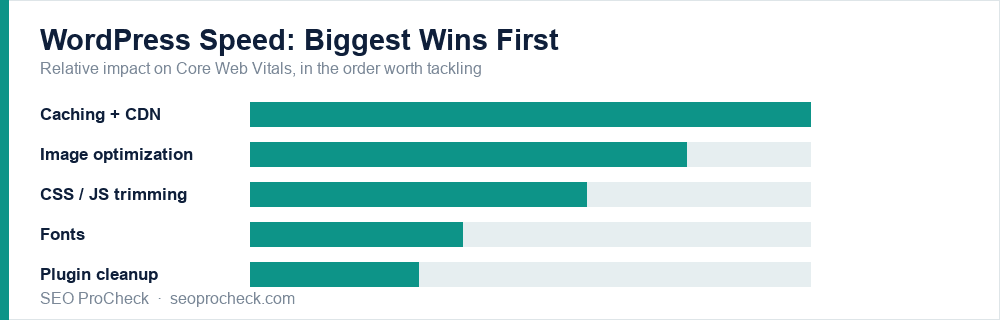
Most WordPress speed problems come down to the same handful of causes — and the same handful of fixes. Here is a prioritized plan that actually moves Core Web Vitals, in the order worth doing it, instead of a scattergun list of fifty micro-tweaks.
1. Caching and a CDN (the biggest single win)
A page cache serves pre-built HTML instead of running PHP and database queries on every request, which slashes server response time and, with it, LCP. Pair it with a CDN to serve assets from close to the user. On LiteSpeed servers, LiteSpeed Cache is excellent and free; otherwise WP Rocket or W3 Total Cache do the job. This step alone turns most failing sites around — do it first.
2. Images
- Serve WebP or AVIF, compress aggressively, and size images to what is actually displayed.
- Set width and height on every image (this also kills CLS).
- Lazy-load below-the-fold images only — never the LCP/hero image.
- Add
fetchpriority="high"to the hero image.
3. CSS and JavaScript
- Minify and combine where sensible; defer non-critical JavaScript.
- Remove unused CSS/JS — bloated themes and page builders ship far more than you use, and that excess is a direct INP tax.
- Inline critical CSS for above-the-fold content so the first paint does not wait on a stylesheet.
4. Fonts
Self-host fonts rather than calling a third party, preload the one or two you use above the fold, and use font-display: swap with a metrics-matched fallback to avoid the layout shift fonts cause.
5. Trim plugin bloat
Every active plugin can add scripts, styles, and database queries to every page. Audit them honestly: deactivate what you do not need, replace heavy plugins with lighter alternatives, and be wary of "do-everything" suites. Unused-but-active plugins are a silent, ongoing LCP and INP tax.
Then re-measure — and be patient
Re-test in PageSpeed Insights to confirm the lab improvement, then watch the field data in Search Console's Core Web Vitals report over the following weeks. Field data lags real changes by up to ~28 days, so resist the urge to keep tweaking before the data catches up.
Failing Core Web Vitals?
Speed and stability are part of every technical audit I run. See how an advanced SEO audit works →
Take this with you
The assistant links open with a question about this page already written. Nothing is sent until you press enter.
Claude Vincent is a technical SEO consultant focused on crawlability, rendering, and AI-search visibility. He writes the field guides and case studies at SEO ProCheck, with a bias toward the durable, unglamorous work that decides whether search engines and AI answer engines can actually read and cite a site.
About SEO ProCheck
Technical SEO consulting and GEO strategy with 20 years of enterprise experience. Case studies, resources, and tools for search and AI visibility.
Work With Me
Technical SEO audits, GEO strategy, site migrations, and international SEO. Hourly consulting for teams who need hands-on support, not just reports.
Subscribe to our newsletter!








Recent Posts
- Most Top Sites Never Say Who They Are in Structured Data October 14, 2026
- Homepage Titles Are Mostly Too Short, Not Too Long October 8, 2026
- Who Actually Serves an llms.txt? 184 Top Sites Measured September 29, 2026