

AI Summary
Organic traffic attribution is how you assign credit for a conversion to the organic search visits that helped cause it. Because most buyers touch several channels before converting, the attribution model you choose can make organic search look like your best channel or your worst, from the exact same data.
- Last click gives all credit to the final touch, which systematically undervalues organic search as a discovery channel.
- First click, linear, and data driven models spread or model credit across the whole path.
- Dark traffic, self referrals, and consent gaps push real organic conversions into the Direct bucket and hide them.
- Judge organic on assisted conversions and its role early in the path, not last click alone.
Organic traffic attribution answers a deceptively hard question: when someone converts, how much of the credit belongs to organic search? Almost no one buys on their first visit. They find you through a Google search, leave, see a retargeting ad, open an email, and come back days later to purchase. Every channel touched that path, but a report has to divide the credit somehow. The rule it uses is the attribution model, and the model you pick decides whether SEO looks like a growth engine or a cost center.
Why attribution matters for SEO specifically
Organic search skews toward the top of the funnel. It is where people discover a brand, research a problem, and compare options long before they are ready to buy. That makes it especially vulnerable to models that only reward the final click. If your reporting credits the last touch, the direct visit or the branded search that closes the deal takes the glory, and the informational article that started everything shows nothing. Understanding attribution is how you stop under investing in the content that quietly feeds every other channel.
The main attribution models
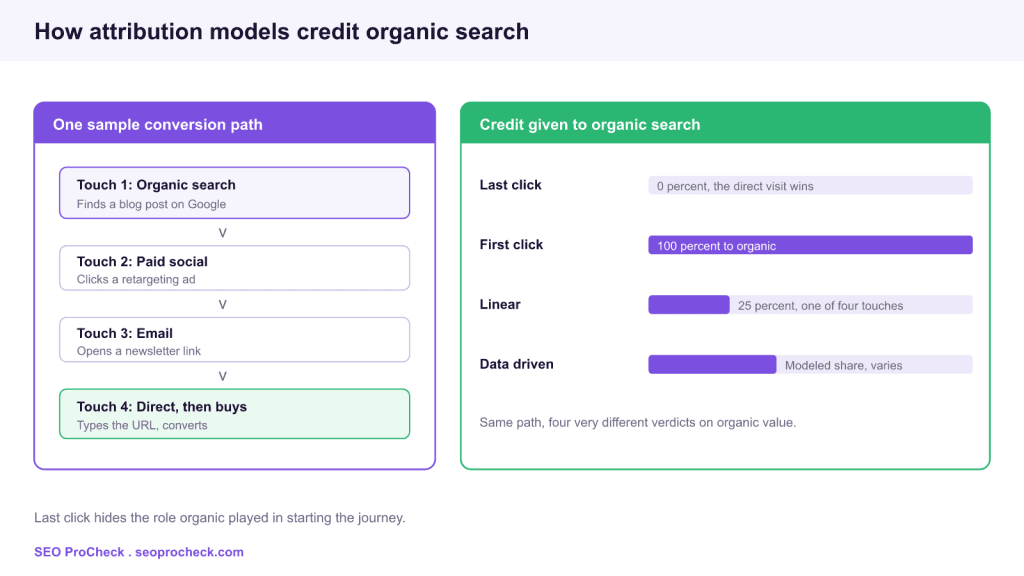
There are a handful of models in common use, and each answers the credit question with a different rule. The table shows how each one treats the same four touch journey from the diagram above.
| Model | Credit rule | Credit to organic in the example | Bias |
|---|---|---|---|
| Last click | All to the final touch | 0 percent | Rewards closers, hides discovery |
| First click | All to the first touch | 100 percent | Overstates discovery channels |
| Linear | Split evenly across touches | 25 percent | Treats all touches as equal |
| Position based | 40 percent first and last, rest split | 40 percent | Favors first and last touch |
| Data driven | Modeled from real path data | Varies | Needs volume, is a black box |
GA4 moved to data driven by default
GA4 retired most rule based models for reporting and now applies data driven attribution to conversions by default. Instead of a fixed rule, it uses a model trained on your own conversion paths to estimate each touchpoint contribution. It is more sophisticated than last click, but it needs enough conversion volume to train and it does not explain its reasoning, so treat its numbers as directional. You can still view last click and other lenses in the Advertising section to compare, which is the fastest way to see how much organic is being hidden by a closer focused view.
The dark traffic problem
Attribution models argue over credit, but a bigger issue is missing data. A large share of real organic conversions never get labeled as organic at all. When a link is shared in a messaging app, opened from a PDF, or clicked after an HTTPS to HTTP hop, the referrer is stripped and GA4 files the session under Direct. Consent banners that block analytics until a user opts in also drop the first, often organic, touch. The result is an inflated Direct channel that is partly organic in disguise. If your Direct traffic is unusually high, assume some of it belongs to search, and lean on Search Console click data, which is measured at the source and not affected by client side consent, to size true organic demand.
How to attribute organic fairly in practice
You do not need a perfect model, you need a consistent and honest one. First, never judge organic on last click alone: pull assisted conversions and the paths where organic appears anywhere, not just last. Second, separate branded from non branded organic, because branded search is often a downstream effect of other channels while non branded is true discovery. Third, reconcile GA4 against Search Console so you can quantify how much organic is leaking into Direct. Building these views into a custom GA4 dashboard keeps the comparison in front of stakeholders instead of buried in an interface.
Attribution feeds forecasting and reporting
Attribution is not an academic exercise. The credit you assign to organic today becomes the baseline you project forward, so a last click view will quietly suppress every future SEO forecast and business case you build. Pair a fair attribution model with a scripted data pipeline, for example an automated Search Console report, so the same measured definition of organic value flows through reporting, forecasting, and target setting without being reinterpreted at each step.
Frequently asked questions
What is organic traffic attribution?
It is the process of assigning credit for a conversion to the organic search visits involved in the path to that conversion. Because buyers usually touch several channels, the attribution model decides how much of the outcome organic search receives.
Why does last click attribution undervalue SEO?
Because organic search often starts the journey rather than ends it. Last click gives all credit to the final touch, so the discovery article that introduced the brand shows zero credit while a closing direct visit takes it all.
Why is my organic traffic showing up as Direct?
Referrer data is often stripped when links are opened from apps, PDFs, or after a protocol change, and consent banners can block analytics on the first touch. Those real organic sessions fall into the Direct bucket, inflating it with hidden search traffic.
Which attribution model is best for organic search?
There is no single best model. Data driven attribution in GA4 is a reasonable default, but review it alongside first click and assisted conversions so you can see the discovery role organic plays and avoid a purely last click verdict.
How does Search Console help with attribution?
Search Console measures organic clicks at the search result itself, before any client side consent or referrer loss, so it gives a truer count of organic demand. Reconciling it against GA4 reveals how much organic value is being misfiled as Direct.
Take this with you
The assistant links open with a question about this page already written. Nothing is sent until you press enter.
Claude Vincent is a technical SEO consultant focused on crawlability, rendering, and AI-search visibility. He writes the field guides and case studies at SEO ProCheck, with a bias toward the durable, unglamorous work that decides whether search engines and AI answer engines can actually read and cite a site.
About SEO ProCheck
Technical SEO consulting and GEO strategy with 20 years of enterprise experience. Case studies, resources, and tools for search and AI visibility.
Work With Me
Technical SEO audits, GEO strategy, site migrations, and international SEO. Hourly consulting for teams who need hands-on support, not just reports.
Subscribe to our newsletter!








Recent Posts
- Most Top Sites Never Say Who They Are in Structured Data October 14, 2026
- Homepage Titles Are Mostly Too Short, Not Too Long October 8, 2026
- Who Actually Serves an llms.txt? 184 Top Sites Measured September 29, 2026