

AI Summary
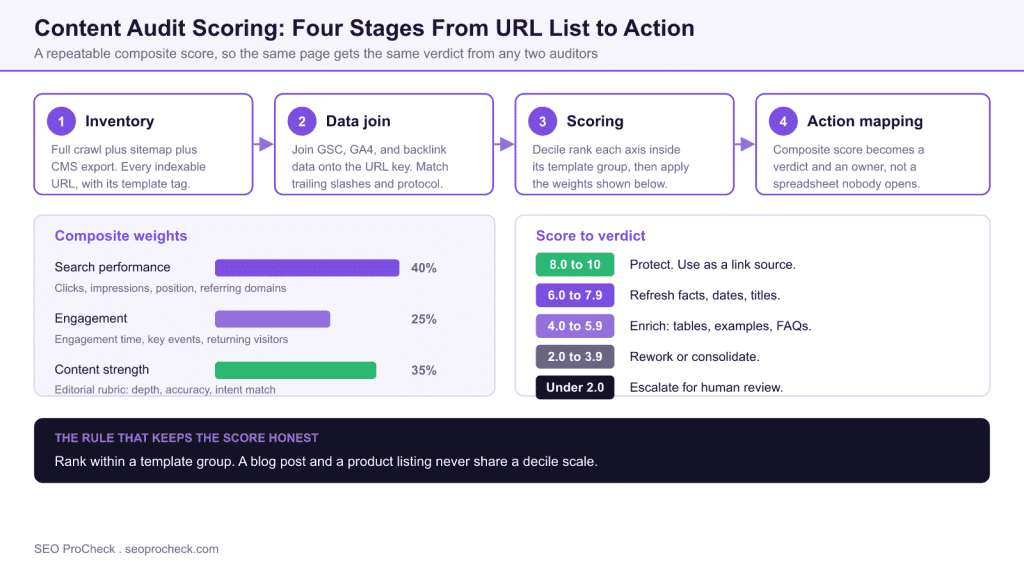
A content audit scoring methodology turns crawl, Search Console, and analytics data into one composite score per URL that maps mechanically to an action. It runs in four stages: inventory, data join, scoring, and action mapping.
- Weight the three axes: search performance 40 percent, engagement 25 percent, content strength 35 percent.
- Decile rank each axis inside its template group, never sitewide.
- Score bands set the verdict: protect, refresh, enrich, rework or consolidate, escalate.
- The axis pattern is more diagnostic than the composite. High performance with low content strength is a page on borrowed time.

A content audit scoring methodology is a repeatable formula that turns crawl, Search Console, and analytics data into one score per URL, which then maps mechanically to an action: leave alone, refresh, enrich, consolidate, or rework. The methodology has four stages (inventory, data join, scoring, action mapping) and its whole value is that the same inputs always produce the same verdict, so audits are comparable quarter over quarter and defensible to stakeholders.
Understanding Content Audits
Content Audits represents a critical component of modern SEO strategy. As search engines continue to evolve and user expectations shift, understanding the nuances of content audits becomes essential for maintaining and improving organic visibility. This guide covers the key concepts, implementation approaches, and strategic considerations that SEO practitioners need to master.
This page covers the scoring methodology, the machinery of the audit. For how to define and score the quality criteria themselves, see our companion guide on measuring content quality objectively; the rubric there plugs into stage 3 below.
The Four-Stage Methodology
Stage 1: Inventory
Crawl the site (Screaming Frog or equivalent) and export every indexable HTML URL with title, word count, template/section, publish and modified dates, and unique inlinks. Cross-check the crawl against the XML sitemap and GSC's Pages report: URLs in the sitemap but absent from the crawl are orphans, and they go in the audit too, flagged as such. The URL is your primary key for everything that follows, so normalize it now: consistent trailing slashes, lowercase host, no tracking parameters.
Stage 2: Data join
Pull performance data over a consistent window (12 months is the safe default; it absorbs seasonality) and join it onto the inventory by URL:
- GSC: Performance → Search results → export by page, or the Search Analytics API with
dimensions: ["page"]for sites over the 1,000-row UI export limit. Capture clicks, impressions, CTR, average position. - GA4: Reports → Engagement → Pages and screens, exported by page path, sessions, average engagement time per active user, conversions/key events attributed to the landing page.
- Crawl-derived: unique inlinks, crawl depth, word count from stage 1.
- Backlinks (optional but useful): referring domains per URL from whatever link index you have access to.
In a spreadsheet this is a series of XLOOKUPs against the normalized URL; in Python it's pandas.merge(on="url", how="left"). Fill blanks with zeros, not empty cells: a page with no GSC row scored zero impressions; that is data, not missing data.
Stage 3: Scoring
Score each URL on three axes, each normalized to 0 to 10 so different units become comparable:
| Axis | Inputs | Normalization method | Suggested weight |
|---|---|---|---|
| Search performance | Clicks, impressions, avg. position, referring domains | Decile rank within template group (top 10% of pages = 10, bottom = 1) | 40% |
| Engagement | Engagement time, key events, returning visitors | Decile rank within template group | 25% |
| Content strength | Editorial rubric: depth, accuracy, original information, intent match | Manual 0 to 2 per criterion, scaled to 10 (see the quality-scoring guide linked above) | 35% |
Two methodology rules matter more than the exact weights. First, normalize within template groups, not sitewide: ranking glossary stubs against pillar guides in the same decile pool produces garbage verdicts at both ends. Second, decile ranking beats raw thresholds ("under 100 clicks = bad") because it self-adjusts to the site's actual traffic level and survives sitewide rises and falls between audit runs.
Stage 4: Action mapping
Composite score = (performance × 0.4) + (engagement × 0.25) + (content × 0.35). Map bands to actions mechanically:
| Composite score | Verdict | Typical work |
|---|---|---|
| 8.0 to 10 | Protect | No changes; use as internal-link source; monitor for decay |
| 6.0 to 7.9 | Refresh | Update facts and dates, tighten intro, improve title/CTR |
| 4.0 to 5.9 | Enrich | Add substance: tables, examples, FAQs, original data; strengthen internal links in |
| 2.0 to 3.9 | Rework or consolidate | Re-angle against the current SERP, or merge with the strongest sibling covering the same intent (301 the weaker URL) |
| 0 to 1.9 | Escalate for manual review | Human decision required: often an orphan, a cannibalized duplicate, or a page whose job isn't organic search at all |
Note that no band's default action is "delete" or "noindex." Low scorers are consolidated into stronger pages or genuinely improved; blanket pruning trades a real URL's history and links for nothing, and a page scoring low on performance may simply never have been given internal links or a competitive angle.
Worked Example
A how-to article in the "guides" template group: performance decile 3 (weak, 40 clicks/yr while group median is much higher), engagement decile 7 (readers who arrive stay), content rubric 6/10 (accurate but no original examples). Composite = (3 × 0.4) + (7 × 0.25) + (6 × 0.35) = 1.2 + 1.75 + 2.1 = 5.05 → Enrich. The diagnosis writes itself from the axis pattern: content satisfies the readers it gets but doesn't earn visibility, so the work is competitive depth and internal links, not a rewrite of prose that already engages.
The scoring model sits inside a wider workflow. For the end to end sequence, including stakeholder sign-off and scheduling, see the content audit process. Verdicts of refresh and consolidate are executed through the content refresh, prune and merge system. And where the audit exposes demand your library never addressed at all, that is a job for content gap analysis rather than for rescoring what already exists.
Key Considerations for Content Audit Scoring Methodology
When approaching content audits, several factors require careful attention. Technical implementation must align with broader SEO objectives while maintaining site performance and user experience. The balance between optimization and over-optimization requires ongoing monitoring and adjustment based on performance data and algorithm changes. Industry benchmarks and competitor analysis provide context for evaluating your own implementation.
The axis pattern is more diagnostic than the composite. High performance + low content = a page ranking on borrowed time, first to fall in a core update: fix it while it still ranks. Low performance + high content = a distribution problem (internal links, title, cannibalization), not a writing problem. Low everything on a young page = insufficient data, not failure; exclude pages younger than ~6 months from consolidation verdicts entirely.
Implementation Best Practices
Successful implementation begins with thorough auditing of current state and clear goal definition. Document baseline metrics before making changes to enable accurate impact measurement. Prioritize changes based on potential impact and implementation effort, focusing on high-impact items first. Test changes in staging environments when possible, and monitor closely after deployment to production. Maintain documentation of changes for future reference and troubleshooting.
Concretely: freeze the scoring formula and date window in a "methodology" tab of the audit sheet before scoring anything; version the sheet per quarter; and record the verdict-to-work-done status per URL so the next audit run can measure verdict outcomes ("of the 60 pages we enriched in Q1, how many moved up a band by Q3?"). That closed loop is what turns an audit from a one-off report into a program.
Common Mistakes to Avoid
Several patterns consistently cause problems in content audits implementations. Rushing implementation without proper planning leads to errors that can be costly to fix. Ignoring the interplay between different SEO factors creates conflicts that undermine results. Failing to monitor and iterate based on performance data means missing optimization opportunities. Over-optimization signals can trigger algorithmic penalties that take months to recover from.
Scoring-specific mistakes: joining GSC (canonical URLs) against GA4 (page paths with parameters) without normalizing, which silently zeros out half your performance data; using a 28-day window and mistaking seasonality for decay; sitewide normalization (covered above); and re-weighting the formula mid-audit because a stakeholder dislikes a verdict, change weights only between audit cycles, and document why.
Measuring Success
Effective measurement requires defining appropriate KPIs aligned with business objectives. Track both leading indicators (rankings, impressions, technical metrics) and lagging indicators (traffic, conversions, revenue) to build a complete picture. Establish reasonable timeframes for evaluation, as SEO changes often take weeks or months to fully manifest in results. Compare performance against historical baselines and competitor benchmarks to contextualize results.
Strategic Recommendations
Approach content audits as an ongoing program rather than a one-time project. Build processes for regular auditing, monitoring, and optimization. Stay current with industry developments and algorithm changes that may affect your strategy. Invest in education for team members to build internal capabilities. Consider how content audits fits within your broader digital marketing and business strategy for maximum impact.
Frequently Asked Questions
How do you score content in a content audit?
Score each URL on three normalized axes, search performance (GSC clicks, impressions, position), engagement (GA4 engagement time and conversions), and editorial content strength, then combine them with fixed weights into a composite out of 10. Predefined score bands translate the composite into an action (protect, refresh, enrich, consolidate) so the verdict is mechanical rather than a per-page debate.
What data do you need for a content audit?
Four sources joined on URL: a full crawl (titles, word counts, inlinks, dates), Search Console page-level performance over 12 months, GA4 engagement and conversion data by landing page, and optionally referring-domain counts per URL. The crawl builds the inventory; everything else is merged onto it via URL as the key.
How long should a content audit take?
The mechanical stages (crawl, exports, joins, quantitative scoring) take one to three days for a mid-size site once the template exists. The editorial rubric pass is the real cost, at a few minutes per URL, which is why most teams score the quantitative axes for everything but run the manual content pass only on the middle bands where the verdict is actually in question.
Should low-scoring pages be deleted or noindexed?
Neither, as a default. Low scorers should be improved or consolidated into the strongest page covering the same intent, with a 301 preserving the weaker URL's equity. Deletion destroys history and links without adding anything; reserve it for pages with no salvageable intent, no traffic, and no links, and make that a manual, case-by-case call, never a score-band automation.
How often should you run a content audit?
Full scored audits quarterly or twice a year, depending on publishing volume; more often and the performance data hasn't changed enough to reshuffle verdicts. Keep a lightweight monthly decay check on your "protect" band (GSC comparison view, last 3 months vs. previous period) so top pages that start slipping get a refresh before the next full audit.
What's the difference between a content audit and a content inventory?
The inventory is the raw catalog, every URL and its attributes, the output of stage 1. The audit is the inventory plus performance data, scores, and verdicts. An inventory tells you what exists; an audit tells you what to do about it, and the scoring methodology is the bridge between the two.
Take this with you
The assistant links open with a question about this page already written. Nothing is sent until you press enter.
Claude Vincent is a technical SEO consultant focused on crawlability, rendering, and AI-search visibility. He writes the field guides and case studies at SEO ProCheck, with a bias toward the durable, unglamorous work that decides whether search engines and AI answer engines can actually read and cite a site.
About SEO ProCheck
Technical SEO consulting and GEO strategy with 20 years of enterprise experience. Case studies, resources, and tools for search and AI visibility.
Work With Me
Technical SEO audits, GEO strategy, site migrations, and international SEO. Hourly consulting for teams who need hands-on support, not just reports.
Subscribe to our newsletter!








Recent Posts
- Most Top Sites Never Say Who They Are in Structured Data October 14, 2026
- Homepage Titles Are Mostly Too Short, Not Too Long October 8, 2026
- Who Actually Serves an llms.txt? 184 Top Sites Measured September 29, 2026